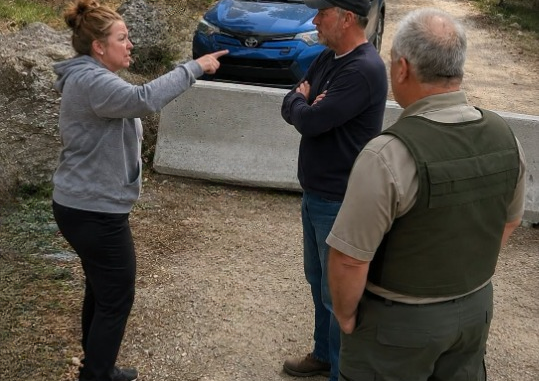
At 6:47 on a Saturday morning, three concrete trucks came rumbling down the private road that crossed my forty-acre Montana property and stopped beside the iron gate my grandfather had welded back in 1987.
From the window of my cabin, I watched Delilah Peyton, the 49-year-old president of the Pine View Estates HOA, directing six workers like she owned the entire mountain.
For six months, she had been sending me fines for “rustic styling,” complaining about my workshop, and insisting that my gate violated the appearance rules of a community I had never even joined.
One citation alone demanded $200, despite the fact that my property had existed decades before Pine View Estates was ever developed.
My wife, Sarah, had passed away two years earlier, and the cabin had become the quiet place where I slowly put my life back together. Because of that, I’d done everything I could to avoid unnecessary conflict.
But when Delilah instructed the workers to pour concrete barriers around my gate posts without obtaining a permit, I decided I was done backing down.
I pulled out my phone and started recording.
Then I handed the crew $60 for coffee and sat down on my porch to watch what happened next.
Delilah thought she was sealing me inside my own property until I finally gave in to the HOA.
What she didn’t realize was that my grandfather’s gate sat at the narrowest point of the only access road connecting all 47 Pine View homes to the highway.
By 8:00 a.m., residents trying to get to work were stuck behind the newly poured concrete.
A school bus couldn’t get through.
Delivery drivers were stranded.
Several SUVs had formed a growing line on the road.
Then Fire Marshal Rodriguez arrived.
He took one look at the obstruction and immediately warned that emergency vehicles could no longer reach the neighborhood.
That was when I went back inside my cabin and retrieved the manila folder I’d prepared several days earlier.
Inside was a certified property agreement containing a single paragraph Delilah had apparently never bothered to read.
The instant she saw it, the color drained from her face.
I had spent twenty years working with the Army Corps of Engineers, so I was very familiar with surveys, easements, and right-of-way documents.
My property attorney, Jake, had already reviewed my deed, land survey, insurance records, and chain of title.
He confirmed that the road remained privately owned.
But the most important detail was buried in an old access agreement.
It contained a clause stating that whoever caused an obstruction preventing emergency access would owe $10,000 for every day the road remained blocked.
In other words, Delilah’s late-night HOA decision had potentially created an enormous financial liability for the very association she was supposed to protect.
Within days, Jake sent formal notices.
The HOA board scrambled to protect its reserve funds.
Homeowners began worrying about how the dispute might affect their mortgages and property values.
Residents started demanding answers about the association’s finances and how such a decision had been approved.
Then things escalated even further.
Delilah allegedly approached a county inspector named Walt and offered him $5,000 to fabricate violations against my property.
Instead of accepting the offer, Walt documented the conversation and turned it over to the authorities.
What had started as a petty neighborhood dispute was now potentially heading toward court.
Three months later, the concrete barriers were gone.
The road had been repaired.
And Pine View had elected a new HOA president: Eleanor Vasquez, a retired paralegal.
Delilah was no longer in charge of the association.
The community eventually agreed to the arrangement I’d proposed from the beginning: legal access across my road for $1 a year, provided everyone respected my property rights.
My grandfather’s old iron gate remained exactly where it had always stood.
Every weathered mark Delilah had wanted removed was still there.
I used much of the settlement money connected to the dispute to fund a scholarship focused on property rights rather than treating the money as a personal victory.
The following summer, Eleanor helped organize a neighborhood barbecue on my property.
Families gathered beside the creek, eating burgers while children played beneath the Montana pines.
No one inspected my fence.
No one measured my woodpile.
No one complained about the rustic appearance of my property.
These days, the gate is usually open.
Not because someone forced me to leave it that way, but because the people around me finally learned the difference between being granted permission and actually owning something.
Leave a Reply