PART 2
The envelope held a foreclosure warning.
For years, Linda had proudly told friends and relatives that her suburban home was completely paid off. She often spoke about the “wise investments” she had supposedly made after becoming a widow.
The reality was far less impressive.
She had refinanced the property twice, borrowed against its equity, and continued funding a lifestyle that had become impossible for her to maintain.
Her mortgage hadn’t merely grown.
She was already three months behind on payments.
And then I discovered something even worse.
Ethan had secretly co-signed one of her loans.
I learned that while standing outside the house as my attorney, Melissa Grant, carefully reviewed the documents.
Ethan had used our marital address, disclosed our combined household income, and signed paperwork without ever telling me.
“You used my income to help your mother qualify?” I asked.
Ethan shifted uncomfortably.
“It wasn’t exactly that simple.”
Melissa gave him a sharp look.
“That is precisely what happened.”
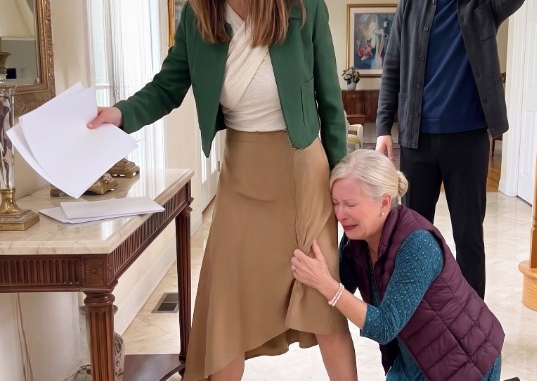
Linda was still kneeling nearby.
Between sobs, she admitted that the bank had refused to give her another extension. She needed nearly $18,000 immediately to prevent foreclosure, followed by ongoing financial assistance.
The $3,000 a month she had demanded from me suddenly made sense.
She expected that amount to cover her mortgage, utilities, car payments, and mounting credit-card debt.
“You could have simply asked me for help,” I said.
“I was ashamed,” Linda whispered.
“No. You believed you were entitled to it.”
Ethan stepped closer.
“Rachel, we can still fix this. Mom knows she crossed a line.”
I looked directly at him.
“Do you?”
He began listing everything he believed he had done for our marriage, almost as if ordinary marital responsibilities somehow justified hiding financial decisions from me.
He claimed he had supported my career, despite regularly criticizing the hours I worked.
He talked about his sacrifices even though I had paid the mortgage, health insurance, vacations, and most of our household expenses.
Then Melissa placed the preliminary divorce documents in front of him.
I had bought the house two years before our wedding, and the deed had always remained exclusively in my name.
Ethan had no automatic right to remain there once I officially withdrew permission.
Melissa had prepared a temporary agreement allowing him ten days to retrieve his belongings.
Linda finally stopped crying.
“You’re really throwing your husband out?”
“I’m ending a marriage that he turned into a financial arrangement with his mother.”
Ethan’s expression hardened.
“You can’t erase ten years together.”
“I’m not erasing anything. I’m finally understanding those ten years for what they were.”
That afternoon, I called the locksmith.
With Melissa present, Ethan was permitted to collect his clothes, work equipment, and personal paperwork. Everything else would be documented and handled properly.
As he carried boxes toward Linda’s vehicle, something struck me.
He didn’t look heartbroken.
He looked frightened.
That night, Melissa called me with even more disturbing information.
She had uncovered two additional issues.
First, about eighteen months earlier, Ethan had opened a credit card listing me as a co-borrower.
The balance was nearly $22,000.
Most of the charges had gone toward Linda’s mortgage lender, an expensive furniture retailer, and multiple cash withdrawals.
Second, someone had attempted to log into my retirement account three days after my promotion.
The access attempt came from Ethan’s laptop.
I sat alone in my office, staring at the city lights outside the window, and felt whatever affection remained inside me disappear.
This wasn’t just a divorce anymore.
It was financial fraud.
The following morning, I contacted every bank involved, froze my credit, changed all of my passwords, and filed a police report.
By lunchtime, Ethan had left seventeen voicemails.
Linda had left thirty-four.
Her final message was different.
She wasn’t begging anymore.
Her voice was cold.
“You think you’re better than us because you have a title. Be careful, Rachel. Families know things about each other.”
I listened to it twice.
Then I forwarded it to Melissa.
For the first time, I understood something clearly.
Linda’s tears had never been about remorse.
They had been about fear.
And now that she was afraid, she was becoming dangerous.
PART 3
Three days after Linda’s threatening voicemail, Ethan showed up at my office building.
Security called me before letting him go upstairs.
“Your husband says it’s urgent,” the receptionist told me.
“Soon-to-be ex-husband,” I corrected. “And he isn’t permitted on my floor.”
Through the security monitor, I watched him pacing near the elevators.
He was wearing the same navy jacket he’d worn when we first met at a charity event ten years earlier.
Back then, I had thought he looked reliable and steady.
Now he looked exhausted.
His hair was disheveled, his eyes were red, and he kept looking toward the entrance as if he expected someone to appear behind him.
I instructed security to escort him out.
A couple of minutes later, my phone buzzed.
Please. Mom did something worse. You need to know before the police discover it.
I forwarded the message to Melissa.
She strongly advised against meeting him alone.
Instead, we arranged a meeting in a ground-floor conference room, with a security officer outside and the entire conversation recorded.
Ethan entered carrying a laptop bag.
He sat opposite me and placed both hands flat against the table.
“I didn’t know everything,” he began.
“That excuse seems to be becoming your favorite.”
He looked wounded.
Then he opened the laptop.
Inside were folders filled with bank statements, loan applications, emails, and copies of signatures.
Linda hadn’t simply convinced him to co-sign her mortgage.
For nearly three years, she had been operating what she called a financial consulting business from her home.
The company had virtually no legitimate customers.
Its main purpose appeared to be moving money between credit cards, short-term loans, and family members.
She had used Ethan’s identity to open two business credit accounts.
She had also used mine.
My name appeared as a guarantor on a $75,000 loan application.
The signature looked convincing.
But it wasn’t mine.
“When was this application submitted?” I asked.
“Four months ago.”
“Were you aware of it?”
“Not initially.”
I leaned back.
“What does that mean?”
Ethan stared at the table.
Linda had asked him for copies of our tax returns, claiming she needed proof of family support while negotiating with her mortgage lender.
He handed them over without asking me.
Weeks later, he noticed an email from a lender congratulating Linda on receiving approval for a business credit line.
He confronted her.
She promised she’d repay everything before I discovered what she had done.
“And you believed her?”
“No,” he said quietly. “But I was scared.”
“Scared of what?”
He finally met my eyes.
“Losing everything.”
I nearly laughed.
He had helped facilitate fraud because he was afraid of losing the lifestyle that the fraud was financing.
Ethan explained that Linda used part of the loan to bring her mortgage current.
Some of it went toward his personal debts.
The rest disappeared through cash withdrawals and transfers into another account.
“Whose account?” Melissa asked through the speaker.
Ethan hesitated.
“My sister’s.”
I had met Ethan’s younger sister, Cassandra, only a handful of times.
She lived in Arizona and rarely attended family gatherings.
Linda always portrayed Cassandra as unstable, irresponsible, and bitter.
Apparently, that wasn’t the whole story.
Ethan told me Cassandra had accused Linda years earlier of opening credit cards in her name.
Nobody believed her.
Linda convinced the family that Cassandra was inventing the story to avoid paying debts she had created herself.
Cassandra eventually moved away and cut contact.
Now Linda was transferring money into an account connected to her.
“Why would she do that?” I asked.
“I don’t know,” Ethan admitted. “Maybe she’s paying her back. Maybe she’s threatening her.”
That afternoon, Melissa contacted Cassandra’s lawyer.
By that evening, Cassandra called me.
Her tone was cautious.
“I heard you filed for divorce,” she said.
“I did.”
“Then you’re finally discovering who they really are.”
Cassandra explained that Linda had manipulated both of her children since their father died.
She convinced Ethan that he deserved financial support because he was the loyal child.
Whenever Cassandra challenged her, Linda portrayed it as jealousy and turned the rest of the family against her.
Eventually, Cassandra discovered accounts opened in her name.
Linda promised to reimburse her.
Instead, she threatened to contact Cassandra’s employer and accuse her of stealing from the family if she spoke publicly.
Cassandra eventually collected evidence, moved to Phoenix, and filed a civil case.
The mysterious transfers were actually settlement payments.
Linda had signed an agreement promising to repay Cassandra $70,000 over several years.
If she stopped making payments, Cassandra could reopen the case.
Now Linda’s entire financial scheme was collapsing.
Her mortgage was delinquent.
The business loan was nearly drained.
The settlement payments had fallen behind.
And after my promotion, she decided I would become her financial solution.
The $3,000 a month wasn’t going to make her rich.
It was simply enough to keep the deception going.
Once Cassandra handed over the older records, the police investigation moved much faster.
Linda had apparently used the same tactics for years: copied tax documents, forged signatures, misleading loan applications, and emotional manipulation.
Ethan agreed to cooperate with investigators in hopes of receiving leniency.
He handed over passwords, emails, and financial records.
He continued insisting that his mother had controlled him.
But the evidence painted a more complicated picture.
Linda had created many of the schemes, but Ethan had benefited from them.
He accepted money toward his debts, helped conceal documents, and lied whenever I questioned suspicious charges.
He hadn’t been manipulated every single time.
Sometimes, he had simply chosen what was easiest for him.
Two weeks later, Linda was arrested outside her home on charges related to identity theft, forgery, and financial fraud.
A local television crew captured footage of her being escorted toward an unmarked vehicle.
She wore a gray cardigan and tried to hide her face from the cameras.
Ethan called me that night.
I answered only because Melissa recommended that every interaction be documented.
“They arrested Mom,” he said.
“I know.”
“She’s sixty-two, Rachel.”
“And?”
“She could go to prison.”
“That will be decided by the evidence and the court.”
His voice cracked.
“How can you be this cold?”
I looked around the temporary apartment where I was staying while the house and financial records were being reviewed.
Cold.
That was what he called me because I had finally stopped protecting him.
“I gave you ten years,” I said. “I paid for our home, our insurance, your car, vacations, and most of our daily expenses. I trusted you with everything I’d built. You repaid that trust by handing my private financial information to your mother.”
“I told you I’m sorry.”
“You’re sorry because there are consequences.”
He went silent.
Then came the question I knew was coming.
“Would you drop the complaint against me?”
“No.”
“I’m cooperating.”
“That may help your case.”
“You really want me to have a criminal record?”
“I want the truth documented.”
He started crying.
For years, Ethan had used silence as a weapon.
Whenever we argued, he would withdraw until I became uncomfortable enough to apologize and repair everything myself.
This time, his tears made me feel nothing but tired.
“I loved you,” he whispered.
“I loved the man I thought you were.”
Then I ended the call.
The divorce process lasted eight months.
Ethan initially requested spousal support, claiming he had contributed to my professional success by taking care of our household.
The financial records proved otherwise.
We had a cleaning service.
We regularly used meal-delivery services.
We hired professionals for nearly every significant home repair.
His request was rejected.
He received a limited portion of certain marital assets, but much of it was offset by the hidden debts he had accumulated.
He moved into an apartment outside Milwaukee and eventually accepted a plea agreement involving probation, restitution, and mandatory financial counseling.
Linda’s case continued longer.
Her attorney argued that financial hardship had influenced her decisions and that she hadn’t intended to cause permanent harm.
Prosecutors presented forged applications, false statements, and testimony from Cassandra and me.
Linda ultimately pleaded guilty to several offenses.
Because she had no previous criminal record, was older, and agreed to repay her victims, she avoided a lengthy prison sentence.
She spent several months in county custody and received years of supervised probation.
Her house was sold.
Most of the proceeds went toward the mortgage, legal expenses, and restitution.
Cassandra recovered only some of what she had lost.
I recovered even less.
But after months of disputes, the banks finally removed the fraudulent debt from my credit history.
The last time I saw Linda was at a restitution hearing.
She looked smaller than I remembered.
Nearly all of her hair had turned white.
She sat beside her attorney wearing a simple black dress, her hands folded tightly in her lap.
After the hearing, she approached me in the hallway.
“I was wrong,” she said.
There were no dramatic tears.
No demands.
No threats.
“I thought you had plenty,” she continued. “I believed helping family was something you were supposed to do automatically.”
“Helping someone is a choice,” I said. “What you did was theft.”
She nodded.
Then she finally admitted what had been underneath everything.
“I couldn’t stand seeing you become more successful than Ethan.”
I studied her face.
There it was.
The real reason.
It wasn’t simply financial desperation.
It wasn’t family tradition.
It wasn’t even loyalty.
It was resentment.
My promotion had disrupted the hierarchy Linda had spent years maintaining.
As long as Ethan appeared to be the most important person in our marriage, she felt secure.
But once my career surpassed his, she needed to find a way to control my success.
The $3,000 wasn’t just about paying her bills.
It was about submission.
She wanted proof that my success still existed beneath her authority.
“I hope someday you can forgive me,” Linda said.
“I stopped carrying you around in my mind a long time ago,” I replied. “That’s enough forgiveness for me.”
Then I walked away.
One year after the divorce became final, I received another promotion—to Vice President of Operations.
The position required me to relocate to Boston.
I sold the Chicago house, bought a smaller condominium near the harbor, and built a life where I no longer felt obligated to apologize for succeeding.
Cassandra and I stayed in occasional contact.
We never became especially close, but we understood one another in a way few people could.
She later told me Ethan had started therapy and was no longer calling Linda every day.
I never asked whether he’d genuinely changed.
His healing was no longer my responsibility.
Two years after the night I left, I found my old wedding ring inside a sealed envelope at the bottom of a moving box.
For a moment, I remembered the kitchen table, the untouched champagne, and Linda’s confident expression when she demanded $3,000 a month or divorce.
She had expected me to hesitate.
She expected me to negotiate.
She believed I would fear divorce more than I feared losing myself.
I placed the ring inside a drawer, closed it, and returned to work.
Choosing divorce cost me a marriage.
Staying would have cost me everything else.
Leave a Reply