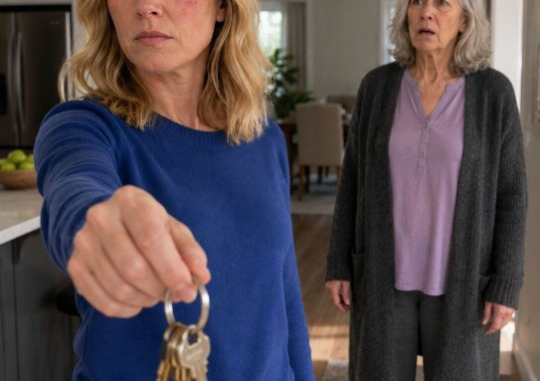
The brass keys hit my cheek before I even understood what had happened. I’d just caught my mother-in-law, Diane, walking out of our bedroom with one of my desk drawers left open. When I asked her what she was doing, her expression immediately turned cold.
“This is my son’s house,” she snapped, as though those words gave her complete authority.
Diane had been staying in our guest room for six months after a flood damaged her condo. But during that time, she had gradually started behaving as though every room in our home belonged to her.
What she didn’t know was that I’d purchased the house years before I ever married Mark. I had used an inheritance from the grandmother who raised me after my parents passed away. The down payment came entirely from that inheritance, the mortgage was in my name alone, and I was the only person listed on the deed.
I picked the keys up from the floor, met Diane’s stare, and calmly said, “Then you won’t be needing these anymore.”
That same afternoon, I called a locksmith and replaced every exterior lock.
When Mark came home and noticed the red mark beside my eye, I expected him to ask what his mother had done. Instead, he said changing the locks was “extreme.”
I handed him one of the new keys.
“This is for you,” I told him. “Not Diane.”
Three days later, while I was at work, a security-camera notification appeared on my phone.
Diane had entered through the front door using Mark’s key.
She tried to open our locked bedroom door before calling Mark on speakerphone.
His response made my stomach twist.
“Just wait. I know where she keeps the documents. We’ll deal with it tonight.”
And suddenly, I knew exactly what they had been searching for.
When I got home, Mark and Diane were sitting at the dining table.
Waiting for me was a printed quitclaim deed.
Mark pushed the document toward me and told me to sign it so his name could be added to the property.
Diane immediately joined in, insisting that a wife who truly trusted her husband wouldn’t keep a house solely in her own name.
I refused.
Instead, I called my attorney, Rachel Kim, and gave her everything I had: the deed, mortgage documents, inheritance records, security footage, and the recording of Mark discussing my documents.
Rachel reviewed everything carefully.
She explained that because the money from my grandmother had remained separate, the ownership situation was unusually straightforward. Mark’s financial contributions had covered ordinary household expenses; they hadn’t been investments that automatically gave him an ownership stake in the property.
Any questions involving insurance, the mortgage, or future estate matters would have to be handled through the proper legal process—not through intimidation at my own dining table.
I’d already filed a police report regarding Diane throwing the keys at me.
That evening, two officers arrived and reviewed the security footage.
Diane insisted the incident had been an accident.
The recordings suggested otherwise.
After I formally withdrew permission for her to stay in the house, she was ordered to leave.
Mark left with her.
The following morning, Rachel filed my divorce petition with the court.
The divorce proceeded without the dramatic property battle Mark apparently expected.
After his attorney reviewed the financial records, he quickly stopped arguing that putting Mark’s name on the deed would somehow save the marriage.
The house remained mine.
Mark moved into an apartment.
Diane was instructed to stay away.
Eventually, everything became final.
I repainted the bedroom a soft pale blue, the same kind of color that reminded me of my grandmother’s kitchen on bright mornings.
Months later, I called the locksmith again to install a smart lock on the garden door.
When he finished, he smiled and asked how many physical keys I wanted.
I looked around the home my grandmother’s final gift had helped me build.
“One.”
He raised an eyebrow.
“For now?”
I thought about everything that had happened.
Then I smiled.
“For now, one is perfect.”
Leave a Reply