After my mother passed away, the silence in my home became unbearable. Looking for a way to cope, I began volunteering at a local hospice. I told everyone I wanted to help others, but the truth was I needed a place where grief felt understood instead of questioned.
That’s where I met Nathan Cole.
Nathan was fifty-nine, witty, stubborn, and never shy about complaining. He criticized weak coffee, daytime TV, and anyone who called him courageous. Unlike the other patients, he had no visitors, no family waiting by his bedside, and only a worn leather bag beside him.
On my second shift, I brought him coffee from a nearby café, remembering he preferred cream. He noticed immediately.
“You remembered.”
“You complained about it long enough,” I joked.
For the first time, he smiled.
Soon afterward, the volunteer coordinator told me Nathan had specifically requested me. She said I reminded him of someone. Instead of asking why, I simply kept visiting him.
Over the following weeks, Nathan shared fragments of his life. He had worked countless jobs, from washing dishes to driving trucks, before eventually running a diner. Whenever I asked if he had children, though, he would steer the conversation elsewhere.
One afternoon, a man in a dark suit arrived carrying legal paperwork. Nathan introduced him only as Eric, the person handling his affairs. Their interaction was cold and distant, as though they barely tolerated one another.
Later, on a rainy evening, Nathan surprised me.
“I have one final request,” he said.
“What is it?”
“I want you to pretend you’re my daughter until I’m gone.”
The request stunned me.
Nathan admitted he had lost the chance to know his real daughter before she was born. Hearing those words reopened wounds I had carried my entire life. My own mother had raised me alone and never revealed my father’s identity, saying only that he had chosen fear over family.
Instead of refusing, I smiled.
“Well then… hello, Dad.”
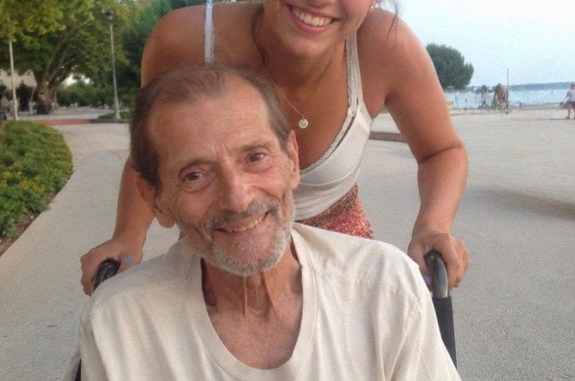
For the next six weeks, we created a family neither of us had truly had. I brought him coffee, worked on crossword puzzles beside him, and pushed his wheelchair through the hospice gardens while he jokingly criticized the flowers.
The hospice even approved two special outings.
The first took us to Millie’s Diner, where everyone greeted Nathan like an old friend. The second was to the beach, where he stood barefoot in the sand with his eyes closed, quietly taking in the moment.
People often assumed I was his daughter.
Nathan never corrected them.
As his health declined, our bond only grew stronger. During my final visit, he asked softly,
“Was I convincing?”
“As a father?”
“As someone worth remembering.”
I squeezed his hand.
“You were.”
Nathan passed away the next morning.
At his funeral, I recognized several hospice workers and people from the diner. Eric stood alone in the back, saying almost nothing.
The following afternoon, he called and asked to meet.
Inside his office sat a small wooden box.
Then he told me something that changed everything.
“Nathan was your biological father.”
I thought he was mistaken.
But inside the box were legal documents acknowledging paternity before my birth, copies of letters my mother had returned unopened, and DNA records confirming the truth.
Nathan had discovered my identity through a genealogy database years earlier. After learning where I volunteered, he intentionally transferred to that hospice so we would meet.
The revelation left me furious.
Eric admitted he had known the truth the entire time. Nathan had insisted on keeping it secret, believing I would reject him if I knew who he really was. Eric obeyed, convinced that giving Nathan six peaceful weeks mattered more than telling me the truth.
I accused him of taking away my right to choose.
He quietly admitted he had been wrong.
Inside the box were also two bundles of letters—one addressed to me and another to Eric.
Only then did I learn Eric was Nathan’s son.
Nathan had abandoned my mother years earlier when she became pregnant, though he later tried to reconnect. She refused every letter he sent. Meanwhile, Eric had grown up with Nathan as his father, but never truly felt loved by him.
Reading Nathan’s letter only complicated my emotions.
He admitted abandoning me.
He admitted failing Eric emotionally.
He confessed he wanted to know if I could love him before learning what he had done.
He hadn’t been pretending to be my father.
He had been pretending not to be.
The next morning I called Eric.
I told him we didn’t owe Nathan the happy ending he wanted.
He agreed.
The only thing tying us together was Millie’s Diner, which Nathan had left to both of us.
At first, we planned to sell it.
But after visiting and meeting longtime employees who depended on the diner for their livelihoods, the decision became far more complicated.
Eric finally admitted publicly that he had helped Nathan hide the truth from me. It was the first time he stopped protecting his father’s reputation.
Days later, he apologized in writing, offered to step away from managing the estate, and insisted I have independent legal counsel.
Together, we reviewed the diner’s finances.
For months, we argued, negotiated, and slowly rebuilt trust. We found a way to keep the business alive by selling unused property, cutting expenses, and partnering with the hospice to provide free breakfasts for patients’ families.
Nothing erased Nathan’s choices.
But working together changed the way Eric and I saw each other.
Eventually, our anger softened.
We never renamed the diner after Nathan.
Instead, we left one corner booth exactly as he remembered it.
On my birthday, Eric sat waiting there with two slices of apple pie.
“I guess he finally got his table for two,” he said.
I looked at the empty chair.
Nathan’s regrets could never undo the pain he caused.
Yet the six weeks we shared had still been genuine.
Love and anger existed together.
I pulled over a third chair.
“No,” I said. “He doesn’t get to decide who belongs here.”
Before opening the diner that morning, Eric placed Nathan’s unopened letter to him on the table. He admitted he still couldn’t bring himself to read it.
I told him he didn’t have to—not yet.
For the first time, we chose our own ending instead of the one Nathan had planned.
As Rosa unlocked the front door and hospice families began arriving for breakfast, she noticed the three chairs together.
Without saying a word, she returned from the kitchen carrying one more fork.
Leave a Reply