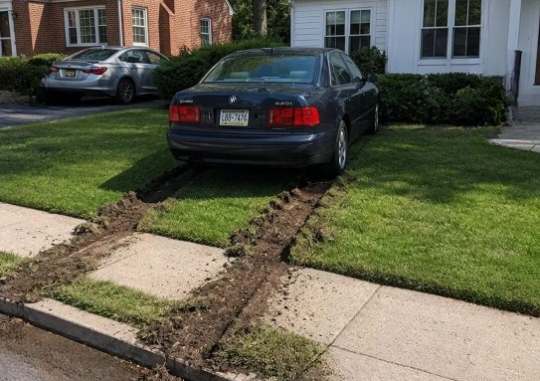
I stopped in my tracks when I looked through my living-room window and saw Sheldon’s black SUV parked directly in the middle of my front lawn.
He had driven straight over the curb, flattened part of my flower bed, and left deep tire tracks across the grass I had spent months carefully restoring.
I was twenty-six and had purchased my modest two-bedroom home with years of savings, along with part of the inheritance my father had left me. Every damaged patch of lawn felt like a personal insult.
Sheldon was in his mid-fifties and had been my neighbor for almost a year. During that time, he had found something to complain about constantly—my hedges, my porch light, my trash cans, and practically everything else around my property.
I had done my best to avoid conflict.
But this time, he’d gone too far.
His own driveway was completely empty, and there were plenty of open spaces along the street.
I walked over to his house and knocked.
When I told him he needed to move his SUV, he simply smiled.
“It’s just grass.”
That was when I realized my attempts to keep the peace had only taught him that he could get away with whatever he wanted.
I decided not to argue.
Instead, I went back inside and checked my security camera footage.
What I saw made my blood boil.
At 6:17 that morning, Sheldon had walked out of his house and looked around to make sure no one was watching.
Then he backed his SUV out of his perfectly usable driveway, deliberately drove across the property line, and parked directly on my lawn.
Before walking away, he even glanced toward my front window and smiled.
I saved the video immediately.
Then I photographed the crushed flowers, the tire marks, and the damaged grass.
I sent everything to Elise, one of the members of our homeowners association board.
She reviewed the footage and confirmed that parking on another homeowner’s property without permission violated our HOA rules.
She advised me to submit a formal written complaint.
Sheldon still refused to move his SUV for the entire day.
That evening, I stood by the window looking at my rain-soaked lawn.
Then I remembered the irrigation equipment sitting in my garage.
A very simple idea came to me.
And the best part was that I wouldn’t have to touch his SUV at all.
I arranged my sprinklers around the lawn and set them to run intermittently throughout the night.
I wasn’t doing anything unusual.
I was simply watering my own property.
It had already rained heavily for three days, leaving the ground extremely soft.
By the next morning, the soil could barely support the weight of Sheldon’s SUV.
His tires had sunk several inches into the mud.
When he tried to drive away, things only got worse.
The wheels spun.
The mud splattered.
And the SUV sank even deeper.
Eventually, Sheldon came storming to my front door.
“You need to fix this!” he shouted.
I calmly reminded him that he had been the one who decided to park there.
He wasn’t happy.
A professional recovery company eventually had to be called.
They arrived with specialized equipment, ground mats, and a heavy-duty winch because a standard tow could have damaged the SUV.
Sheldon ended up paying for the recovery, the towing equipment, the HOA violation, and the repairs to my landscaping.
Fortunately, I had documented everything.
The security footage showed exactly when he entered my property.
The photographs showed the condition of the lawn.
And my written complaint established that he had been warned.
If the matter had eventually gone to court, I would have had a complete timeline proving exactly what happened.
But it never got that far.
The biggest victory wasn’t the money Sheldon had to spend.
It was what happened afterward.
For the next two weeks, he stopped commenting on everything I did.
No more complaints about my trash cans.
No more criticism of my landscaping.
No more comments about my visitors.
No more arguments about my porch light.
Eventually, we started speaking again.
But our conversations were different.
They stayed limited to things that actually affected both of our properties.
He stopped entering my driveway.
He stopped touching my belongings.
And, most importantly, he finally respected the property line.
I had spent months believing that avoiding confrontation was the same as protecting my peace.
I eventually realized that constantly giving in can teach someone that there will never be consequences for crossing your boundaries.
I never damaged Sheldon’s SUV.
I never sabotaged it.
I never needed some elaborate revenge scheme.
I simply documented what he had done, protected my property, and allowed the consequences of his own decision to speak for themselves.
The boundary between our two houses had always been there.
After that morning, Sheldon finally started acting like he could see it.
Leave a Reply