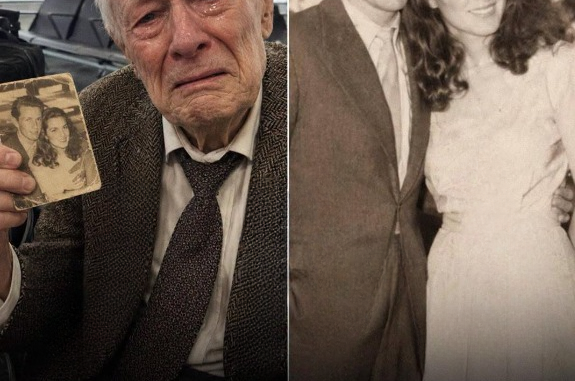
A canceled flight left me sitting beside a stranger for four unexpected hours. We talked about almost everything, until he saw an old photograph of my mother and asked me a question that completely changed my life.
“What year were you born?”
Arthur’s fingers had tightened around my wrist.
His voice was barely audible over the airport announcements, rolling suitcases, and frustrated passengers arguing with airline employees.
I pulled my hand away.
“1986.”
He closed his eyes.
“What month?”
“March.”
His passport had fallen open on the floor between us.
“Arthur, are you okay?”
“What was your mother’s name?”
We had been talking for nearly four hours. He knew my mother had died suddenly two months earlier. He knew I was headed to Chicago to clean out the house where she had grown up. He even knew that I’d never met my biological father.
But there was one thing I had never told him.
My mother’s name.
“Why are you asking?”
“Please.”
Something about his expression unsettled me.
Not because he looked threatening.
Because he looked completely devastated.
“Elaine.”
Arthur covered his mouth.
Then he repeated the name under his breath.
“Elaine.”
He said it like someone finally speaking the name of a person he’d spent decades trying not to remember.
I locked my phone and held it tightly against my chest.
“How did you know my mother?”
He pointed toward the photograph on my phone.
It showed Mom at twenty-one, standing beneath a row of oak trees with sunlight shining through her dark hair. Around her neck hung a delicate silver heart locket made of intricate metalwork.
I’d seen that necklace in countless childhood photographs.
She wore it until I was about ten.
Then it vanished.
“I gave her that necklace,” Arthur said.
My first reaction was disbelief.
Then suspicion.
Mom had always been extremely private about the years before I was born. Whenever I asked about my father, she gave me the same vague explanation.
“He wasn’t ready to be part of a family.”
She never told me his name.
She never showed me his photograph.
She never told me whether he even knew I existed.
“That locket was specially made,” Arthur continued. “There shouldn’t be another one identical to it.”
“Jewelry can look alike.”
“Not that one.”
He reached into his wallet and pulled out an old, worn photograph.
My mother was in it.
She looked younger, perhaps twenty years old, sitting beside a fountain with her face turned toward someone outside the frame.
Around her neck was the same silver locket.
I felt a chill run through me.
On the back of the photograph, written in faded blue ink, were the words:
Florence, 1984. Love, Elaine.
“Where did you get this?”
“Elaine gave it to me.”
“When?”
“The summer before everything fell apart.”
I studied him carefully.
Arthur was seventy-five, with silver hair, pale blue eyes, and the stiff posture of a man who had spent his entire life keeping his emotions under control.
There was nothing about him that immediately proved we were related.
“You told me your wife died twelve years ago.”
“She did.”
“Were you married to my mother?”
“No.”
“Did you have an affair with her?”
“No.”
“Then what happened?”
Before he could answer, another announcement echoed through the terminal.
All flights to Chicago were still canceled.
Passengers crowded around the customer service counters, but Arthur and I remained near Gate 14 as the snowstorm continued to bury the runway.
“I met Elaine in Florence,” he finally said. “We were both twenty-three.”
“My mother never lived in Italy.”
“She studied there for one semester.”
I knew Mom had studied art history.
I had never known about Florence.
Arthur gave a faint smile.
“She hated olives. She got lost almost every morning. And she always carried three pencils because she was convinced one of them would eventually break.”
I thought about the way Mom carried three pens in her purse until the day she died.
I sat down.
Arthur had been studying architecture at the time. Mom was attending a nearby university through an exchange program.
They met inside a bookstore when both reached for the same poetry book.
“That sounds like something from a movie,” I said.
“Elaine said the exact same thing.”
They spent four months together.
Arthur came from a wealthy family that cared deeply about reputation and appearances. His father owned a major construction company and expected Arthur to eventually take over the business. He also expected his son to marry the daughter of one of his business partners.
Elaine didn’t fit into that plan.
She was the daughter of a school secretary and a mechanic. She wanted to become a teacher. She challenged Arthur’s father during dinner and laughed when his mother criticized her clothes.
“I loved that about her,” Arthur said. “My parents didn’t.”
Before Elaine returned to America, Arthur bought the silver locket from a jeweler near the Ponte Vecchio.
They had two tiny initials engraved inside.
A and E.
He had also placed a small folded note inside.
“Wherever you go, take my heart.”
It sounded sentimental and young.
It also sounded exactly like something my mother would have made fun of while secretly keeping forever.
“Were you engaged?”
“Secretly.”
Arthur had proposed.
Elaine had accepted.
But before they could tell their families, his father discovered their relationship.
He threatened to cut Arthur off financially and remove him from the family business.
Arthur told him to go ahead.
So his father fabricated a crisis.
He told Arthur that his mother had suffered a heart attack in London.
Arthur immediately returned home.
There had been no heart attack.
His passport was taken.
His bank accounts were frozen.
His father even threatened to stop paying for Arthur’s younger sister’s education if he went back to Elaine.
“You were an adult,” I said.
“I was. But they knew exactly how to control me.”
Arthur wrote to my mother constantly.
But no answer came.
When he finally recovered his passport six weeks later, he flew to America.
By then, Elaine had moved out of her college apartment and her phone had been disconnected.
Arthur traveled to her parents’ home in Illinois.
My grandmother answered the door.
I remembered Grandma June as a gentle woman who baked cinnamon bread and made my Halloween costumes.
According to Arthur, she stared at him for a long time before telling him Elaine wanted nothing more to do with him.
“Did you believe her?”
“No.”
He returned twice more.
During his final visit, my grandfather threatened to call the police.
Then Arthur received a letter written in my mother’s handwriting.
It told him their relationship had been a mistake.
It claimed she was engaged to someone else.
It told him never to contact her again.
“Do you still have the letter?”
“Yes.”
“Why?”
“Because for years, it was the only thing I had left from her.”
I thought about my grandparents.
They had helped raise me.
Grandpa had taught me how to drive. Grandma had stayed beside me through childhood fevers and heartbreak.
The idea that they might have deliberately separated my mother from the man she loved seemed impossible.
Then I remembered Mom whenever I asked about my father.
She never seemed angry.
She always seemed afraid.
“Why don’t you believe the letter was real?” I asked.
“Because of the locket.”
Arthur looked at the photograph on my phone.
“If Elaine wanted me out of her life, why was she still wearing the necklace in 1985?”
I was born in March 1986.
The dates suddenly felt much heavier.
“I need you to say what you’re thinking.”
Arthur looked directly at me.
“I think I might be your father.”
Everything around me seemed to disappear.
The airport announcements continued. Children cried. Suitcases rolled across the floor.
But none of it felt real anymore.
My biological father had always existed as a blank space in my life.
Sometimes I imagined he had been cruel.
Sometimes I imagined he simply didn’t care.
Sometimes I thought he might already be dead.
I had never imagined meeting him beside an airport charging station.
“You don’t know that.”
“No.”
“My mother could have met someone else.”
“Yes.”
“You could be wrong.”
“I could.”
“Then why are you looking at me like that?”
Arthur’s eyes filled with tears.
“Because your hand is on your neck.”
I looked down.
Whenever I was anxious, I pressed two fingers against the base of my throat.
Mom used to tease me about it.
Arthur slowly touched the same spot on his own neck.
“I do that too.”
One shared habit proved nothing.
Neither did the locket, the photograph, or the dates.
But the possibility was already inside my mind.
I couldn’t force it back out.
Then a paper envelope slipped from Arthur’s passport.
I picked it up.
“What’s this?”
“A letter I wrote to Elaine after my wife died.”
“You were still thinking about her?”
“I never stopped.”
He had written the letter twelve years earlier, after his wife’s death brought all the memories of the life he never lived rushing back.
He apologized for not fighting harder.
He admitted that he had eventually married someone else, four years after Florence.
His wife, Margaret, had known about Elaine.
“Did you love your wife?”
“Very much.”
“Then how could you still love my mother?”
Arthur thought for a moment.
“Love isn’t always a room with only one chair.”
The answer made me angry.
Then, unexpectedly, it made me cry.
Mom had been dead for two months, yet I still reached for my phone whenever something happened that I wanted to tell her.
Grief had taught me that love could continue even when the person was gone.
Arthur didn’t try to comfort me.
He simply sat there and waited.
Eventually, I asked where he was headed.
“Chicago. My sister died last month, and I’m going there to settle her estate.”
His family had lived less than an hour from my mother’s hometown.
Arthur now lived in Boston.
I lived in Denver.
The snowstorm had rerouted both of us through Minneapolis.
If Flight 412 had departed on schedule, we probably would have walked past each other without ever speaking.
If I had shown him a newer photograph, he might never have noticed the locket.
My phone buzzed.
The airline had found me a seat on a flight leaving at six the following morning.
Arthur checked his phone.
He still had no replacement flight.
I stood up.
“I should find my new gate.”
Arthur stood too.
“No.”
I stopped.
“What?”
“Please don’t board.”
“You don’t get to decide what I do.”
“I know.”
“Then move.”
He stepped aside.
That should have made it easy to leave.
It didn’t.
“I spent forty years wondering whether Elaine believed I abandoned her,” he said. “You spent your whole life wondering who your father was. I’m asking for one day.”
“One day for what?”
“To find out the truth before we lose each other again.”
The word “again” hit me harder than I expected.
I could board the flight, exchange contact information with him, and arrange a DNA test later.
That would have been the logical thing to do.
But my entire life had been shaped by people who believed silence was safer than honesty.
So I sat down again.
“One day.”
Arthur exhaled like he’d been holding his breath for four decades.
The airport eventually closed for the night.
Employees brought out cots and bottled water.
Neither of us slept.
Arthur showed me photographs from Florence.
In one, Mom stood beside him on a bridge, laughing as the wind blew through her hair.
In another, she was asleep on a train with her head resting against his shoulder.
I had never seen her look so young.
So happy.
At sunrise, I called the attorney handling my mother’s estate.
“Are there any personal papers left in the house?”
“There are several boxes in the attic,” she replied. “One of them is marked Florence.”
Arthur’s hands began trembling.
By noon, the storm had weakened.
We rented the last available car and drove six hours through snow and slush.
When we finally reached my mother’s house, I stood on the porch with the key in my hand.
“I haven’t been inside since the funeral.”
“We can wait,” Arthur said.
“No.”
The house still smelled faintly of lavender soap.
Her shoes were still beneath the coat rack.
A mug sat upside down beside the kitchen sink.
For one painful moment, I almost expected her to walk through the door and explain everything.
We found the attic boxes beneath an old quilt.
The one marked Florence contained photographs, museum tickets, postcards, and dozens of letters tied together with a blue ribbon.
Every envelope was addressed to Mom.
Every letter had been written by Arthur.
Most had been opened.
Some were stained with tears.
Arthur sat down on the attic floor.
“She received them.”
“At least some of them.”
At the bottom of the box was the silver locket.
The metal had darkened with age.
Arthur turned it over.
The initials were still there.
A and E.
I opened it.
Inside was the same folded message.
Wherever you go, take my heart.
Arthur began to cry.
Then I found another envelope.
My name was written across the front.
Maya.
Mom had written it six years earlier.
She explained that she had always intended to tell me the truth, but shame had eventually turned into fear.
Her parents had intercepted Arthur’s early letters.
When Mom became pregnant, they told her Arthur had married someone in England. They even showed her a newspaper announcement that had been arranged by his father.
By the time Arthur came to Illinois, my mother had been sent to stay with an aunt.
My grandmother had forged the rejection letter by copying Mom’s handwriting.
Years later, Mom discovered Arthur’s real letters hidden among Grandma’s belongings.
By then, Arthur was married.
Mom decided that contacting him might destroy another woman’s family.
So she raised me alone.
The final part of the letter was the hardest to read.
“Arthur is your father. I never told him about you. That was my choice, not his. If you ever find him, tell him I kept the locket because I needed one piece of that summer to remain real.”
Arthur made a sound I will never forget.
It wasn’t simply crying.
It was the sound of a man discovering that forty years of heartbreak had been built on someone else’s lies.
I sat beside him.
Neither of us spoke for a long time.
The DNA test came later.
It confirmed what Mom’s letter had already told us.
Arthur was my father.
We didn’t suddenly become a perfect family.
Arthur had another daughter, Caroline, and she struggled with my unexpected arrival.
I resented the childhood she had shared with him.
She resented how much of his attention was suddenly focused on the daughter he never knew existed.
Arthur tried too hard at first.
He sent gifts, called every morning, and apologized for birthdays he had never known he was missing.
Eventually, I told him:
“Stop trying to become the father I needed when I was ten. Get to know the woman I am now.”
He listened.
That meant more than another apology.
Today, we speak twice a week.
Caroline and I are slowly figuring out how to become sisters without pretending it feels effortless.
Last summer, Arthur and I returned to Florence.
He took me to the bookstore where he and Mom first met.
It had become a clothing store.
We stood outside anyway.
Later, beside the river, Arthur asked me if I blamed him.
“Sometimes.”
“For leaving?”
“For not fighting harder.”
He nodded.
“I blame myself too.”
Then I told him something harder.
“I blame Mom too.”
Arthur looked surprised.
“She was scared.”
“I know. But being afraid still means making choices.”
For most of my life, I had protected my mother’s memory by refusing to be angry with her.
Finding Arthur taught me something important.
Loving someone doesn’t mean pretending they never made mistakes.
Mom loved Arthur.
She loved me.
But she also allowed fear and silence to make decisions that affected all of us.
At the airport, Arthur had asked me not to board because he couldn’t bear losing another opportunity to discover the truth.
I stayed because I couldn’t bear it either.
Sometimes I think about how easily we could have missed each other.
A different gate.
A flight that wasn’t canceled.
A photograph I never showed him.
A charging station we never happened to share.
For thirty-eight years, I believed my father knew I existed and chose to stay away.
Arthur spent four decades believing my mother had rejected him and moved on.
Both of us had been living with the wrong story.
The truth had been waiting in an attic, hidden among old letters and a silver heart.
It took a blizzard, a canceled flight, and four hours beside a stranger to finally uncover it.
Arthur isn’t a stranger anymore.
He can’t give me back the years we lost.
But he is my father.
And whenever he calls, I answer before silence gets another chance to speak for either of us.
Leave a Reply