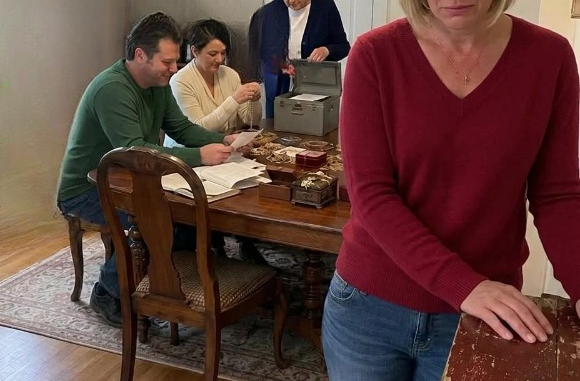
I struggled with my uncle to move the old wardrobe into the back of my truck, and the first thing that struck me was its unbelievable weight.
It was a worn-out piece of furniture with cracked doors, a broken leg, and years of water damage. It looked like something most people would have thrown away. Yet somehow, it felt as if it was packed with heavy stones.
My uncle, my father’s younger brother, wiped sweat from his forehead as we lowered it onto the moving blankets.
“Are you sure this thing isn’t filled with bricks?” he joked.
I didn’t respond.
Instead, I looked back at the house.
My mother stood on the porch gripping the railing tightly. Her fingers were pale from how hard she was holding on.
It had been forty days since my father died.
Forty days filled with sympathy cards, meals from neighbors, and a house that still carried traces of his cologne.
But my mother didn’t look like someone grieving.
She looked terrified.
It was the kind of fear someone shows when they know a secret is about to come to light.
From inside the house, my sister-in-law shouted without even looking away from her phone.
“If he doesn’t want that thing, just leave it by the alley. Don’t bring it back.”
My sister Sarah laughed from the living room.
My older brother Michael remained at the kitchen table, acting as if none of this concerned him.
I closed the truck’s tailgate.
I didn’t say a word.
During the drive back to Columbus, my uncle stayed quiet for several minutes. He stared out the passenger window, clearly debating whether he should get involved in a family situation that technically wasn’t his.
Finally, he spoke.
“Your father cared about that wardrobe.”
I glanced at him.
“I know.”
“He never let anyone move it.”
I tightened my grip on the steering wheel.
“I remember.”
And I did.
When I was a kid, I once reached into that wardrobe to grab one of my father’s tools.
He immediately stopped me.
“Don’t take anything from there without asking.”
At the time, I felt embarrassed and hurt.
But later that night, my father walked into my room carrying a powdered doughnut wrapped in a paper towel.
That was how he apologized.
He sat beside me, messed up my hair, and said something I didn’t fully understand back then.
“Some things are protected not because they’re expensive, but because the wrong people shouldn’t have access to them.”
As a child, I assumed he meant his tools.
But now, with that old wardrobe rattling behind me in the truck, I wondered if he had meant something else.
When we reached my apartment, my uncle helped me move it into the spare room.
My place wasn’t impressive.
A small two-bedroom apartment.
A cramped kitchen.
A bathroom that always smelled slightly damp.
But it was mine.
Nobody told me how to live there.
Nobody decided what I deserved.
The wardrobe was pushed against the wall beside old boxes, college books, and a bike I had never repaired.
My uncle stared at it.
“Your mother didn’t want you taking this.”
I looked at him.
“You noticed?”
He nodded.
“I’ve known your mother a long time. When she’s scared, she presses the left side of her mouth together. She looked like she was trying not to break her own teeth today.”
His words stayed with me.
Before leaving, he gave me one final warning.
“Don’t accuse anyone yet. Find out what you actually brought home. Your father wasn’t the kind of man who left unfinished business behind.”
After he left, the apartment became silent.
I opened the wardrobe doors.
Inside were old hangers, mothballs, receipts, a measuring tape, and two pocketknives.
Nothing valuable.
Nothing unusual.
Until I reached the bottom drawer.
It refused to open fully.
I pulled harder.
Nothing.
Then I noticed something strange.
The drawer was much shorter than the others.
There was empty space behind it.
I grabbed my phone and turned on the flashlight.
Hidden in the wood was a nearly invisible seam.
I carefully removed the drawer.
Behind it was a secret compartment.
Inside were three things:
A yellowed envelope.
A brass key wrapped in black tape.
And a small black notebook.
The envelope had only two words written on it:
For Daniel.
I sat down on the floor.
Seeing my father’s handwriting affected me more than I expected.
I unfolded the letter.
It read:
If you are reading this, I am gone. I did not leave you this wardrobe because I felt sorry for you. I left it because you understand the difference between something old and something worthless. You were the only one who stayed when hospitals became difficult and everyone else disappeared. The notebook contains things your mother does not fully know and things your brother and sister have chosen to ignore. Do not let them rewrite the truth.
My hands shook slightly as I opened the notebook.
Every page contained records.
Dates.
Names.
Amounts.
My father had documented everything.
Loan to Michael for house deposit: $10,000. Repaid: $0.
Sarah’s graduation expenses: $3,500.
Money taken from savings for Sarah’s car repairs: $800.
Michael’s legal fees after his accident: $1,200.
Then I found one entry that stopped me.
Daniel paid for refrigerator replacement: $600. Asked me not to record it. Recording anyway.
For years, whenever money came up, my mother always said the same thing.
“Families don’t keep score.”
But my father had kept score.
Not because he wanted revenge.
Because someone needed to remember the truth.
Near the back of the notebook, I found a page marked with blue tape.
It said:
Read the second envelope.
I reached back into the hidden compartment.
The second envelope contained legal documents.
A notarized statement.
And another key.
The papers were about the land behind my parents’ house.
Everyone had always called it useless.
A forgotten strip of property filled with old machinery, weeds, and junk.
But my father had purchased it separately years earlier using money from a workplace injury settlement.
The property was legally his.
And according to the documents, he had left it to me.
The reason was written clearly:
It was meant as recognition for the years I had helped him and carried responsibilities my siblings avoided.
The main house belonged to my mother.
But the back lot was different.
It had never been part of the house.
It was mine.
At the bottom of the envelope was another note.
Do not chase love from people who only value convenience. But do not walk away empty-handed just to avoid conflict. Some silence creates peace. Other silence gives permission.
I sat there for a long time.
The wardrobe was no longer an old piece of furniture.
It was evidence.
The next morning, Sarah called.
“Mom said if you found anything in that wardrobe, you need to return it. She thinks she left important documents inside.”
I almost laughed.
“Really?”
“Yes. Honestly, you don’t even want that ugly thing. Michael can come pick it up.”
I leaned against the wall.
“The wardrobe is already in my apartment.”
There was a pause.
Then her voice changed.
“What about the papers?”
“I’ll look through everything carefully.”
I ended the call.
Within hours, I had missed calls from both Sarah and my mother.
Michael sent one message:
Don’t create problems over an old piece of furniture. If you found something, we handle it as a family.
A family.
The same family that had spent weeks dividing my father’s belongings.
Sarah took the jewelry.
Michael took the tools.
Now suddenly they wanted unity.
That afternoon, I visited Mr. Henderson, my father’s longtime friend and a retired attorney.
He reviewed the documents carefully.
When he finished, he looked at me.
“Your father knew exactly what he was doing.”
“Are these documents enough?”
“They’re strong. You need to confirm the property records, but if your mother is worried about that wardrobe, she already knows there’s something important inside.”
That evening, when I returned home, Michael was waiting outside my apartment.
“What took you so long?” he asked.
I unlocked my door.
“I live here. You don’t need to wait outside.”
“Mom is upset.”
“I’m sure she is.”
His eyes narrowed.
“What did you find?”
I smiled slightly.
“Interesting. Everyone was calling it worthless until they wanted to know what was inside.”
Michael stepped closer.
“If there are documents, we handle this privately.”
“No,” I said. “We handle this honestly.”
Before I closed the door, I looked toward the parking lot.
My mother was stepping out of Michael’s vehicle.
She wasn’t there because she missed me.
She was there because she wanted something back.
And that was when I realized:
Taking the wardrobe wasn’t the end of the inheritance fight.
It was only the beginning.
Leave a Reply