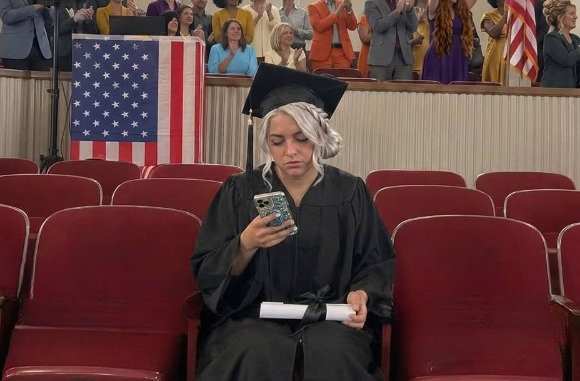
Four empty seats in the second row of the Stanford auditorium became the moment that changed everything for me.
I had saved those seats for the people I thought would be the proudest: my father, my mother, my younger sister Camille, and one in honor of my grandmother. I had mailed the tickets weeks in advance, and the night before graduation, my mother reassured me.
“We’ll be there, sweetheart. You worry too much.”
But when I walked across the stage to receive my second master’s degree, there was no familiar face cheering for me.
After the ceremony ended, I remained in the quiet auditorium while other graduates hugged their families and took pictures. I expected to feel shattered.
Instead, I felt empty.
Like something inside me had finally gone silent.
I had always been the reliable one.
I drove hours home for family holidays.
I contributed thousands toward my father’s medical expenses.
I paid Camille’s rent for months when she said she was struggling to find work.
I kept giving because I loved them, even when that love started to feel like holding up a house that was slowly collapsing.
Then I checked my phone.
Seventeen relatives had contacted me.
Not one message came from my parents.
My aunt Delphine left a voicemail.
“I’m sorry things didn’t work out with school. Everyone has disappointments.”
Another relative said they heard my degree had fallen through.
Someone else told me that advanced education simply was not meant for everyone.
I was confused.
So I called my aunt.
“What are you talking about?” I asked.
She hesitated.
“Your mother said you failed your thesis defense. She told everyone you were too embarrassed to let people attend your graduation.”
I looked back at the empty chairs.
“Aunt Delphine, I graduated with honors. My thesis received special recognition. My parents promised they would be here.”
The silence that followed said everything.
Later, I discovered the truth.
My family had skipped my graduation because they were celebrating Camille’s twenty-sixth birthday instead.
They had rented a party tent, hired entertainment, and invited dozens of guests.
My mother had created a story about my failure because admitting she chose my sister’s birthday celebration over my greatest achievement was too embarrassing.
I left campus and walked into a nearby coffee shop.
I ordered a coffee, opened my laptop, and saw an email waiting for me.
It had arrived at 11:23 that morning—the exact time I had crossed the stage.
The subject line read:
Congratulations from Halden Vale Group.
At first, I thought it was spam.
Halden Vale was a global technology and infrastructure company worth billions. The message was from Ingrid Søberg, their Senior Vice President of Strategic Talent Acquisition.
She explained that the company had spent fourteen months reviewing my academic research and published work.
They wanted to meet with me about a position designed around my expertise.
I read the email again.
And again.
On the same day my own family decided my achievement was something to hide, strangers had recognized the value of everything I had worked for.
I replied with one word.
“Yes.”
A week later, I sat inside a Park Avenue office overlooking Central Park while Ingrid explained why they had contacted me.
“One of our founders read your research on emerging-market infrastructure risks three times,” she said. “You identified problems our experts have struggled with for years.”
Then she offered me a position as Director of Emerging Market Strategic Analysis.
I would lead a team of nine analysts.
The three-year compensation package was worth nine million dollars.
“Nine million?” I repeated.
She smiled.
“We don’t overpay. We pay people according to their value.”
I thought about those four empty chairs.
“When do you need my answer?”
“You have seven days,” she said. “But remember something—you do not need to prove yourself to us. We already see what you can do.”
For the first time in years, someone saw me without needing something from me.
When I returned home, I studied every page of the offer.
The salary was extraordinary.
The signing bonus was enough to erase my student debt.
One section even mentioned the possibility of adding my parents and sister as dependents.
I stared at that section for a long time.
For years, I had waited for my mother to tell me she was proud.
I never realized that waiting for her approval had kept me from moving forward.
So I called her.
At first, she talked about Camille’s birthday party.
Then I interrupted.
“Aunt Delphine told me what you said.”
The line went quiet.
“You told everyone I failed.”
“I was trying to protect you,” she replied.
“Protect me?”
“Camille’s celebration was already planned.”
“I graduated with distinction.”
“You’ve always been strong, Marlo. Camille needs more support.”
That sentence finally made everything clear.
She had not misunderstood my achievement.
She had simply decided it mattered less.
“You created a failure story because it was easier than admitting what you did,” I said.
“Don’t be dramatic.”
I ended the call.
That night, I accepted Halden Vale’s offer.
A company I had never met called my future remarkable.
My own family had only ever called me useful.
The first bonus payment arrived shortly after I signed.
I paid off my student loans, secured professional financial advice, and bought my grandmother’s old Berkeley home for cash.
My mother had inherited the house and planned to eventually give it to Camille.
She did not realize I was the buyer until the paperwork was complete.
When she found out, she was furious.
“That house was supposed to go to Camille.”
“Nana left me a message reminding me that my life was bigger than the expectations I grew up with,” I told her. “I visited her every month. Camille rarely did.”
“Sell it back.”
“No.”
“Marlo—”
“I love you, Mom. But I’m done living according to your decisions.”
She called repeatedly afterward.
I did not answer.
Eventually, my father called.
He admitted my mother had told him the ceremony had been postponed.
“I sent you the tickets,” I said. “If you didn’t know what happened, it’s because you never asked.”
He was quiet.
“You’re right,” he said.
Then he asked if I was okay.
“I’m doing well. I have a great job. I’m building my life.”
After a long pause, he said the words I had waited years to hear.
“I’m proud of you.”
Not compared to Camille.
Not followed by advice.
Just pride.
I moved to New York and dedicated myself to the work.
I built my team.
Traveled internationally.
Completed major projects ahead of schedule.
For the first time, I was not the person sitting quietly at the edge of the room.
I belonged at the table.
Then a business article announced my promotion.
My mother called immediately.
“Is that really you?”
“Yes.”
“What have we done?”
I told her I needed space.
Not because I hated her.
Because I needed time to heal.
She asked how much money I made.
That was her first question.
I refused to answer.
“The important thing is that a company built a position around the person you always said was too intense,” I told her.
I skipped Thanksgiving and Christmas that year.
Surprisingly, she accepted it.
Later, my sister Camille called after seeing the article.
She admitted she finally understood how unfairly our family had treated me.
Mom had spent years warning her not to become like me—too independent, too ambitious, too intimidating.
“I think we were both trapped in roles,” I told her.
“You were expected to be the perfect daughter. I was expected to be the useful one.”
She apologized.
I forgave her, but I also made my boundary clear.
“I love you, but I cannot keep carrying your life for you.”
For the first time, we started building a relationship based on honesty.
Years later, I spent Christmas in New York.
My father sent me a handwritten card.
Thinking of you. Love, Dad.
Camille told me she had found a job and was proud of supporting herself.
My mother eventually admitted the truth.
She had skipped my graduation because she felt insecure about her own education and struggled with jealousy.
She had not forgotten the day.
She had chosen not to be there.
I told her I appreciated her honesty, but forgiveness would take time.
In the summer of 2026, I hosted a gathering at my grandmother’s restored Berkeley home.
My father came.
Camille came.
My closest friends came.
My mother was not invited.
And for once, she respected the boundary.
Standing among people who had truly shown up for me, I understood something important.
Family is not only about who shares your blood.
It is about who chooses to stand beside you.
Camille became more independent.
My father began supporting me without trying to control my choices.
My mother and I slowly rebuilt trust through letters and honest conversations.
I was eventually promoted again, created a scholarship program, helped others pursue their goals, and built a life that belonged completely to me.
For twenty-nine years, my family had decided my worth without asking me.
They created a version of me that was easier for them to accept.
But those four empty chairs were never the symbol of my greatest loss.
They were the beginning of my freedom.
That day, in a silent auditorium, I finally heard my own voice.
It said:
“I’m done waiting.”
And those words did not destroy my family.
They ended the part of me that was willing to disappear just to keep everyone else comfortable.
Leave a Reply