PART 2
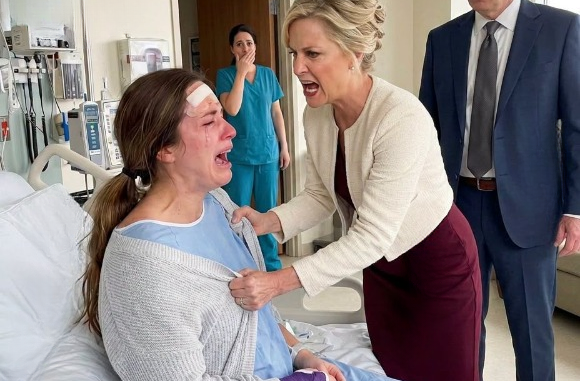
A nurse heard me scream.
Mom immediately stepped away from the bed, adjusting her sweater as though nothing unusual had happened.
Richard quietly moved toward the window.
When Nurse Alicia Grant entered the room, Mom forced a smile.
“She just had a muscle spasm.”
I could barely catch my breath.
Alicia studied me, then looked at Mom. Her expression became serious.
“I need everyone except the patient to leave.”
Mom protested.
“But I’m her mother.”
“And I’m her nurse,” Alicia replied firmly.
Mom stared at me before walking out.
There was no concern in her expression.
Only a warning.
As soon as the door closed, Alicia came closer.
“Did someone hurt you?”
My first instinct was still to protect my mother.
It lasted only a few seconds.
“My mother hit me.”
Alicia immediately contacted hospital security and the police.
About an hour later, Detective Marcus Reed arrived.
By then, Tyler had already given officers his version of the crash.
According to him, I had been driving drunk. He claimed we’d argued, I’d lost control of the Dodge, and he jumped out because he thought we were about to go over an embankment.
Richard backed up his story.
So did Mom.
Because Tyler had escaped with relatively minor injuries while I had suffered devastating ones, their version initially made me look like the obvious driver.
Detective Reed looked at me.
“Do you have anything that could prove otherwise?”
“My phone.”
Police had recovered it from the wreckage. The screen was badly damaged, but the phone itself still worked.
“Open the RoadGuardian app.”
Reed found the application and I gave him my password.
The recording loaded.
There was Tyler, clearly sitting behind the wheel.
I was in the passenger seat.
My voice could be heard telling him to slow down.
Tyler laughed.
Then the Dodge hit the ice.
The vehicle spun.
I screamed.
Then Tyler opened the driver’s door and jumped out.
Seconds later, the Challenger slammed into something.
The camera continued recording for another eighteen seconds.
Detective Reed watched the footage twice.
Then he looked at me.
“Does your family know you have this?”
“No.”
He nodded.
“Good.”
Later that day, police questioned Mom, Richard, and Tyler separately.
Their stories remained identical.
Mom even signed a statement claiming she had personally watched me leave her driveway in the driver’s seat.
The dashcam proved that couldn’t possibly be true.
It showed Tyler driving away from her house nearly forty minutes before I encountered him.
The following morning, Detective Reed returned with another officer.
Tyler had been arrested.
Unauthorized use of a vehicle.
Driving without a license.
Leaving the scene of a serious accident.
Reckless driving.
Investigators had also discovered evidence suggesting he had tried to wipe fingerprints from the steering wheel before abandoning the vehicle.
Then Reed showed me something else.
His expression had become unusually serious.
“There’s another matter.”
He showed me security footage from the hospital.
A camera positioned outside my ICU room had recorded Mom entering.
The hospital’s patient-safety system had captured enough audio to record my scream and Mom demanding that I lie to investigators.
Alicia’s medical notes documented fresh swelling around my already fractured ribs shortly afterward.
My mother had attacked me while I was lying injured in intensive care.
And she had done it because she wanted me to give the police a false story.
Richard had stood there and watched.
By that evening, Mom was also under investigation.
The house I had paid off suddenly felt like it belonged to another chapter of my life.
Then my attorney called with something even more shocking.
Dad had never transferred ownership of the Challenger to Mom.
Two months before his death, he had signed the vehicle title over to me.
Mom had hidden the paperwork.
PART 3
I remained in the hospital for twelve days.
Tyler spent six days in county jail before Richard posted his bond.
Mom was released sooner, and her attorney immediately tried to portray what happened in my ICU room as nothing more than an emotional misunderstanding.
Apparently, striking your injured daughter while she’s lying in intensive care can become an “emotional misunderstanding” when you have an expensive lawyer.
My attorney, Rachel Bennett, saw the situation very differently.
She was forty-two, calm, extremely sharp, and nearly impossible to intimidate.
Her first question was whether I had proof that I had paid off Mom’s mortgage.
I did.
Bank transfers.
Wire confirmations.
Emails.
One message from Mom stood out.
Your father would be so proud of you for saving our home.
Rachel read it twice.
“Keep this.”
“Why?”
“Because I don’t think your mother has been honest about everything.”
She was right.
While investigating the Challenger’s ownership, Rachel uncovered another document hidden among Dad’s estate records.
Shortly before his illness became terminal, Dad had established a trust.
The house still belonged legally to Mom. Paying off the mortgage hadn’t made me the owner, and I had never expected it to.
But Dad had specifically left his vehicles, watches, tools, family photographs, firearms, and several investment accounts to me.
Mom had always claimed Dad never created a detailed will.
She had lied.
Richard had already been wearing Dad’s watches.
Tyler had sold two of Dad’s hunting rifles through a licensed dealer using paperwork that raised questions about how he had claimed ownership.
Several expensive tools had also disappeared from the garage.
The deeper Rachel dug, the more disturbing the situation became.
But nothing hurt as much as what Mom did next.
She called me.
Hospital security had blocked her number while I was admitted, but once I returned home, she used Richard’s phone.
I answered because some part of me still hoped I would hear my mother in her voice.
“Emma.”
Her tone was cold.
“What do you want?”
“You’ve destroyed this family.”
I actually laughed.
It hurt my ribs.
“I destroyed it?”
“Tyler made a mistake.”
“He stole Dad’s car.”
“He borrowed it.”
“He didn’t have a license.”
“He’s nineteen.”
“He left me trapped inside a moving vehicle.”
There was silence.
Then she said:
“You survived.”
Those two words changed something inside me.
Not violently.
Not dramatically.
Just completely.
It felt as though something inside me had finally snapped free.
I said, “You hit me while I was lying in an ICU bed.”
“You were going to ruin his life.”
“And you decided mine mattered less.”
“He has his entire future ahead of him.”
“So do I.”
Her voice hardened.
“You have money. You have your career. You don’t need anyone. Tyler needs support.”
I looked through my apartment window at the January snow.
For years, Mom had praised me for being independent.
Now she was using that independence as a reason to sacrifice me.
“I paid off your house,” I reminded her.
“I never asked you to.”
That wasn’t true. I still had the messages from the night she had cried about the mortgage.
But I didn’t argue.
I simply said:
“Don’t contact me again.”
Then I hung up.
Three weeks later, Tyler’s lawyer approached prosecutors about a plea agreement.
The dashcam made a trial extremely dangerous for him.
Investigators had video showing him behind the wheel, audio of me telling him to stop, GPS data, crash footage, and physical evidence from the vehicle.
But the strongest evidence came from Tyler himself.
Detective Reed obtained surveillance footage from the gas station where I had found him.
The cameras showed Tyler driving the Dodge into the parking lot.
They showed me arriving separately.
They showed me confronting him at the driver’s window.
And they showed Tyler still behind the wheel when we left.
There was no credible explanation left.
Tyler eventually pleaded guilty to several charges, including unauthorized use of the vehicle, reckless driving, leaving the scene of an injury crash, and driving without a valid license.
His sentence included jail time, probation, restitution, driving restrictions, and court-ordered programs.
It wasn’t the decades Richard claimed I was trying to impose on his son.
But it was enough to make the truth official.
Mom’s case was more complicated.
She faced charges related to the assault in the hospital and her attempt to pressure me into giving false information.
Her lawyer portrayed her as a grieving mother caught between two children.
Then the prosecutor played the hospital recording.
Mom’s own voice echoed through the courtroom.
“You will tell the police you were driving.”
Then came my scream.
The courtroom became completely silent.
Mom stared straight ahead.
I watched her, hoping to see some sign of regret.
There wasn’t one.
When I testified, her attorney asked whether I resented Tyler for becoming part of our family.
“No.”
“Did you resent your mother for remarrying after your father’s death?”
“No.”
“Were you upset that Mr. Cole and his son lived in the house your father once occupied?”
“I was upset because Tyler stole my father’s car and nearly killed me.”
The lawyer changed tactics.
“You use the word ‘stole,’ but Tyler believed he had permission to use the vehicle, correct?”
“No.”
“How do you know what he believed?”
“Because the dashcam recorded me telling him he did not have permission.”
Rachel sat behind the prosecution table and gave me the smallest nod.
The questioning ended shortly afterward.
Mom eventually accepted a plea agreement rather than risk a harsher sentence.
Richard wasn’t criminally charged simply for being present in the ICU.
However, the false statements he gave police created problems of their own.
He had claimed he saw me drive away.
Once the dashcam disproved that story, investigators began examining his other statements.
That investigation led them back to Dad’s missing property.
One of Dad’s watches was discovered at a pawnshop.
Another had been sold online.
Several tools turned up in Richard’s brother’s garage.
The firearms Tyler had sold became part of a separate property investigation.
Rachel filed a civil claim concerning Dad’s estate and demanded the return or repayment of anything that had been improperly taken.
Mom was furious when the legal papers arrived.
She called from another number.
I didn’t answer.
She sent emails.
I ignored them.
Then she mailed me a letter.
I read one paragraph:
After everything I did for you, I can’t believe you would choose possessions over your own mother.
I stopped reading.
The Challenger had never really been about a car.
It was about permission.
It was about Dad’s property.
It was about Tyler believing rules didn’t apply to him.
It was about Mom deciding that protecting him required sacrificing me.
And, ultimately, it was about a tiny camera preserving the truth while three people tried to create another version of what happened.
Six months after the crash, I finally walked without a cane.
The Challenger was declared a total loss.
That hurt more than I expected.
Dad had loved that car.
Every Sunday morning, he washed it even when it was already spotless.
Before getting behind the wheel, he always tapped the hood twice.
When I was a teenager, he taught me to drive in an empty high-school parking lot.
“Cars don’t forgive panic,” he’d told me. “When something goes wrong, look where you want to go—not where you’re afraid you’ll end up.”
I thought about those words constantly during physical therapy.
Because the title confirmed the Challenger belonged to me, the insurance payment came to me.
I could have bought another one.
Instead, I purchased a dark blue Jeep Grand Cherokee.
Something practical.
I used the remaining insurance money to help cover the legal expenses connected to Dad’s estate.
Rachel eventually recovered most of the missing property.
Dad’s favorite watch came back scratched.
I decided not to repair it.
The scratches were now part of its story.
The house remained Mom’s.
I never tried to take it from her.
I never demanded repayment for the mortgage either.
Friends told me I should.
Maybe they were right.
But I didn’t want to spend another year fighting over money I had originally given freely.
I wanted peace.
Richard eventually moved out after his relationship with Mom collapsed under the pressure of the investigations.
According to a relative, they spent months blaming each other.
Richard blamed Mom for involving the police.
Mom blamed Richard for Tyler’s behavior.
Tyler blamed everyone except himself.
Eventually, I stopped asking what any of them were doing.
Nine months after the accident, I visited Dad’s grave.
Autumn leaves covered the ground.
I sat beside his headstone and fastened his old watch around my wrist.
“I’m sorry about the Dodge,” I whispered.
The cemetery remained silent.
There was no response.
There didn’t need to be.
I remembered one of my final conversations with Dad before his illness took away most of his ability to speak.
He had asked me to promise him something.
Not to protect the car.
Not the house.
Not even Mom.
He said:
“Don’t let grief make you responsible for everyone.”
At the time, I thought he was talking about the funeral.
Now I understood.
After Dad died, I had tried to preserve everything.
Mom’s home.
Her financial security.
Peace with Richard.
Peace with Tyler.
Every compromise seemed easier than confrontation.
Until one of those compromises left me trapped inside a stolen Dodge on black ice.
I looked down at Dad’s watch.
Then I smiled.
“I finally understand.”
The civil case concluded before Christmas.
Richard and Tyler reimbursed the estate for property they couldn’t return.
Mom signed documents acknowledging the trust and giving up any claim to the belongings Dad had specifically left to me.
The final box arrived at my apartment on December 18.
Inside were photographs, Dad’s military medals, his old baseball glove, tax records, three watches, and a small envelope.
My name was written across it in Dad’s handwriting.
I sat on the floor before opening it.
Inside was a single sheet of paper.
Dad had written it shortly after receiving his diagnosis.
He said he knew I would try to take care of everyone after he was gone.
He thanked me for loving Mom.
Then he wrote that loving someone did not mean surrendering my own judgment.
The final line was simple:
Trust what you know, even when someone you love tells you not to.
I read it several times.
Then I looked at the little dashcam sitting on my desk.
Police had returned it after the case was closed.
A tiny black box.
Nothing impressive.
Nothing extraordinary.
Just a device that had recorded the truth.
Tyler drove.
Tyler jumped.
Mom attacked me.
Richard watched.
They lied.
The camera didn’t.
And for the first time since Dad died, neither did I.
Leave a Reply