The attorney gently pushed a small velvet box across the conference table. I stared at it, unable to bring myself to open it. Across the room, my sister, Vanessa, sat quietly in a black dress, dabbing at an eye that hadn’t shed a single tear. Moments earlier, the lawyer had finished reading my father’s will. The family home belonged to Vanessa. His savings belonged to Vanessa. She inherited the car, the furniture, and every piece of jewelry that had once belonged to our mother.
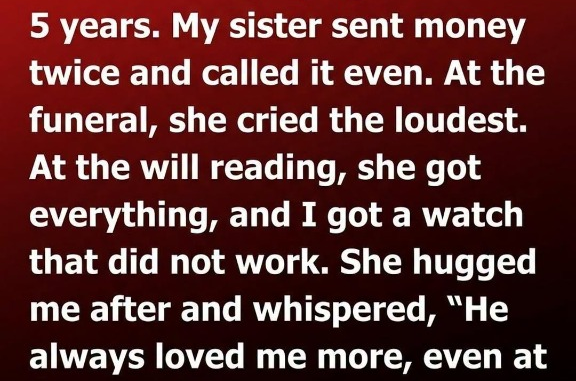
After spending five years caring for my father every single day, all I received was an old silver wristwatch with a cracked face that had stopped keeping time long ago.
My name is Clara.
When my father first became ill, I was thirty-two years old with a stable career, my own apartment, and a future I had carefully built. Doctors initially believed his condition could be managed, but months gradually turned into years. Before I realized how much my life had changed, I had moved back into my childhood home to become his full-time caregiver.
Vanessa lived several states away.
She mailed money twice—once for five hundred dollars and later another three hundred—always accompanied by messages telling me how strong I was.
The reality was far more demanding.
Insurance left us with over a thousand dollars in monthly expenses. There were medications to purchase, medical appointments to arrange, special meals to prepare, and countless sleepless nights when Dad called out in fear or pain.
I learned how to help him stand, which foods he could safely eat, and which old songs calmed him during his worst evenings.
Not long before he passed away, he squeezed my hand and quietly said, “You gave me something no one else could.”
“Your time.”
I smiled and told him that was simply what family did.
At the time, I believed that was enough.
During the funeral, Vanessa cried dramatically while relatives gathered around to comfort her.
I stood beside Dad’s casket in silence, too emotionally exhausted to display my grief for people who hadn’t witnessed the difficult years behind us.
A week later, everything became even harder.
Inside the lawyer’s office, I listened as nearly everything my father owned was left to Vanessa.
Afterward, surrounded by family in the hallway, she hugged me tightly for appearances before whispering, “He always loved me more.”
For nearly three weeks, I packed my belongings from a house that was no longer mine.
The broken watch sat untouched on the kitchen table, and I couldn’t understand why Dad had chosen to leave me something that no longer worked.
Then one rainy afternoon, there was a knock at the front door.
An elderly gentleman introduced himself as Harold Whitman.
“I’m your father’s attorney,” he said.
We sat together at the kitchen table.
He picked up the old watch, smiled gently, and explained that my father had wanted me to receive it first because he believed I understood that damaged things could still hold tremendous value.
Then Mr. Whitman opened a worn leather folder.
Inside was another will.
He explained that six weeks before Dad died, he had contacted him privately to prepare a new, legally witnessed version after realizing he wanted to correct several mistakes.
According to Mr. Whitman, Vanessa knew this document existed but hoped it would never be presented.
The earlier attorney had handled a version created after Vanessa convinced Dad that I was caring for him only because I expected an inheritance.
Once Dad recognized the misunderstanding, he chose to rewrite everything.
Vanessa would still inherit the family house because he knew it mattered deeply to her.
Everything else belonged to me.
His bank accounts.
A parcel of land he had quietly purchased decades earlier.
An investment portfolio he had patiently built throughout his working life.
The folder also contained insurance records, mortgage paperwork, tax documents, and estate files that clearly reflected his final wishes.
Before leaving, Mr. Whitman unfolded one final note written in my father’s shaky handwriting.
He explained that the watch had stopped the year my mother passed away.
He had never repaired it because, as he wrote, time may stop, but love never does.
When Vanessa learned about the second will, she reacted with anger.
She accused me of manipulating our father, threatened legal action, and insisted she would challenge everything.
I didn’t argue.
The documents spoke for themselves.
The will had been properly executed, witnessed, and legally valid.
For the first time in years, I refused to sacrifice my own peace simply to avoid conflict.
Eventually, Vanessa sold the house.
I used part of my inheritance to purchase a modest home with large windows, a small garden, and enough sunlight to fill every room with life.
I slowly returned to work, donated to the hospice staff who had cared for my father with such kindness, and began rebuilding the future I had placed on hold.
I also had Dad’s watch repaired.
The jeweler offered to replace the cracked crystal.
I asked him not to.
Now it rests on my wrist every day.
It keeps perfect time again, even with the crack still visible—a quiet reminder that although life can leave its marks, genuine love never loses its value.
Leave a Reply