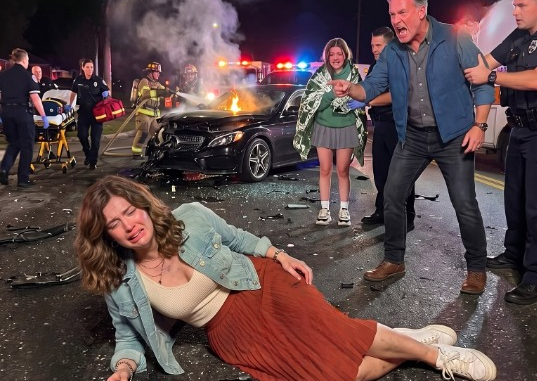
After our car accident, I was still trapped inside when my father shouted at the paramedics to save my sister first. Then he pointed at me and said, “The other one never really mattered. Don’t waste time on her.” I was conscious the entire time—I heard every word.
In the chaos of the crash, I was pinned in the passenger side of my father’s black Lincoln, my leg crushed beneath the twisted door as firefighters worked to cut me free. Smoke filled the air while red and blue lights flashed across the street, turning everything into a blur of sirens and emergency motion.
My younger sister, Olivia, was nearby, wrapped in a silver thermal blanket, crying out for our father. She was injured but still visible, still responsive. I could hear her voice, see her move.
But I couldn’t feel my lower body.
“Sir, step back,” a paramedic ordered sharply.
“My Olivia first!” my father yelled, his voice breaking—not with concern for me, but for her. “She’s all I have. Grace is—” He paused briefly, then said it anyway. “Grace doesn’t matter.”
One of the firefighters looked at me through the smoke, hesitation flickering in his eyes.
I wanted to tell him I mattered.
I wanted to tell my father everything I had done—working to support the family after Mom’s death, helping raise Olivia, sacrificing my education plans, carrying responsibilities no one saw.
But I couldn’t speak.
Everything had changed only minutes earlier.
We had been driving back from Aunt Meredith’s house when the car started to smell strange. Olivia wanted to stop somewhere, but Dad refused. When I mentioned the odor, he dismissed me. Then the engine failed.
And everything went dark.
“Grace, can you hear me?” a paramedic asked.
I blinked.
“We’re getting you out.”
I saw my father holding Olivia’s hand, reassuring her softly.
“You’re safe, sweetheart. I’ve got you.”
Olivia looked past him—at me.
For a moment, something shifted in her expression.
Not fear.
Not shock.
Something heavier.
Guilt.
That was when I remembered what she had said just before we got in the car:
“Grace, don’t be mad. I only told him because I thought he already knew.”
Told him what?
My plans to leave. The bank documents. The apartment I had secured. My decision to move out and start over.
The firefighters finally pulled me free.
My father never looked at me.
That night, I stopped being his ignored daughter.
I became a witness.
PART 2
I woke up three days later in St. Vincent Medical Center. My body was held together by stitches, tubes, and pain, and a police officer was stationed outside my room.
At first, I assumed it was standard procedure for the accident.
Then Aunt Meredith leaned in close and whispered, “Grace… don’t speak to your father alone.”
Her face looked drained, like she hadn’t slept in days. She held my hand tightly, as though letting go might make me disappear.
“What happened?” I asked, my voice dry and weak.
“You were badly injured,” she said.
“I know that.”
Her eyes shifted toward the hallway. “The police found something.”
Before she could explain, my father walked in carrying a small bouquet from the hospital shop—cheap flowers, the kind he used to bring my mother when he forgot something important.
“Gracie,” he said softly.
I stared at him.
He tried to smile, but it didn’t hold. “You really scared us.”
Us.
The word felt wrong.
Aunt Meredith stood up immediately. “Daniel, she needs rest.”
“I’m her father.”
“And I’m the one she asked for when she woke up,” she replied.
His expression tightened, just for a moment—enough for me to see the version of him I had heard at the crash site.
Then he softened again.
“Grace,” he said, stepping closer, “you may have misheard things that night. You were in shock. Olivia was hurt. I didn’t know what I was saying.”
But I remembered everything clearly.
“The other one never really mattered.”
My fingers curled into the blanket.
“I heard you,” I said quietly.
His gaze sharpened.
“You were confused,” he insisted. “You had a concussion.”
“I was awake,” I replied.
He glanced toward the officer outside, then lowered his voice. “This is a family matter.”
That was when Detective Keller walked in.
She didn’t introduce herself warmly. She spoke like someone who already had the facts.
“Grace Holloway,” she said. “I need to ask you about the vehicle when you’re ready.”
My father let out a short laugh. “She just woke up.”
“You can wait outside, Mr. Holloway,” Keller said calmly.
“I’m not going anywhere.”
The officer at the door stepped in.
After a tense pause, he left.
Keller closed the door behind him.
Then she said, “The crash was not an accident.”
My heart monitor spiked.
She opened her notebook. “The fuel line was tampered with. There was also an accelerant present under the vehicle. But here’s what matters—your father had the car inspected two days earlier. The mechanic warned him it was unsafe to drive.”
Aunt Meredith covered her mouth.
I stared at the ceiling.
He had known.
Keller continued, “Your sister says she doesn’t remember everything clearly.”
“She remembers,” I said quietly.
Both of them looked at me.
“She told him something before we left,” I explained. “She said she told him because she thought he already knew.”
“About what?” Keller asked.
“My apartment. My bank account. My plan to leave.”
Aunt Meredith exhaled shakily.
“I was leaving,” I admitted.
Keller’s expression changed slightly. “Did your father benefit from you staying?”
I thought about everything—money, control, dependency, obligations.
“Yes,” I said. “He did.”
PART 3
Detective Keller didn’t give me everything at once. She asked questions carefully, piece by piece, like she was assembling something fragile and dangerous.
Over the following days, while I relearned how to move without pain, the truth came in fragments.
First, the mechanic.
Peter Walsh confirmed that he had inspected the Lincoln and warned my father not to drive it due to a damaged fuel line.
“I wrote it on the invoice,” he said. “Unsafe to operate.”
My father had signed it anyway.
And still driven the car.
Next came the financial records.
My mother had left behind a structured settlement meant partly for me—protected until I turned twenty-one. My father had controlled it in the meantime, allowed only limited access for education or housing.
But investigators found repeated attempts to access funds he wasn’t entitled to.
All denied.
Then came Olivia.
At first, she avoided me. Then one day she finally entered my room, standing near the doorway like she wasn’t sure she belonged there.
“I didn’t mean for this to happen,” she said.
That was the first honest thing she said.
When I pressed her, the truth unraveled.
She admitted my father had found my transfer documents. She admitted she told him where I kept my paperwork. She admitted she thought he would only be angry—not that anything worse would happen.
“He just went quiet,” she whispered. “Then he started asking questions about where everything was.”
I understood then.
It wasn’t just anger.
It was control.
When she finished, I said, “When they ask you, tell the truth.”
She shook her head. “He said they’ll blame me.”
“Did you cause the crash?” I asked.
“No.”
“Then tell the truth.”
She left without answering.
Two days later, Detective Keller returned with a file.
“Your sister gave a statement,” she said.
I expected denial or confusion.
Instead, Olivia had told everything.
About my plans. About the documents. About my father’s reaction in the car before the crash. About the way he changed after reading my file.
Most importantly, she confirmed what he said that night.
“Grace always makes things sound worse than they are.”
That was enough.
The arrest came on a rainy morning.
I watched it from my hospital bed as the news showed my father being taken from our home in handcuffs. He didn’t look scared.
He looked offended.
At the first hearing, the prosecution laid everything out—the mechanic’s warning, the financial motive, the forensic evidence on the fuel line.
Then they played the bodycam recording.
His voice filled the courtroom:
“Save my daughter first — the other one never meant much anyway.”
I didn’t look at him while it played.
But I could feel the room shift.
When I testified later, my voice shook only once.
“I remember thinking I wasn’t going to survive,” I said. “And I remember realizing my father was okay with that.”
The defense tried to frame it as shock, misunderstanding, stress.
But the facts didn’t bend.
He was convicted.
Twenty-eight years.
When the sentence was read, he shouted—not in denial, but in disbelief.
“After everything I did for you!”
That was the last thing I ever heard him say as a free man.
Leave a Reply