PART 2
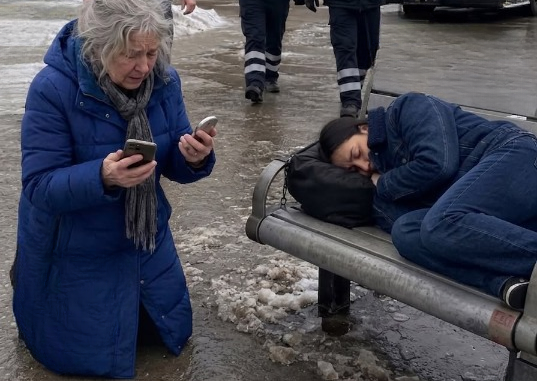
The security guard had run to retrieve the surveillance footage, and I remained beside Chloe until the paramedics arrived.
They moved quickly, asking questions while I answered every detail with the same precision I had used throughout my career.
Her name.
Her age.
Her injuries.
The time I found her.
The last person who had seen her conscious.
Everything mattered.
Every second mattered.
Because I knew something most people never learn until it is too late:
The first moments after a crime are where truth is either protected or lost.
The ambulance arrived within minutes.
The paramedics wrapped Chloe in thermal blankets, checked her injuries, and carefully lifted her onto the stretcher.
As they moved her, her eyes opened briefly.
For just a second, she looked like the little girl who used to run into my kitchen with scraped knees, certain that her mother could fix anything.
“I’m here,” I whispered.
She squeezed my hand weakly before they closed the ambulance doors.
I followed her to the hospital.
The ride felt endless.
The monitor beside her kept beeping, and I watched every number because numbers were easier to hold onto than fear.
At the hospital entrance, the nurses immediately began documenting everything.
I gave them the facts.
“Possible domestic assault,” I said. “Possible attempted homicide. Two identified suspects. Possible blunt-force trauma. Victim was abandoned in freezing conditions.”
The nurse paused briefly, then began writing faster.
Within minutes, Chloe’s injuries were being recorded.
Photographs were taken.
Medical reports were created.
A timeline began forming.
Evidence.
The one thing people like Marcus always underestimate.
Evidence.
A detective arrived while Chloe was being taken for scans.
He was younger than I expected, but he listened carefully.
I gave him everything.
Marcus’s early morning call.
The bus terminal location.
Chloe’s statement.
The missing shoe.
The missing wedding ring.
The possibility of surveillance footage.
The message Marcus had sent.
The photograph.
The detective studied the information quietly.
“Did you say he sent you a picture of his Thanksgiving dinner?”
“Yes.”
“Why?”
“Because he wanted to show me what he was doing instead of helping my daughter.”
The detective looked down at his notes.
Then he asked, “Was the dinner still happening?”
I already knew the answer.
“Yes.”
Of course it was.
People like Marcus did not cancel celebrations because someone else was suffering.
They simply moved forward and acted as if the damage did not exist.
At 7:26 AM, the first images from the bus terminal cameras arrived.
The detective opened the file.
The room became silent.
There was Marcus’s vehicle.
Marcus opening the passenger door.
Sylvia standing beside him.
Chloe barely able to stand.
Marcus walking away.
Then Sylvia bending down.
Not to help.
Not to comfort.
She was taking something.
The detective zoomed in.
“Her ring,” he said.
I nodded.
“She removed her wedding ring.”
He stared at the image for several moments.
“That changes things.”
“No,” I replied quietly.
“It reveals things.”
Then my phone rang.
Marcus.
I let it ring twice before answering.
“Eleanor,” he said immediately. “Where are you?”
I put the call on speaker.
The detective watched.
I said nothing.
Silence makes arrogant people nervous.
“What are you doing?” Marcus demanded. “Do not create a scene.”
Still nothing.
“Chloe embarrassed herself last night,” he continued. “She was emotional. She fell. She needs help, but not whatever story you’re trying to create.”
The detective’s expression changed.
Marcus kept talking.
“I have important people at my house today. If you show up here making accusations, I will make sure Chloe loses everything. She is unstable. I have witnesses.”
Then Sylvia’s voice appeared in the background.
“Tell that old woman she should be thankful we didn’t report her daughter first.”
The detective raised his hand slightly, signaling me to keep him talking.
So I asked one question.
“What happened to the rug, Marcus?”
He relaxed.
I could hear it.
He thought he was explaining himself.
“She bled on it,” he said.
The detective immediately wrote something down.
A confession.
A careless sentence.
The kind of mistake people make when they believe nobody important is listening.
For the first time that morning, I felt something close to relief.
Not happiness.
Not satisfaction.
Just certainty.
The truth was beginning to catch up.
At 8:03 AM, a supervisor arrived at the hospital.
He reviewed the evidence.
The medical reports.
The surveillance images.
The phone recording.
Chloe’s statement.
The photograph.
The timeline.
He asked the important questions.
Was there likely a weapon?
Yes.
Was there an injured victim?
Yes.
Were there signs of intimidation?
Yes.
Was there probable cause?
The detective looked at the evidence again.
“Yes.”
I knew my role had changed.
I was no longer the prosecutor.
I was the mother.
My job was not to control the case.
My job was to stand beside my daughter.
But before they left, I told the supervisor one thing.
“Marcus thinks nobody powerful is standing behind Chloe.”
The supervisor looked at me.
“He is about to learn he was wrong.”
At 8:41 AM, officers arrived at Marcus’s house.
Later, I learned what happened through reports and recordings.
The Thanksgiving dinner was still underway.
The turkey was on the table.
The candles were lit.
Guests were laughing.
And Chloe’s place at the table had been removed.
That detail stayed with me.
Because an empty chair tells a story.
But removing someone’s chair is an attempt to erase them completely.
Sylvia was cutting the turkey when the officers knocked.
At first, she assumed it was nothing important.
Marcus assumed the same.
Then the second knock came.
Stronger.
Official.
The room changed instantly.
Guests stopped talking.
Marcus stood up.
Sylvia told someone not to open the door.
Then the officers entered.
Calmly.
Professionally.
No chaos.
No shouting.
Just the truth arriving.
Marcus tried confidence first.
Then anger.
Then his reputation.
He talked about his position.
His career.
His connections.
But none of those things mattered anymore.
The evidence was already speaking.
The golf club.
The photographs.
The footage.
The medical records.
The phone call.
Sylvia tried a different strategy.
She claimed Chloe was unstable.
She claimed Chloe had attacked them.
She claimed I was confused.
Then the officer showed her the image from the terminal.
The moment she was taking Chloe’s wedding ring.
Everything changed.
Her expression went completely blank.
Because there was no explanation that could erase what the camera had recorded.
The ring was found inside her handbag.
The lie ended there.
The hospital called at 9:18.
Chloe had several broken ribs.
A concussion.
Internal injuries.
But she was alive.
That was the only word that mattered.
Alive.
I sat in the hallway afterward because my legs finally stopped cooperating.
For years, I had watched victims fight to be believed.
Now I understood what it felt like to wait outside a hospital room hoping someone you loved would open their eyes.
When Chloe woke later that afternoon, she looked at me and whispered:
“Did I ruin Thanksgiving?”
Those words broke me more than anything else.
Because that is what cruelty does.
It convinces the person who was hurt that they are the problem.
I held her hand.
“No, sweetheart,” I said.
“You didn’t ruin anything.”
“They did.”
She cried quietly.
Chloe was never someone who cried loudly.
Even her pain was private.
But that day, she finally let herself be held.
And I promised her something.
No one would ever make her feel disposable again.
The months that followed were difficult.
Justice did not arrive like a movie ending.
There were hearings.
Medical appointments.
Evidence reviews.
Legal meetings.
Protective orders.
Divorce proceedings.
Healing was slow.
But Chloe fought.
The same determination that helped her become an engineer helped her rebuild her life.
One day, she placed a folder on my kitchen table.
Everything was organized.
Police reports.
Medical records.
Timeline.
Attorney documents.
I looked at her and smiled sadly.
“You made a case file.”
She shrugged.
“I needed control over something.”
I understood.
I hated that she needed it.
But I loved that she found a way to take her power back.
Marcus eventually accepted a plea agreement.
The evidence left him nowhere to hide.
Sylvia continued blaming everyone else until the stolen wedding ring became impossible to explain.
The other woman claimed she did not know everything that happened.
Maybe she didn’t.
But she knew enough to sit at a table where someone else’s place had been removed.
And sometimes silence is its own decision.
Chloe healed slowly.
Some days were good.
Some days were not.
A loud noise could bring everything back.
A car door closing outside could make her freeze.
So we built new routines.
The porch light stayed on.
Tea before bed.
A spare key to my house.
A permanent seat at my Thanksgiving table.
The following Thanksgiving, Chloe brought sweet potatoes.
She intentionally made them too firm.
Then she challenged me to admit they were better than mine.
For the first time in a long time, she laughed.
A real laugh.
The kind I thought I might never hear again.
I looked around my kitchen.
The pies.
The cinnamon.
The warmth.
And for the first time, those memories belonged to joy again instead of fear.
People sometimes ask if I regret never telling Marcus about my past.
I don’t.
If he had known who I was, he might have hidden his cruelty better.
He might have been more careful.
Instead, he showed exactly who he was.
He believed my daughter had no one powerful enough to protect her.
He was wrong.
She had evidence.
She had the law.
And she had me.
When someone tried to erase my daughter’s voice, I made sure every camera, every report, every witness, and every courtroom heard her story.
Because Chloe was never garbage.
She was never disposable.
She was my daughter.
And she was always worth fighting for.
Leave a Reply