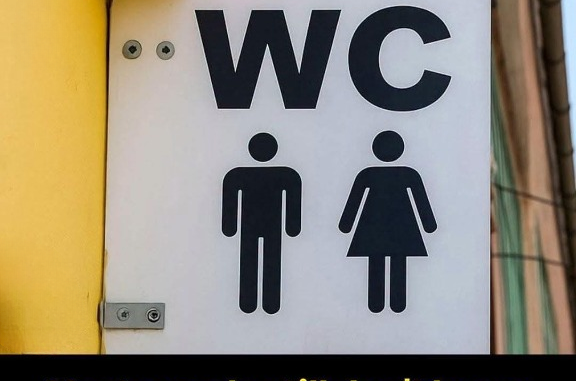
Have you ever spotted the letters “WC” on a restroom door and never wondered what they actually stand for? Every day, millions of people pass these familiar signs in airports, train stations, hotels, restaurants, shopping malls, and historic landmarks across the globe. The abbreviation has become so recognizable that most people instantly associate it with a restroom without thinking twice.
What many don’t realize is that those two letters trace back more than 150 years.
What Does “WC” Mean?
Contrary to popular belief, “WC” isn’t simply another word for bathroom.
It stands for “Water Closet,” a term that became widely used in the late 1800s as indoor plumbing began changing homes and public buildings. While the phrase may sound outdated today, it was once considered a symbol of modern convenience.
A Glimpse Into the Past
To understand where the name came from, it helps to picture life before indoor plumbing.
Throughout much of the 19th century, many homes had rooms reserved for bathing, but they lacked running water and flushing toilets. Bathing meant hauling water by hand, heating it, and filling a tub manually.
Toilets, meanwhile, were usually located outside in separate outhouses.
As plumbing technology advanced, builders needed space inside homes for the new flushing toilets. Instead of redesigning entire houses, they often converted small storage areas or narrow enclosed rooms into dedicated toilet spaces.
Since these compact rooms contained running water, they became known as Water Closets.
Eventually, the abbreviation “WC” appeared on doors, architectural plans, and public signs, becoming the standard label throughout much of Europe and many other parts of the world.
Why the Term Still Exists
Modern bathrooms are far different from the tiny water closets of the Victorian era.
Today, a single bathroom often includes a toilet, sink, shower, bathtub, and storage space. Even so, the abbreviation “WC” has remained in use for generations and can still be found on restroom signs in many countries.
It’s one of those familiar details people recognize without ever questioning its history.
A Social Media Surprise
Recently, the meaning behind “WC” resurfaced after videos explaining its origin went viral online.
Many viewers admitted they had passed the sign countless times without knowing what the letters actually meant.
Some were genuinely shocked, while others found it amusing that they had never thought to ask.
At the same time, plenty of people already knew the answer and were entertained to see such a common abbreviation suddenly become a trending topic.
The discussion served as a reminder of how often we overlook the ordinary things around us.
More Than a Restroom Label
The story behind “Water Closet” goes beyond language.
It reflects one of the most significant advances in public health and home design during the Industrial Revolution.
The arrival of indoor plumbing improved sanitation, reduced the spread of disease, and made everyday life far more comfortable than it had been for earlier generations.
What began as a practical solution to housing indoor toilets eventually became part of everyday vocabulary.
A Lasting Piece of History
The next time you notice “WC” on a restroom door, you’ll know it’s more than just a simple sign.
Those two letters are a lasting reminder of a time when indoor plumbing was a revolutionary innovation and installing a flushing toilet inside the home marked a major improvement in comfort and hygiene.
Although today’s bathrooms have evolved far beyond the original water closets of the 19th century, the abbreviation has endured—preserving a small but fascinating piece of history that millions of people encounter every day without realizing where it came from.
Leave a Reply