Part 1: A Medical Emergency on the Wedding Day
The morning of my sister-in-law Megan’s wedding began with a stabbing pain just below my ribs.
At first, I assumed the rich rehearsal dinner was to blame. My mother-in-law, Linda, had spent months insisting that absolutely nothing—bad weather, illness, traffic, or what she called “attention-seeking drama”—would be allowed to ruin Megan’s perfect Charleston wedding.
By midmorning, I could barely stay on my feet.
My husband, Daniel, found me curled up on the hotel bathroom floor, pale, shaking, and drenched in sweat.
“We’re going to the hospital,” he said without hesitation.
I argued weakly. Megan was his only sister. He was supposed to escort their widowed mother before the ceremony, and I was expected to stand beside the bridal party.
Before I could say anything else, I passed out.
Doctors quickly discovered that my appendix had burst. The infection was already spreading, and the surgeon explained that waiting any longer could have become life-threatening.
Daniel called Megan from the hospital. She cried but insisted he stay with me.
Linda’s reaction couldn’t have been more different.
She accused me of inventing the emergency because I couldn’t stand Megan being the center of attention. She demanded Daniel leave the hospital immediately and return to the wedding. When he refused, she stopped answering his calls.
My surgery lasted almost two hours.
When I finally woke up, Daniel was still beside me, wearing the same wrinkled suit he’d planned to wear to the wedding.
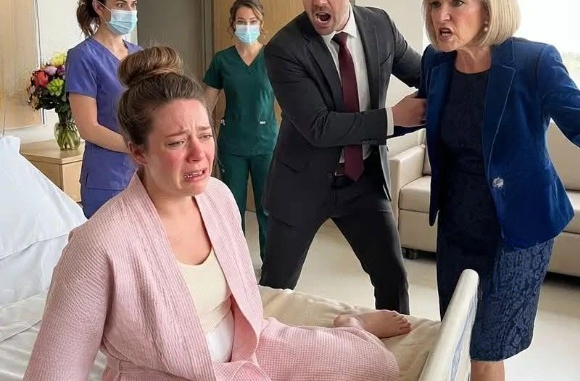
That evening, the hospital room door opened.
Linda walked in wearing her silver gown, mascara smeared and fury written across her face.
“You ruined everything,” she snapped.
Daniel stood immediately.
“Mom, leave.”
She ignored him.
“Megan walked down the aisle without her brother. Everyone kept asking where you were. Do you realize what you’ve done?”
I could barely speak because of the breathing tube that had recently been removed.
She leaned over me.
“Stop pretending.”
Without warning, she struck the area where I had just undergone surgery.
Pain exploded through my abdomen, and the monitors erupted with alarms.
Daniel grabbed his mother and pulled her away before she could get any closer.
“What is wrong with you?” he shouted.
Nurses rushed into the room. One called security while another checked my incision. The blow had disturbed the wound and shifted part of the drainage equipment.
For the first time, Linda looked shaken.
Daniel pointed toward the door.
“You just attacked my wife.”
When security arrived, Linda instantly changed her story.
“She grabbed me first,” she claimed. “I was defending myself.”
Daniel stared at her in disbelief.
“My wife just had emergency surgery. She can barely move.”
Doctors took me back into surgery to repair the damage.
After midnight, I woke once more to find Daniel still sitting beside my bed.
“They had to fix the incision,” he said quietly. “You’ll be here for several more days.”
Then I asked the question that had been on my mind.
“What happened to your mom?”
“The police arrested her.”
A nurse had witnessed everything, and hospital surveillance supported what had happened. My medical records documented the additional injuries and second procedure.
Soon afterward, calls from Daniel’s relatives began pouring in.
Some blamed stress from the wedding. Others said involving the police had embarrassed the family. Even Megan wondered whether everyone could simply describe the incident as a misunderstanding.
Daniel silenced his phone.
Part 2: The Story Linda Wanted Everyone to Believe
The next morning, Megan came to the hospital.
Her wedding hairstyle was falling apart, and she looked emotionally drained. Daniel remained standing protectively beside my bed.
“I didn’t know Mom was coming here,” she said.
Then she admitted Linda had spent the wedding telling guests that I had faked my illness so Daniel would skip the ceremony.
“I almost died from a ruptured appendix,” I whispered.
“I know,” Megan replied softly.
She apologized before asking the question she had really come to ask.
“Would you tell the prosecutor you don’t want to press charges?”
Daniel answered before I could.
“She hit Rachel’s surgical incision.”
Megan lowered her eyes.
“She was emotional.”
“She sent my wife back into surgery.”
“She’s still our mother.”
Daniel’s voice remained calm.
“And Rachel is my wife.”
Megan spoke about everything Linda had sacrificed after raising them alone. She worried about her mother’s reputation, finances, and what would happen if she were convicted.
Finally, I asked one question.
“If your husband’s mother attacked you after surgery, would you call it a misunderstanding?”
She couldn’t answer immediately.
Eventually she whispered, “No.”
After she left, Daniel admitted something he had avoided for years.
“I should have stopped this long ago.”
Linda had spent years criticizing everything about me—my appearance, my career, my cooking, even how often Daniel visited my family.
Whenever I complained, Daniel usually asked me to ignore her to keep peace within the family.
Now he finally understood the truth.
That peace had always depended on my silence.
“I’m done protecting her,” he said.
While I recovered, Linda’s relatives spread their own version of events online, painting me as manipulative and accusing Daniel of abandoning his grieving mother.
Our attorney advised us not to respond.
The hospital had surveillance footage, eyewitnesses, photographs, and medical documentation. Facts would matter far more than social media.
Several days later, Megan returned.
This time she wasn’t asking for favors.
“I watched the hospital video,” she admitted.
Linda’s lawyer had shown it to family members while preparing the defense. Although it didn’t capture every second inside the room, it clearly showed Linda approaching my bed, followed by my scream and hospital staff rushing in.
Megan also learned that Linda had stormed out shouting that I deserved what happened.
“I’m sorry,” she said quietly. “I cared more about my wedding than what she did to you.”
Then she shared something even more disturbing.
Weeks before the wedding, Linda had already been telling relatives that I would fake a medical emergency to steal attention from Megan.
When the real emergency happened, everyone had already been conditioned to doubt me.
Linda had built the narrative long before the truth unfolded.
Prosecutors later offered her a plea agreement requiring counseling, restitution, probation, and acceptance of a permanent no-contact order.
She refused.
She believed Daniel would eventually forgive her.
He didn’t.
“No contact means exactly that,” he told her.
Part 3: The End of Linda’s Control
Linda rejected the plea deal because she believed Daniel would eventually give in.
For years, that tactic had always worked.
Whenever she cried, blamed others, or reminded her children of her sacrifices, someone always apologized.
This time was different.
Instead of surrendering, Daniel started therapy.
He realized his mother had trained both him and Megan to treat her emotions as everyone’s responsibility.
Whenever she became angry, everyone gave in.
Whenever she felt hurt, someone else accepted the blame.
Megan eventually sought counseling as well.
Her husband, Caleb, reminded her that protecting a parent should never come before protecting your marriage or your own values.
Gradually, she stopped defending Linda too.
Without either child standing beside her, Linda’s influence faded.
She persuaded relatives to pressure Daniel, but he blocked every number.
When one uncle appeared at our house demanding reconciliation, Daniel spoke through the closed door.
“Leave now, or I’ll call the police.”
There were no more arguments.
Only firm boundaries.
Four months later, the case went to trial.
Linda’s attorney argued that my medication affected my memory and suggested the hospital room had been chaotic enough that perhaps she struck the bed rather than me.
Then the evidence was presented.
My surgeon testified that my incision had been stable before Linda entered the room.
The attending nurse described exactly what she witnessed.
Hospital surveillance confirmed Linda’s aggressive behavior.
But the strongest evidence came from Linda herself.
A police officer’s body camera recorded her saying that because I had ruined the wedding, she had finally given me “something real to cry about.”
The courtroom fell silent.
Megan later testified about the accusations Linda had made before the wedding and admitted her mother had spent weeks convincing relatives that I planned to sabotage the ceremony.
She also admitted something heartbreaking.
“She never once asked how Rachel was after the second surgery.”
The jury found Linda guilty.
At sentencing, she still refused to apologize, insisting it had been one emotional mistake.
The judge disagreed.
He explained that walking into a hospital room, confronting a recovering patient, and physically striking her were deliberate choices—not a momentary accident.
Linda received a jail sentence followed by probation, was ordered to repay my medical expenses and lost wages, and a permanent protective order was granted.
As deputies escorted her away, she looked at Daniel.
“You’re really letting them take your own mother?”
Daniel never looked away.
“You did this to yourself.”
Healing physically took weeks.
Healing emotionally took much longer.
Daniel joined me in counseling and accepted responsibility for every time he had asked me to tolerate his mother’s behavior rather than confront it.
He couldn’t erase the past.
He could only choose differently moving forward.
And he did.
Over time, Megan and I rebuilt our relationship.
One year after the wedding, she and Caleb hosted a quiet anniversary dinner.
Before dessert, she raised her glass.
“To the people who stand by you when it matters.”
Daniel squeezed my hand beneath the table.
For years, Linda ruled the family because everyone believed resisting her was harder than giving in.
She expected Daniel to surrender.
She expected Megan to defend her.
She expected me to stay silent.
This time, every one of us proved her wrong.
Her control didn’t end with her conviction.
It ended the moment her family refused to pretend she was the victim anymore.
Leave a Reply