I always believed love meant showing up, even when it wasn’t returned. Looking back now, I understand the hardest part of my story didn’t begin with heartbreak, but with the moment everything I thought I knew was turned upside down.
When I married David, I understood there was one condition I couldn’t avoid: his 13-year-old daughter, Emily, had lost her mother to cancer two years before I arrived. I told myself patience would be enough, that love would eventually bridge the gap. I promised I would treat her as my own.
But Emily made it clear she had no intention of accepting me.
I packed her lunches with little notes tucked into napkins. I stayed up late sewing her a witch costume after she “forgot” to mention a school event until the last minute.
She would throw the notes away without reading them. I only found out through a friend’s mother, who mentioned it carefully over coffee.
One afternoon, she said flatly, “I’m only nice to you because Dad makes me.”
I tried to stay calm.
“That’s okay. You don’t have to be nice. Just be honest.”
She looked at me and said, “Fine. Then you’re just the replacement.”
That word stayed with me.
Over time, my efforts often went unnoticed or were undone. Meals I cooked ended up ruined or discarded. A birthday cake I made for David was knocked off the counter.
Still, I kept showing up.
I drove her to activities, attended performances, bought what she needed before she asked, and supported her at every milestone. David saw it and held onto hope that things would improve.
They didn’t.
Then, years later, David suffered a sudden heart attack at work. By the time I reached the hospital, it was clear there was little that could be done.
Before he passed, he held my hand and asked me not to give up on Emily. He told me she wasn’t angry at me, but at the loss of her mother.
He began to say there was something unfinished—something meant for me—but didn’t finish. His last words were, “Emily knows. Ask Emily.”
After he died, Emily sat waiting in the hospital, withdrawn and unreadable. I almost spoke to her about what he said, but something in her expression stopped me.
The morning after the funeral, I found her packing to leave. She said coldly that there had never been a “we” between us and walked out, warning she would never return as long as I lived in the house.
Five years passed in silence. I left messages on holidays and kept the house unchanged, preserving both David’s workshop and Emily’s room as they were.
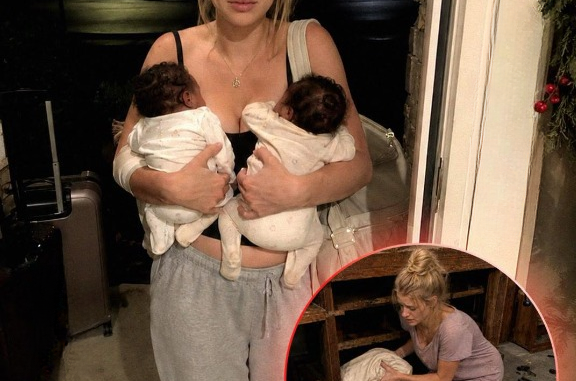
Then one night, she suddenly appeared at my door—with two newborn twins. She had nowhere to go after being thrown out by her boyfriend.
I brought her inside without hesitation.
Life quickly became overwhelming: sleepless nights, crying babies, endless care. Emily stayed distant but polite.
One day she left the house to rest, and I took the babies out for a walk.
Partway through, I realized I’d forgotten something and returned home.
That’s when I noticed Emily was missing.
I heard noise coming from David’s old locked workshop—the same room that had been untouched for five years.
Inside, the lock had been broken. Tools and drawers were scattered everywhere.
Emily was there, holding a wrapped bundle tightly. She told me it belonged to me and that her father had asked her to give it to me the day he died—but she had hidden it all this time.
Inside the bundle was a wooden box containing a letter in David’s handwriting, a restored wedding ring, and a property deed for a cabin in my name.
Emily explained that David had entrusted her with the items, but she was too overwhelmed by grief to face the workshop or deliver them. Only years later, after becoming a mother herself, did she finally return to fulfill his request.
We both broke down as the truth came out, and I read David’s letter aloud, in which he expressed love for both of us and his wish for a family that truly belonged together.
Afterward, I held Emily as she cried, and something between us finally softened.
Months later, life had changed completely. The house was filled with noise, children’s laughter, and daily chaos.
One day, Emily called me “Mom” without realizing it.
And in that moment, it felt like everything David had left behind—his letter, the ring, the cabin—had led to something greater than any of it.
It led to her.
Leave a Reply