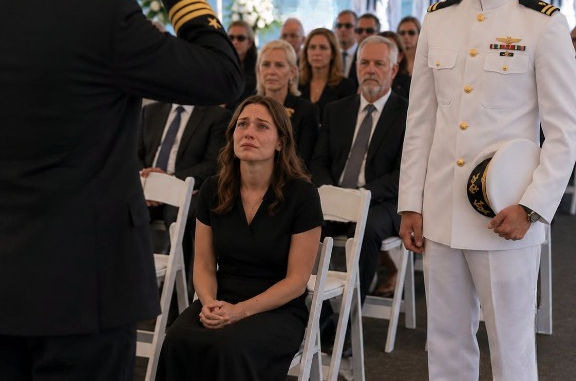
The day my family ridiculed me at my brother’s Trident ceremony, I chose not to argue or explain myself. I had spent the entire night driving to Naval Amphibious Base Coronado because I wanted to be there for Ryan’s important moment. I wasn’t looking for attention—I only wanted to quietly support my younger brother.
Instead, I was met with judgment.
My mother glanced at my black dress with disappointment. My father made a subtle joke under his breath. Other relatives whispered that I didn’t belong among the family guests. Ryan stood nearby in his uniform, proud and accomplished, but he didn’t defend me.
He simply warned me not to make things uncomfortable.
I could have told them everything.
I could have explained who I really was and why I was there.
But I stayed silent.
Some truths don’t need to be announced. They reveal themselves when the time is right.
For most of my life, my family had viewed Ryan as the one who could do no wrong. He was the child they celebrated, while I became the daughter they struggled to understand.
When I left college and chose to join the Navy, they assumed I had made a mistake. Because I couldn’t talk openly about certain parts of my work, they interpreted my silence as a sign that I had failed.
Ryan became the source of family pride.
I became the person they questioned.
But despite everything, I still showed up for his ceremony.
Because underneath all the disappointment and distance, he was still my little brother.
I remembered the little boy who once asked me if being scared meant he wasn’t brave. I remembered telling him that courage wasn’t the absence of fear—it was choosing to move forward anyway.
As the ceremony began, my relatives continued whispering.
Then something unexpected happened.
A Navy commander stepped away from the front of the tent and walked directly toward me.
The atmosphere changed immediately.
The conversations stopped.
My mother’s expression disappeared.
My father straightened in his seat.
Ryan looked confused.
The commander stopped in front of me, stood at attention, and gave me a formal salute.
Then he explained something my family never knew.
I wasn’t supposed to be sitting in the general family section.
My name was included in the official ceremony notes as Lieutenant Commander Emily Carter, a distinguished guest being recognized for contributions that had supported significant Naval operations.
The silence that followed was overwhelming.
My family suddenly realized they had spent years judging someone they never truly tried to understand.
I was escorted to a reserved seat closer to the stage while the commander explained that not all service is visible. Some people serve in ways the public never sees, but that does not make their contributions any less meaningful.
Ryan still received his Trident.
And I applauded for him.
His accomplishment mattered, even though the morning had been painful.
After the ceremony, Ryan approached me and apologized. He admitted that he had allowed others to make me feel like an outsider when he should have stood beside me.
My parents struggled to express what they were feeling, but for the first time, I saw something different in their faces.
They finally saw me.
I arrived at that ceremony as the sister everyone underestimated—the one they believed didn’t belong.
I left as the woman whose name had been honored on the official list all along.
Leave a Reply