When the Same Marriage Rules Finally Applied to Both of Us
Marriage is often shaped by countless small decisions and compromises. At first, they may seem harmless. But over time, those choices can quietly become expectations—and expectations can slowly transform into unfair patterns that no longer feel like a partnership.
That is what happened to Nadia, a 43-year-old mother of two, who found herself questioning the balance of her marriage after a long-standing family tradition was suddenly challenged.
Nadia’s Story
My husband and I have been married for eight years, and together we have two young children.
Throughout our relationship, family visits always followed the same routine.
Nearly every holiday, school vacation, and extended weekend was spent with his parents.
Because they lived farther away, each visit required planning and usually meant staying several days. Once plans were made, changing them was almost never an option.
My parents, however, lived much closer.
Yet somehow, we spent far less time with them.
Our visits were often brief, rushed, or canceled because of reasons that always seemed understandable at the time. But deep down, it never felt equal.
As the years passed, my parents watched their grandchildren grow from a distance, while my husband’s parents became involved in nearly every important moment of their lives.
Whenever I tried to talk about the imbalance, my husband would respond the same way.
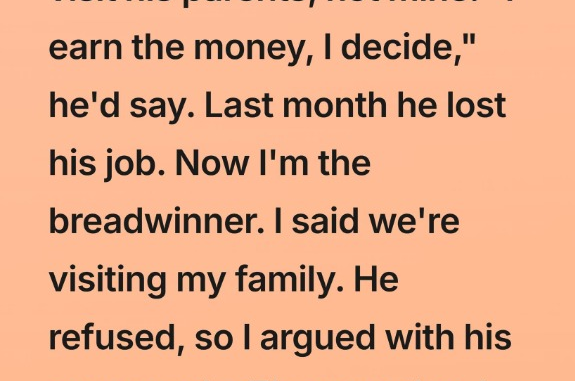
“I’m the one providing most of the income,” he would say. “So I should have the final say.”
Because he earned more money than I did, he believed that gave him greater authority over family decisions.
Eventually, every conversation ended the same.
And eventually, I stopped fighting.
Not because I thought he was right.
Because I was exhausted.
I didn’t want every disagreement about money to turn into another battle inside our home. So I accepted the arrangement, even while watching my own parents feel increasingly disconnected from their grandchildren.
Over time, I carried the frustration quietly.
I planned every trip.
Packed every bag.
Bought every gift.
Made every difficult phone call explaining why we couldn’t visit my family.
Meanwhile, our children naturally formed a much stronger bond with one set of grandparents simply because they saw them more often.
I kept hoping things would eventually become more balanced.
But they never did.
Then Everything Shifted
Last month, my husband unexpectedly lost his job.
The change affected him deeply.
For years, being the main provider had influenced how decisions were made in our household. Suddenly, that source of control and confidence disappeared.
As the holidays approached, I suggested something different.
I wanted us to spend this year’s celebration with my parents.
It wasn’t meant as revenge.
It wasn’t meant to punish anyone.
I simply wanted fairness.
His response was immediate.
No.
The speed of his answer surprised me. It was as if nothing about our situation had changed.
That was when I calmly replied:
“I’m just using the same rule you’ve always used. I’m the one earning more now.”
The room became completely quiet.
I watched him process what I had said.
The same reasoning that had seemed acceptable when it benefited him suddenly sounded very different when the situation was reversed.
Years of Resentment Finally Surfaced
What happened next was not really about one holiday.
It became a discussion about everything we had avoided for years.
Eight years of decisions.
Eight years of feeling unheard.
Eight years of believing my opinions mattered less because my paycheck was smaller.
We spent hours talking about frustrations that had been building beneath the surface.
Then, the following day, something unexpected happened.
When I came home from work, I saw suitcases sitting near the front door.
My husband was leaving.
He told me he was going to stay with his parents.
“If you’re going to make me look bad like that, I’m done,” he said.
I was completely shocked.
I hadn’t shouted at him.
I hadn’t brought the children into it.
I hadn’t insulted him.
I had simply reflected the same logic he had used throughout our marriage.
Yet hearing those words returned to him seemed impossible for him to accept.
Now I’m Left Wondering
Since he left, I’ve replayed everything in my mind.
Was this truly about where we spent one holiday?
Or was it about losing the ability to make decisions alone?
Was our marriage actually built on teamwork and mutual respect?
Or did it only work because one person had more financial power?
What happens when the person with less power suddenly gains more?
I honestly don’t know if he will return.
I don’t know whether I should apologize for finally asking for equal treatment or recognize that this argument exposed a deeper problem that existed long before this moment.
Our Thoughts
Nadia’s experience reveals an important lesson about relationships.
A Marriage Should Be a Partnership, Not a Power Structure
Money matters, but income should never determine whose opinion carries more importance. Decisions involving children, family traditions, and shared life choices should come from respect and cooperation.
Financial Circumstances Can Change—Respect Should Remain
Jobs disappear.
Salaries change.
Careers take unexpected turns.
But when money becomes a way to control decisions, resentment often grows quietly until even small disagreements become major conflicts.
Walking Away Doesn’t Fix the Real Issue
When children are involved, leaving during conflict rarely solves the underlying problem. It often delays conversations that still need to happen.
Sometimes Outside Support Can Help
Long-term relationship patterns can become so familiar that couples stop noticing them. Counseling can help partners identify unhealthy habits and rebuild communication.
Both Families Deserve Space
Children benefit from meaningful relationships with both sides of their family. Creating balance allows them to feel connected to their entire support system.
In the end, this story may not really be about holidays.
It may be about a deeper question every marriage eventually has to answer:
Are we truly equal partners?
Or are we only comfortable when the arrangement favors one of us?
Leave a Reply