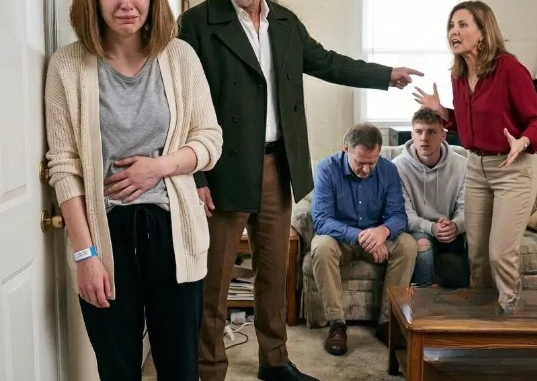
I came home after surgery holding my discharge papers in one trembling hand and a pharmacy bag tucked under my arm. The anesthesia hadn’t fully worn off yet—my body felt heavy and unsteady, my mouth tasted like metal, and every step from the driveway to the porch pulled sharply at the stitches beneath my clothes.
Right behind me, Adrian Vale closed the car door quietly.
He wasn’t part of my family, not even someone they knew. In Boston, his name was tied to hospital systems, legal reports, and charity foundations—he ran Vale Medical Group and chaired multiple medical nonprofits. He was also the man who personally approved my emergency surgery when my insurance stalled and the person who stayed with me when I collapsed outside a clinic two nights earlier.
To me, he was a stranger who refused to walk away when I needed help most.
I pushed the front door open.
The smell of fried onions and stale air hit me immediately.
My mother, Linda Hart, looked up from the couch and didn’t ask how I was or why I looked pale and unsteady. Instead, she said sharply, “You’re back. Stop pretending and make dinner.”
My brother Kyle leaned back with his feet on the coffee table and scoffed. “Yeah, don’t fake being tired to skip chores.”
My father sat in his recliner, eyes on the muted TV. He glanced at me briefly, then looked away without a word.
I stood there, barely able to stay upright, too exhausted to argue.
Then Adrian stepped inside.
Everything in the room changed instantly.
My mother froze mid-sentence. Kyle slowly lowered his feet. My father straightened as if startled into awareness.
Adrian wore a dark coat and carried himself with calm certainty. His gaze moved across the room—dirty dishes, cluttered counters, and finally me, struggling to stand.
Then he looked at my mother.
“Mrs. Hart,” he said evenly, “your daughter was discharged less than two hours ago after abdominal surgery. She has twenty-seven stitches, a high risk of complications, and strict instructions not to cook, clean, lift, or climb stairs without assistance.”
My mother blinked. “And you are…?”
“The person who drove her home because no one in this house answered the hospital calls.”
Kyle laughed under his breath. “She’s fine. Maya always exaggerates—”
Adrian turned his gaze to him.
Kyle stopped immediately.
Adrian placed several documents on the coffee table—discharge papers, call logs, and nurse notes confirming repeated failed contact attempts with my family.
My father’s face went pale.
“Explain to me,” Adrian said calmly, “why a post-surgical patient walked into this home and was told to cook dinner.”
No one answered.
The silence felt heavier than the room itself.
My mother recovered first. “This is a family matter. Maya knows how things work here.”
Adrian looked at me. “Do you?”
The question landed harder than any accusation.
My throat tightened. I had spent years swallowing discomfort, covering for them, and pretending things were normal because it was easier than confrontation. But pain cut through that habit now—real, physical pain from my surgery—and I finally spoke.
“No,” I said quietly. “He isn’t overreacting.”
My mother stared at me like I had betrayed something unspoken.
Kyle muttered, “So now you’re siding with him?”
“I’m not siding with anyone,” I said. “I just had surgery. I called all of you. No one answered. I woke up alone. He stayed. And the first thing you told me to do was cook.”
My mother’s voice sharpened. “After everything I’ve done for you—”
“What exactly did you do today?” I asked.
Silence followed.
Adrian stepped in again, calm but firm. “Maya has two options tonight. She can stay here under strict medical compliance, or she can go with me to a monitored recovery facility with nursing support.”
My mother bristled. “You’re taking her away?”
“She arrived here unable to stand and was given chores instead of care,” Adrian replied. “Don’t confuse concern with control.”
Dizziness hit me suddenly.
“Maya?” Adrian said immediately, steadying me.
“I need to sit,” I whispered.
He guided me into a chair.
“Get her water,” he told Kyle.
Kyle hesitated.
Adrian’s expression didn’t change.
Kyle moved.
Then Adrian crouched slightly so he was at my level. “You decide. Not them.”
Something inside me shifted. For the first time, I wasn’t being managed or dismissed.
I looked around the room that had shaped my entire life—where silence was normal and exhaustion was expected.
And I said, “I want to leave.”
My mother stiffened. “You’re being emotional.”
“I’m being honest,” I said.
Kyle scoffed. “So you’re just leaving with some wealthy stranger now?”
Adrian answered before I could. “She’s being transferred to a medically supervised recovery residence. Everything is arranged and documented.”
My father stepped forward weakly. “Maya, maybe we should talk—”
“You always say that,” I said.
He stopped.
Adrian calmly arranged transport and requested a civil standby for me to collect my belongings safely. My mother called it “betrayal.” My brother called it “drama.” My father said nothing that mattered.
When I left, the house behind me felt smaller than I remembered.
At the recovery residence, a nurse checked my vitals, gave me medication, and brought me food I didn’t have to justify needing. The room was quiet. No criticism. No demands.
Before leaving, Adrian said, “Tonight, you just rest.”
And for the first time in a long time, I did.
Leave a Reply