When I woke up after three days at St. Mary’s Hospital in Portland, the first thing I reached for wasn’t the call button, water, or my phone—it was my left hand.
My engagement ring was gone.
Panic hit so hard the heart monitor spiked instantly. A nurse rushed in, followed by Daniel, who tried to calm me down. I had been admitted after collapsing at work from severe internal bleeding, and I remembered fragments of it all—sirens, bright lights, my mother crying outside the operating room.
I also remembered handing my mother my ring before surgery.
“Keep it safe,” I’d whispered, trusting her.
When I asked Daniel about it, his expression tightened.
“I called her,” he said. “She told me not to worry.”
That should have been enough to worry me.
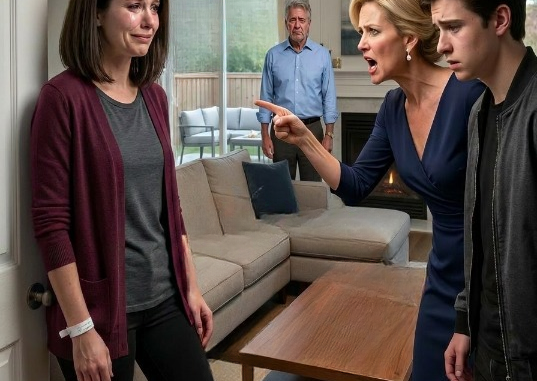
A week later, after I was discharged, Daniel drove me to my parents’ house to pick up clothes. What I saw outside stopped me cold: tents on the lawn, gold balloons, caterers, speakers, and a giant banner reading “CONGRATULATIONS, AIDEN!”
My brother was celebrating a music “launch” funded entirely by fantasy and convenience.
My mother greeted me in a champagne dress, smiling like she had just won something.
When I immediately asked about my ring, my father avoided my gaze. My brother just smirked.
Then my mother said it casually, like it meant nothing.
“We sold it. It was excessive anyway. Your brother needed the opportunity.”
For a moment, I couldn’t even speak.
Then I laughed.
And when they asked why, I looked at Daniel—and he was smiling too.
Then I said it:
“The ring you sold was fake.”
The room froze.
My brother demanded to know what I meant. My mother insisted I was lying.
I explained calmly: the real ring had been in a safety deposit box since two days after the proposal.
She refused to believe it—until Daniel spoke up.
“The jeweler called me,” he said. “The one who bought it.”
My mother’s confidence cracked.
He added that the buyer, Victor Hale, was known for handling questionable goods.
Panic flickered across her face, but she still tried to justify it.
“I did it for the family,” she insisted.
But the truth was clear: she hadn’t protected anything—she had stolen from me.
Daniel placed a police report on the table.
Outside, a patrol car arrived.
For the first time, she had no control over the situation.
The officers didn’t arrest her immediately—they investigated. Statements were taken. Evidence was shown. My father eventually admitted she had taken the ring from the hospital and dismissed it as something I “wouldn’t miss.”
By the next day, the buyer returned the fake ring and confirmed the transaction details.
Every part of her plan began to collapse.
Not just the ring, but the entire party she had funded with it.
My father later told her to leave the house.
My mother spent the following days sending messages filled with blame, guilt, and accusations, until I finally blocked her after she told me I should be grateful the ring had been “useful.”
Days later, my brother came to see me, exhausted and ashamed, admitting he hadn’t known at first—but acknowledging he hadn’t stopped it once he did.
That was the final fracture.
Eventually, I moved forward.
I married Daniel quietly in a small garden surrounded by a few people who actually cared about me. No spectacle, no performance, no family chaos.
I wore the real ring on my finger.
Later, Daniel asked if I had any regrets.
I looked around at the people who stayed, then at the space where my family no longer was.
“Only one,” I said.
He asked what it was.
I smiled faintly and said:
“I should have bought the fake one sooner.”
Leave a Reply