When I opened the guest bedroom door at my mother-in-law’s house, I found my eight-year-old daughter curled in the corner, sobbing into a pile of her own cut hair.
For a few seconds, my brain refused to accept what I was seeing.
Meadow’s long golden curls—her pride, the hair she’d cared for since preschool, the “princess promise” she loved so much—were scattered across the beige carpet in uneven clumps. Purple ribbons I had tied that morning were still tangled in some of the strands. Others stuck to her tear-streaked face and clothes like something torn away in a struggle.
And she was nearly bald.
Not carefully trimmed, not gently cut—uneven, jagged stubble covered her head, with irritated marks and a thin line of dried blood near her ear.
“Meadow?” I whispered.
She looked up.
And something in me broke—not loudly, not dramatically, but in a cold, final way that left no space for denial.
Behind me stood Judith Cromwell, holding electric clippers and a trash bag like she had just finished a routine task.
“She needed a lesson,” she said calmly.
“A lesson?” I repeated.
Judith didn’t flinch. “She was becoming vain. Always admiring herself. A child who cares too much about appearance becomes shallow.”
I stared at the clippers. “You shaved my daughter’s head.”
“I corrected her,” she replied. “Something you and Dustin failed to do.”
Then she added that she had already spoken to my husband—and that he had approved it.
That was the moment everything inside me went still.
When I reached Meadow, she collapsed into me, shaking so hard she could barely breathe. Judith dismissed it as “just hair,” insisting it would grow back.
But Meadow’s voice finally broke through as she whispered, “Daddy said yes.”
Those words said everything.
In that moment, I understood this wasn’t just about a cruel act—it was about a pattern I had ignored for years. Judith believed control was discipline. My husband called it “keeping the peace.” And my daughter was the one paying for it.
I took Meadow and left that house immediately.
At home, my husband didn’t ask if she was okay. He only said I was overreacting and defended his mother’s “intentions.” That was when I realized he had already chosen a side long before that day.
Meadow stopped speaking much after that. She avoided mirrors, refused school, and slept in a hat to hide what had been done to her. A doctor later confirmed signs of trauma, and I was told to document everything.
So I did. Photos. Medical reports. Every piece of evidence I could gather.
And I left.
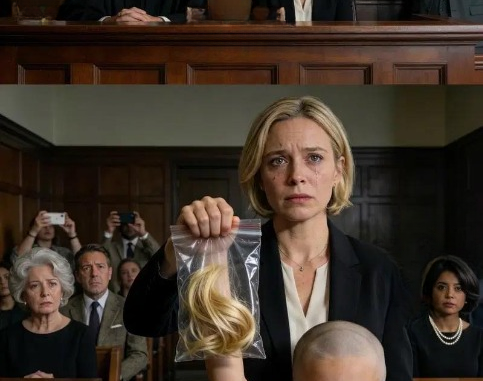
In court, my mother-in-law called it “discipline.” My husband said he “trusted his mother.” Neither understood what the judge made clear that day: a child had been harmed by the very people meant to protect her.
A protection order was granted. My marriage didn’t survive it.
We rebuilt our lives in a small apartment, just me and Meadow. Slowly, she began to heal. Her hair started to grow back. She stopped flinching when I touched her head. She learned to laugh again.
One night, while I braided her hair, she looked at herself in the mirror and said quietly, “I’m valuable even without it.”
That was when I knew something important had returned to her—something no one had managed to take away completely.
Not just her hair. Her sense of self.
Leave a Reply