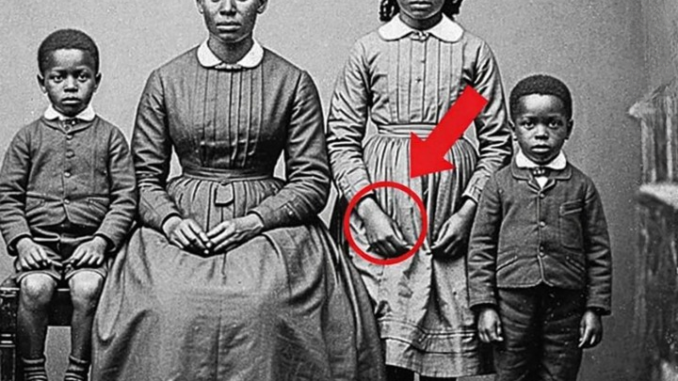
At first, it looked like any other old family photograph: a formally posed couple, their children carefully arranged, all wearing serious expressions shaped by the long exposure times of the era. Yet a subtle, nearly invisible detail caught the eye—and in that moment, the image shifted from a simple portrait into something far more meaningful. Hidden in plain view was a quiet trace of a story long buried, waiting to be discovered.
The photograph itself seemed unremarkable—a sepia-toned portrait from 1872. A couple sat stiffly before a wooden backdrop, surrounded by five neatly positioned children dressed in their best clothes, their faces calm and unsmiling. Countless images like this exist, often preserved but rarely examined beyond their surface.
But this one held something more.
The Detail That Changed Everything
Over a hundred years later, historian and archivist Sarah Mitchell was scanning the image at high resolution. Instead of focusing on the faces, her attention drifted to the wrist of a young girl near the center. There, faint circular marks formed a pattern—too exact to be wrinkles in fabric, too intentional to be damage caused by age.
These weren’t imperfections in the photograph. They were marks left on a person.
As Sarah looked closer, the photograph transformed from a keepsake into evidence—evidence of a life shaped by confinement, control, and fear, and of a moment marking change.
Near the edge of the image, a faded studio stamp could just be made out. Two words stood out: “Moon” and “Free.” This clue led Sarah to Josiah Henderson, a photographer known for capturing portraits of formerly enslaved African American families after the Civil War—people seeking recognition, visibility, and proof of their lives.
A Name Restored
Gradually, the story came together. Census data, church records, and property documents revealed the family’s identity: the Washingtons. James, the father, lived in Richmond with his wife Mary and their five children in the early 1870s.
The girl with the marked wrist was named Ruth. Records indicate the family had lived through slavery before emancipation. Children were often restrained to prevent escape, and the marks on Ruth’s wrist bore silent witness to that past—even as the photograph captured her in freedom.
Yet the image also tells a story of perseverance. After gaining freedom, James worked tirelessly to provide for his family. Mary took on whatever work she could find. Their children learned to read and write—abilities once denied to them. Ruth grew up carrying both the pain of the past and the promise of a different future.
A line preserved in the family Bible endured through generations:
“My father wanted us all in the picture. He said the image would outlast our voices.”
From Silence to Memory
Today, the photograph is no longer unknown. It is featured in an exhibition honoring families rebuilding their lives after slavery. What once seemed like an ordinary portrait now stands as a powerful symbol of resilience, dignity, and unity.
Ruth’s hand remains a quiet focal point. It does not demand attention or speak loudly. It simply exists—a reminder that history often reveals itself through the smallest details.
Sometimes, a single overlooked mark can shatter generations of silence. And sometimes, one photograph becomes more than a record—it becomes a voice finally heard.
Conclusion
This image shows that even the smallest details can carry profound meaning. A simple act—preserving a photograph or noticing something easily missed—can echo across time. Within those quiet details lie stories of endurance, humanity, and hope, waiting to be recognized, remembered, and honored.
Leave a Reply