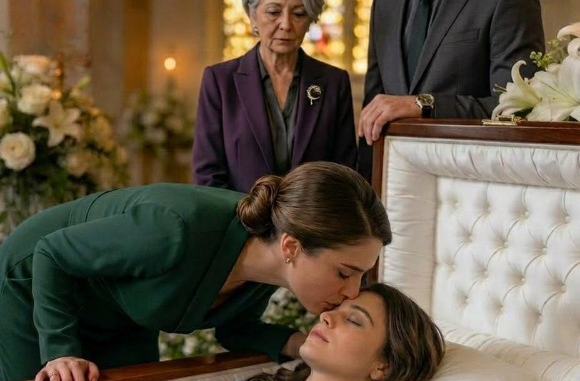
Just as the service reached that fragile, suspended moment, the church doors swung open.
The sharp click of heels echoed across the marble floor—too loud, too cold, completely out of place.
I turned.
My son-in-law, Ethan Caldwell, walked in laughing.
Not slowly. Not respectfully. Not even pretending to grieve. He strode down the aisle like he was arriving at a celebration instead of a funeral.
He wore a perfectly tailored suit, his hair immaculate. On his arm was a young woman in a striking red dress, smiling far too confidently for someone standing before a coffin.
The room shifted. Whispers rippled. Someone gasped. Even the priest faltered mid-sentence.
Ethan didn’t care.
“Traffic was awful,” he said casually, as if he’d just shown up late to lunch.
The woman beside him glanced around with idle curiosity, like she was taking in a new venue. As she passed me, she slowed—almost as if she might offer sympathy.
Instead, she leaned in and whispered, her voice icy:
“Looks like I won.”
Something inside me shattered.
I wanted to scream. To drag her away from that coffin. To make them both feel even a fraction of what my daughter had endured.
But I stayed still.
I clenched my jaw, fixed my gaze on the casket, and forced myself to breathe—because if I spoke, I knew I wouldn’t stop.
Weeks earlier, my daughter, Emily Carter, had come to see me… wearing long sleeves in the middle of summer.
“I’m just cold, Mom,” she said.
I pretended to believe her.
Other times, her smile was too bright—her eyes glassy, like she had cried and quickly wiped it away.
“Ethan’s just stressed,” she would say, as if repeating it could make it true.
“Come home,” I begged. “You’re safe with me.”
“It’ll get better,” she insisted. “Now that the baby’s coming… everything will change.”
I wanted to believe her.
I truly did.
Back in the church, Ethan dropped into the front pew as if he owned it. He draped his arm around the woman in red and even let out a quiet laugh when the priest spoke of “eternal love.”
I felt sick.
Then I noticed movement from the side aisle—Michael Reeves, Emily’s attorney.
I barely knew him. Quiet. Reserved. The kind of man whose silence carried weight.
He stepped forward holding a sealed envelope like it mattered.
Because it did.
Reaching the front, he cleared his throat.
“Before the burial,” he said firmly, “I am required to carry out a direct legal instruction from the deceased. Her will will be read… now.”
A ripple passed through the room.
Ethan scoffed.
“A will? My wife didn’t have anything,” he said with confidence.
Michael looked at him—not with anger, but with certainty.
“I’ll begin with the primary beneficiary.”
Then he spoke my name.
“Margaret Carter, mother of the deceased.”
My knees nearly buckled. I grabbed the pew to steady myself.
Even in death… my daughter was still protecting me.
Ethan shot to his feet.
“That’s impossible! There’s been a mistake!”
But Michael calmly opened the envelope and continued.
Emily had left everything to me—her home, her savings, her car—every dollar she had.
And more.
A private fund she had set up months earlier. Enough for a fresh start. Enough to escape.
“This is absurd!” Ethan shouted. “I’m her husband! That belongs to me!”
Michael raised a hand.
“Mrs. Carter also submitted documented evidence of domestic abuse, including recordings, written statements, and medical records. The will was signed six months ago under full legal capacity.”
The air seemed to vanish.
Someone whispered, “Oh my God.”
Another began to cry.
Ethan looked around, searching for support—but found only faces that no longer believed him.
“Additionally,” Michael continued, “any insurance or compensation will be managed by Mrs. Carter. Should she be unable to fulfill this role, the funds will be redirected to a foundation supporting victims of domestic violence.”
Ethan’s face drained of color.
“This is a setup!” he shouted. “She was manipulated!”
For the first time, I spoke.
“No,” I said, steady and clear. “She wasn’t manipulated. She was afraid. And even then… she found the courage to act.”
The woman in red stepped back, shaken.
“I didn’t know,” she stammered. “He told me she was unstable… that she exaggerated everything…”
No one answered.
Because excuses no longer mattered.
Only the truth did.
And the truth had just been spoken—right beside her coffin.
Michael closed the document.
“The reading is complete.”
Ethan sank back into the pew, diminished, stripped of his certainty.
The service resumed.
But nothing felt the same.
Because my daughter… even in silence… had finally been heard.
In the days that followed, grief turned into action.
With Michael’s help, I filed reports, submitted evidence, and made sure Emily’s voice would not fade away.
Ethan’s life began to unravel. Investigations opened. His lies collapsed.
The woman in red disappeared.
And me?
I transformed Emily’s home—the place where she had suffered—into something new.
A refuge.
Not perfect. Not grand. But real.
A place where women could walk in broken… and hear the words:
“You’re safe now.”
Some nights, I still sit in the quiet and remember her—
Her laughter. Her hope. The way she said, “I’m fine,” when she wasn’t.
It still hurts.
But now there’s something else, too.
A fire.
Because my daughter didn’t just leave me an inheritance.
She left me a purpose.
And one truth I will never forget:
Silence doesn’t protect.
Silence destroys.
And speaking up—even with a trembling voice—can save a life.
Leave a Reply