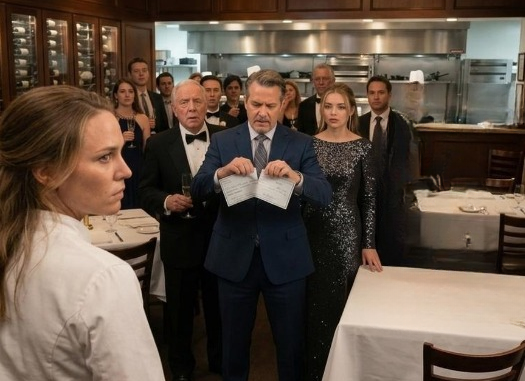
Claire Bennett had spent three years turning her father’s struggling steakhouse into a modern, celebrated restaurant. She overhauled the menu, trained the staff, and invested her own savings to perfect every dish—but when the investors arrived for the grand opening, her father put her younger sister, Vanessa, front and center. Claire stayed in the kitchen, dressed in her chef’s whites, while Vanessa charmed the guests and took credit for a vision that wasn’t hers. Watching her seared halibut and brown butter carrots earn applause she hadn’t earned, Claire felt the sting of invisibility once more. When her father whispered, “Don’t make this night about you,” something inside her quietly snapped. She untied her apron, walked out of the kitchen, and left the chaos—and the bill—behind.
Sitting alone in her car, Claire finally allowed herself to breathe. Her phone buzzed with messages, but she only responded to Ethan, an investor who had recognized her talent. His text was simple: “I asked for you. They lied. Call me when you’re ready.” When she did, he confirmed what she already knew—he was there for her food, not her sister’s charm, and certainly not her father’s showmanship. That conversation became a turning point, a reminder that her work had value independent of her father’s approval. Ethan invited her to a meeting the next morning, one-on-one, to discuss a path forward on her terms.
The next day, Ethan presented an offer that changed everything: five million in funding, operational support, and the chance to open her own restaurant—completely separate from her father. For the first time, someone truly saw her, without conditions or compromise. Accepting meant leaving the family business, competing publicly against it, and risking her father’s anger—but it also meant owning her talent, vision, and life. Claire chose herself, and brought along her closest team—including Vanessa, who finally admitted her complicity in their father’s schemes.
Within weeks, Claire and her team converted a former bakery into First Cut, a thirty-seat open-kitchen restaurant that celebrated her leadership and culinary skill. Opening night had no grand speeches, no distractions—just honest, beautifully prepared food where every guest could see who created each plate. Critics praised not only the dishes but the clarity and confidence of the restaurant’s vision. For the first time, Claire’s name and talent stood in the light, fully hers. When her father eventually reached out, it was merely to acknowledge the review—a gesture she didn’t need. She was no longer hidden. She was finally seen.
Leave a Reply