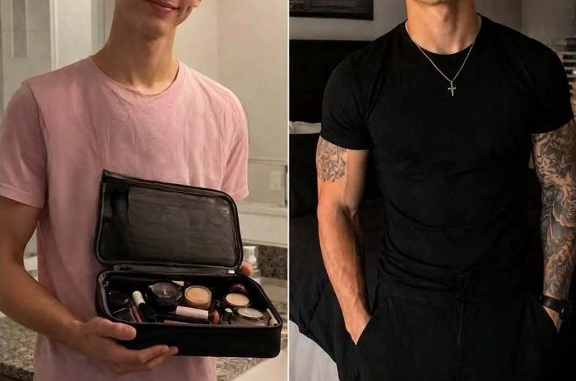
When I opened my apartment door and found my father standing there, my first reaction was to close it. Andrew looked nothing like the confident, uncompromising man who had thrown me out on my eighteenth birthday because he believed my passion for makeup was something to be ashamed of. His clothes were rumpled, his eyes were tired and red, and his voice shook as he said, “Please come home. I’ll do whatever it takes.”
We hadn’t truly spoken in ten years.
In that time, I had built a successful career from a modest professional makeup kit, helping women with scars, birthmarks, and physical changes from surgery decide how they wanted to present themselves to the world. I reminded my father that he had been the one who decided I no longer belonged in his home. Instead of defending himself, he pulled a photograph from his pocket.
The moment I saw my mother Belinda’s face after a devastating car accident, my anger vanished.
I was furious that no one had contacted me sooner, especially my twin brother, Jake, who had stood by silently when our father forced me to leave. Yet less than an hour later, I found myself heading back to the house I had avoided for a decade.
During the drive, Dad explained that Mom had stopped looking at herself in mirrors and believed my makeup expertise might help restore some of her confidence. He described it as “fixing” what the accident had changed, a word I immediately disliked. My work was never about fixing people. It was about helping them make their own choices about what they wanted to highlight, conceal, or embrace.
When I arrived, Mom came downstairs and wrapped me in a long, emotional hug. Then she looked at my father and quietly said, “I don’t need this to disappear.”
At that moment, I understood that my return wasn’t really about makeup. It was about confronting years of unresolved pain.
The following morning, Dad had arranged concealers and color-correcting products across the kitchen counter, convinced they would help. Mom gently told him she wasn’t interested.
I explained that real support begins with listening rather than deciding for someone else. It was a lesson Dad had never learned when I was younger.
Over the next several weeks, Mom and I spent time talking—not just about her recovery, but about the practical and emotional challenges she faced. We discussed medical appointments, insurance claims, financial concerns, and the struggle of rebuilding self-confidence after a traumatic accident. While Dad worried about legal matters, investments, and paperwork, Mom was focused on something much more personal: maintaining control over her own identity.
Eventually, after her doctor confirmed her skin had healed sufficiently, she visited my apartment and asked me to help soften the appearance of part of a scar. Midway through the process, she stopped, removed some of the makeup herself, and studied her reflection.
Then she smiled.
The decision had been entirely hers.
As time passed, I realized our family would never return to what it once was—and that was okay. I never moved back home. Jake eventually admitted that fear had kept him silent all those years ago. My father slowly came to understand that saying sorry could not erase a decade of absence.
Months later, he visited my apartment and noticed my makeup brushes drying beside the sink—the same tools he had once viewed as proof that I was wasting my future.
This time, he looked at them differently.
“You’ve built something meaningful,” he said quietly.
“I have,” I replied.
The memory that stays with me most happened at a family dinner. I asked Mom if I could take her photograph.
She hesitated for a moment before lowering her hand from the scar on her cheek and agreeing.
Nothing was hidden.
Nothing was covered.
When she looked at the picture on my phone, she smiled warmly and said, “Send me that one.”
Leave a Reply