PART 1“You’d really choose to marry a sixty-year-old woman instead of finding a proper girl?”
That’s what my mother shouted at me in the yard, loud enough for my uncles, the neighbors, and even the gas delivery man to hear.
My name is Efraín. I’m twenty, tall, and from a small ranch in Guanajuato where news spreads faster than it happens. While guys my age were thinking about bikes, parties, and girls, I had become the town’s main topic of gossip—because I was going to marry Doña Celia.
People called her that not because she was old, but because she carried authority. She dressed with elegance, spoke gently, and had a way of looking at you like she truly understood. She had money, yes, but she never flaunted it. I met her while fixing a fence at a property she had just bought. I burned my hand, and while others laughed, she was the only one who came to help—bringing water, ointment, and a calm presence that caught me off guard.
After that, everything changed.
She started treating me differently—lending me books about business I could barely follow, teaching me English without making me feel small, showing me how to think ahead, save, and invest. No one my age had ever made me see beyond the limits of my life. With her, I felt like I could become something more.
And yes—I fell in love.
Not with her wealth or her lifestyle, but with how she listened to me, like I mattered.
When I told my family, chaos broke out.
They said she was manipulating me, that I was confused, that she would use me and discard me. But I stood firm. I defended her against everyone, even when the whole town labeled me as foolish or opportunistic.
The wedding took place at an old hacienda, lit with candles and filled with music. Everything felt too grand—too many men in black suits, too much security for a simple ceremony. I noticed, but I ignored it.
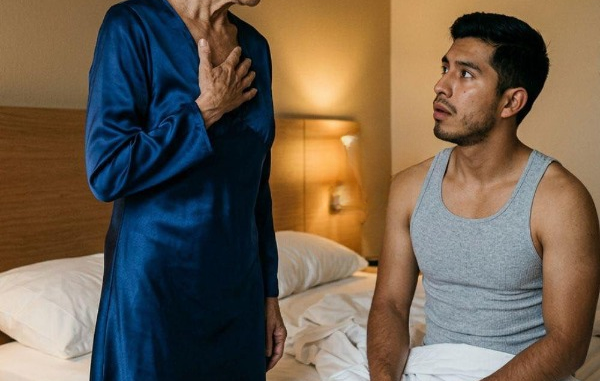
That night, alone in a large bedroom, Celia closed the door with trembling hands and placed a thick envelope and a set of keys on the table.
“My wedding gift,” she said. “One million pesos and a truck.”
I smiled nervously and pushed it back.
“I don’t need that. Being with you is enough.”
She looked at me differently then—sad, almost fragile.
“Son… I mean, Efraín… before anything else, I need to tell you something.”
A chill ran through me.
Slowly, she removed her shawl. My eyes fell on her left shoulder—and I froze.
A dark, round mark.
Exactly like my mother’s.
Same shape. Same place.
My hand trembled as I pointed.
“That mark… why do you have it?”
She stepped back, closing her eyes. The room suddenly felt suffocating.
“Because I can’t stay silent anymore,” she whispered.
And before she even finished speaking, I felt it—
my life was about to fall apart.
PART 2
I couldn’t sit still. She did—collapsing onto the bed like the weight of years had finally caught up to her.
“Twenty years ago,” she began, “I had a son.”
Confusion came first. Then anger. Then a tightening fear in my chest.
“What does that have to do with me?”
She looked straight at me.
“Everything.”
She told me about her past—how at forty she was married to Octavio Beltrán, a powerful man in agribusiness. On the surface, he was respectable. In reality, he was controlling, dangerous, and surrounded by influence and violence.
Her marriage, she said, had been a gilded cage.
When she tried to leave, he wouldn’t allow it. And when she became pregnant, she realized the child wouldn’t be loved—it would be controlled, just like everything else he owned.
“If I had tried to escape with you,” she said, crying now, “he would have found us. And if he found you, he would have turned you into something like him.”
“You.”
The word echoed in my head.
“No,” I said.
“Yes, Efraín.”
“No.”
“You are that child.”
Everything inside me shattered.
I laughed—but it was hollow, filled with disbelief.
“You’re insane.”
“I didn’t recognize you at first,” she rushed to explain. “When I met you, I just saw a kind, intelligent young man. But then things started to connect—dates, details. I had someone investigate. Eight months ago, I learned the truth.”
I stared at her, stunned.
“Eight months ago? And you still married me?”
She lowered her head.
“I tried to push you away.”
“Not hard enough!”
“No,” she admitted. “Not hard enough.”
Her honesty made it worse—it didn’t let me simply hate her.
“And the bodyguards?”
“They’re because of Octavio. He’s still alive. If he knows who you are, he can use you.”
That hit deeper than anything else.
Not only had she let me fall in love—she had dragged me into a dangerous past without telling me.
“And my mother? The one who raised me?”
“She knew,” Celia said.
That broke me completely.
“No.”
“Yes. Her name is Rosaura. I left you with her to protect you. She was the only person I could trust.”
I couldn’t take it anymore.
I grabbed my jacket and left everything behind—the keys, the money, the room. I walked for hours until I ended up at a roadside gas station, still in my wedding suit, wondering how many times a person can break in one night.
At dawn, I went home.
My mother was outside feeding the chickens. When she saw me, she froze.
“Efraín…”
“Tell me the truth,” I demanded.
My father stepped out, immediately sensing what was happening.
My mother turned pale. Her voice trembled.
“If Celia already told you… then prepare yourself. That’s not even the worst part.”
PART 3
My mother had to sit down—she could barely stand.
Through tears, she told me everything.
Twenty years earlier, during a storm, Celia had arrived at their door with a baby in her arms—me. She was terrified, accompanied by two trusted men. She begged my mother to take me and keep me away from Octavio Beltrán.
She left money, documents, and contacts—but my mother said that wasn’t what convinced her.
“It was the way she let you go,” she told me. “Like it was breaking her soul.”
Then my father spoke, steady and firm:
“I always knew you weren’t my biological son. And not once—not for a single day—did that make it harder to love you.”
That hurt more than anything.
I wanted to hate them—but I couldn’t. They had lied, yes—but they had loved me every step of the way.
I stayed away for a few weeks. During that time, Celia sent documents—she had already started the annulment process. Along with them was a letter. No excuses. No pleading. Just the acknowledgment that she had come into my life in the worst possible way.
Then came the warning:
Octavio Beltrán knew I existed.
Soon after, I noticed a suspicious van parked outside where I was staying. That’s when I realized the danger was real.
I didn’t call Celia.
I called my father.
He came immediately. On the way, I asked him:
“Did you ever regret raising me?”
He didn’t hesitate.
“Never. You’re my son because I chose you every single day.”
After that, I stopped running.
I met Celia again—this time without illusions. She looked tired, stripped of the elegance I once admired.
“You will never speak to me as your husband again,” I told her. “If you have any place in my life, it will only be as my biological mother—and I don’t know if I can give you even that.”
She accepted, crying.
With legal help and protection, we kept Octavio away. When men came looking for me at the ranch, my father stood his ground, making it clear they would have to go through him first.
That’s when I understood who truly protected me.
A year later, outside the courthouse where the annulment was finalized, the four of us stood together. Celia thanked my mother, her voice breaking.
My mother simply said,
“You don’t owe me. You owe him. Live better.”
Today, I’m still Efraín. I’m twenty, running a small workshop, continuing my studies, and living with a story people still whisper about. Let them talk.
Because that night, I didn’t just lose a wife who never should have been.
I lost a lie.
And in its place, I gained something stronger—the right to define my own truth.
I may be the son of the woman who gave birth to me.
But more than that, I am the son of the two people who raised me, chose me, and loved me without condition.
And I learned that while blood may find you…
it isn’t always what saves you.
Leave a Reply