I didn’t think much of the camping trip at first—just another school activity meant to challenge the kids and give them a break from routine. But the next morning, everything shifted after a phone call I couldn’t ignore. As I walked into the school, my heart was racing, unsure of what my son might have done.
I’m a single mother, and I’ve raised Leo, now twelve, to be quiet but observant. Since losing his father, he hasn’t been loud or attention-seeking, but he has developed a deep sense of empathy that often goes unnoticed.
A few days before the trip, Leo mentioned that his best friend Sam, who uses a wheelchair, had been told he couldn’t attend because the hiking trail was too difficult. Leo didn’t argue or make a scene—he simply said it wasn’t fair. I assumed it would end there, like most childhood disappointments.
But when the buses returned, I immediately noticed something was wrong. Leo looked completely drained, his clothes covered in dirt, his body shaking from exhaustion. When I asked what had happened, he only said, “We didn’t leave him.” Later, another parent explained what he meant—Leo had carried Sam on his back for part of the trail so his friend wouldn’t be excluded.
At first, the school was upset. Safety rules had clearly been broken, and there were concerns about what had happened on the trip. I understood their point, but beneath my worry was a quiet pride I couldn’t deny. Still, I assumed the matter would end there.
I was wrong.
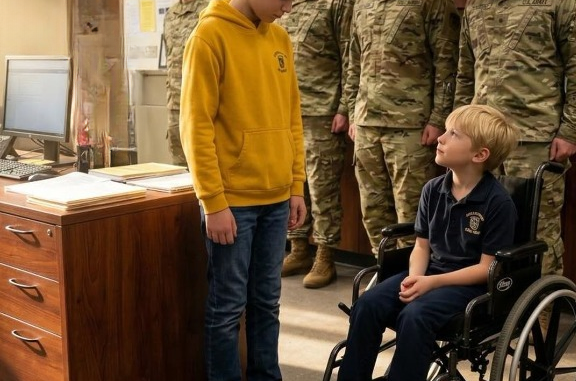
The next morning, the principal called urgently, asking me to come in right away. When I arrived, I found several uniformed men waiting, their presence serious enough to make my stomach tighten. Leo was visibly scared, believing he was in trouble for what he had done.
But what followed wasn’t punishment at all.
The men explained they had known Sam’s late father and spoke about how important it had been to him that his son never feel excluded. Leo’s actions, they said, reflected that same spirit. Instead of discipline, they had come to recognize what he had done.
Sam’s mother had also been deeply moved by how happy her son was after the trip and had reached out in gratitude. In response, a scholarship initiative was created in Leo’s honor, along with a small recognition of his kindness and determination.
In that moment, my fear eased into something else entirely. I realized I couldn’t control every situation my son would face, but I could see the kind of person he was becoming—and feel quietly grateful that, when it mattered, he chose compassion over convenience.
Leave a Reply