My Boss Called My Maternity Leave “Selfish” — Then HR Called an Emergency Meeting
When I told my boss, Darren, that I was pregnant and intended to take maternity leave, his response caught me completely off guard.
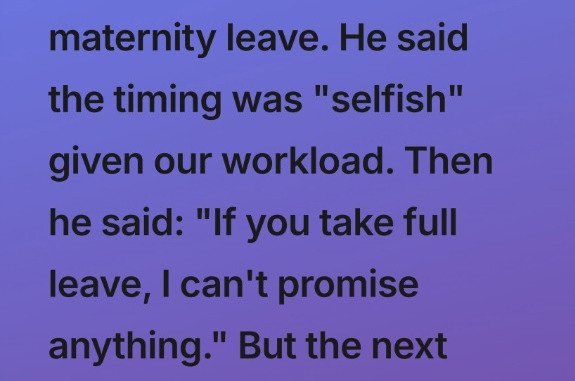
He said the timing was “selfish” because our team was already stretched thin. Then he leaned back in his chair and added, “If you take the entire leave, I can’t guarantee what happens afterward.”
I walked out of his office trying not to cry.
But the following morning, everything changed when HR suddenly called an all-staff meeting.
Marissa, the HR director, stood at the front of the room and announced that the company was investigating reports of employees being pressured or intimidated when requesting protected leave.
Then her gaze landed on Darren.
His expression immediately changed.
Marissa explained that several employees had complained about inappropriate remarks concerning maternity leave, sick days, and family emergencies. She made it clear that the company would not tolerate retaliation, intimidation, or pressure against employees exercising their rights.
Darren visibly paled.
After the meeting, he avoided me. Later that afternoon, Marissa asked me to meet privately.
She explained that someone had anonymously reported Darren’s comments about my pregnancy.
I hadn’t been the person who reported him.
Honestly, I had been too scared.
Then she told me something even more surprising: two other employees had described similar experiences. Darren had apparently developed a habit of making employees feel guilty whenever they needed time away from work.
For the first time, I understood that I wasn’t the problem.
Still, the pressure didn’t disappear.
Darren suddenly became extremely polite. He copied HR on nearly every email and constantly asked how he could “support” me.
I continued doing my job to the best of my ability because I refused to let anyone question my dedication.
Then one afternoon, I started experiencing significant back pain and called my doctor. She advised me to reduce my stress and slow down.
That evening, I told my husband, Radu, that I had decided to take my full maternity leave.
“Then take it,” he told me. “Your health comes first.”
I submitted the paperwork and included HR on the request.
Darren summoned me to his office almost immediately.
He complained that our department couldn’t afford to be without me for that long. I calmly reminded him that I was entitled to maternity leave.
“You’re putting me in a very difficult position,” he said.
I looked at him and replied that I hadn’t planned my pregnancy around the company’s deadlines.
For once, he had nothing to say.
A week later, corporate announced a broader investigation into management practices.
The complaints went far beyond my situation. Employees had reported unpaid overtime, denied sick leave, inappropriate remarks, and managers using intimidation to keep people from speaking up.
Darren wasn’t being investigated because of me alone.
He was part of a much larger pattern.
One employee named Clara had even kept messages from Darren after he dismissed her father’s hospitalization as “family drama.” Her documentation became part of the investigation.
Over the next several weeks, Darren’s behavior changed dramatically.
The inappropriate jokes stopped.
The late-night meetings stopped.
Employees slowly began feeling comfortable speaking openly again.
I eventually started my maternity leave three weeks before my due date.
Several months later, Clara contacted me with an update.
Darren had been removed from his management position after investigators uncovered repeated violations of company policies.
A new manager, Sorina, took over and introduced flexible schedules, clearer expectations, and healthier boundaries. Employee morale improved quickly.
Meanwhile, I was at home adjusting to life with my newborn daughter.
During my leave, a former client reached out with an opportunity at his new consulting firm. The salary wasn’t spectacular, but the position offered remote work, flexible hours, and something my previous workplace had failed to give me: respect.
I discussed it with Radu, considered the risks, and ultimately decided not to return to my old job.
Starting over wasn’t easy.
There were difficult months, financial uncertainty, and plenty of doubts. But little by little, the new company expanded.
Then, a year later, we secured a major contract with my former employer.
When I entered the conference room as the consultant leading the project, Darren looked up and froze.
This time, I wasn’t sitting across from him as an employee asking permission to prioritize my family.
I was there as the professional his company had hired.
The meeting itself was calm and professional.
Later, Darren approached me privately and admitted, “I handled things badly back then.”
It wasn’t the perfect apology, but by then, I didn’t need one.
Looking back, Darren’s demotion and my career change weren’t the most important outcomes.
The biggest change was realizing that taking care of myself and my family had never been selfish.
Deadlines matter.
Work matters.
But people matter too.
I hadn’t asked for special treatment. I had simply asked to be treated with basic respect.
Sometimes, standing up for yourself doesn’t just change your own circumstances. It can make it easier for the people who come after you to stand up for themselves too.
Clara later told me that more employees were finally taking their full leave without being afraid of retaliation.
That meant more to me than any promotion ever could.
Darren made his choices.
I made mine.
And eventually, the word “selfish” stopped having any power over me.
Leave a Reply