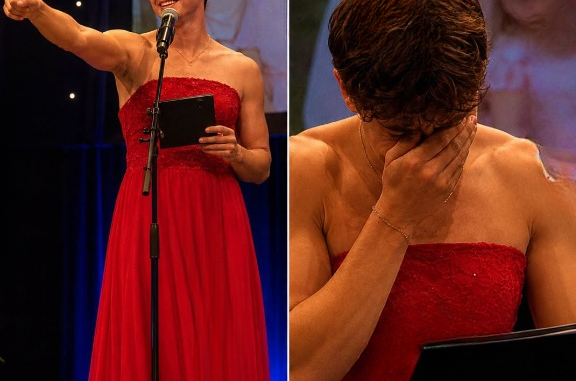
The laughter started before my son Aaron had even reached the principal. Nearly 600 people packed the auditorium, and several students already had their phones raised as he walked across the stage wearing a bright red dress that ended just below his knees.
I held my graduation program so tightly that the paper crumpled between my fingers. Just two weeks earlier, I had begged my 18-year-old son not to go through with it, knowing exactly how much ridicule and judgment he would face.
The dress had belonged to his twin sister, Mary, who had passed away only months before graduation after battling a serious illness. She had picked out the dress during one of the last shopping trips we shared, and watching Aaron wear it reopened memories I had only recently learned to live with.
But I was the only person in that auditorium who understood that Aaron had a reason far deeper than anyone could possibly imagine.
His father, Dean, had refused to attend after warning Aaron not to turn graduation into a spectacle. Even his best friend, Ben, had stopped returning his calls and messages.
That very morning, the school had offered Aaron a “more appropriate” outfit for the ceremony, but he politely refused.
Now, as scattered laughter followed him while he descended the stage, Aaron suddenly stopped paying attention to the photographers. Instead, he walked directly toward where I was sitting.
When he reached me, his eyes were filled with tears.
“This is for you—for both of them,” he whispered.
Then he slipped his hand into the pocket of Mary’s red dress and pulled out something carefully wrapped in tissue paper.
Inside was a dried yellow daisy with one petal missing, along with a handwritten note from Mary. I recognized the flower immediately. She had picked it outside the hospital on the same afternoon we bought that $89 red dress, joking that I should be arrested for letting her steal it.
Aaron explained that Mary had secretly given him the flower and letter three days before she passed away. In her note, she admitted she might never live long enough to attend graduation, but she didn’t want her red dress locked away in a closet and remembered only as a symbol of grief. She wanted Aaron to wear it so I could watch both of my children graduate together.
Around us, the laughter slowly faded.
Students lowered their phones. The auditorium became completely quiet.
Even the principal apologized and asked Aaron if he wanted to share Mary’s story from the stage.
Suddenly, all the practical concerns that had consumed our family—insurance forms, mortgage bills, investments, estate paperwork, calls with attorneys, and possible legal matters—seemed insignificant compared with Mary’s final wish.
When her graduation photograph appeared on the giant screen, the entire auditorium stood and applauded.
After the ceremony, several people who had laughed at Aaron approached him and apologized.
Ben admitted that he had judged his friend without taking the time to understand what was really happening.
Aaron simply smiled and told him, “I was making a statement—just not the one you thought.”
Then my phone vibrated.
It was a message from Dean. He had seen a video from the ceremony.
His entire message consisted of five words:
“I should have been there.”
I didn’t respond, and Aaron never asked me to.
That evening, we placed Mary’s yellow daisy inside a small frame and hung it beside an old photograph of the twins when they were eight years old, smiling with missing teeth and leaning against each other.
For months, every photograph of Mary had reminded me of the person we’d lost.
But that night, something changed.
Aaron had walked across a stage surrounded by laughter because keeping a promise to his sister mattered more to him than protecting himself from embarrassment.
And somehow, during that unforgettable graduation ceremony, it felt as though Mary had been there with us too.
Leave a Reply