“You look pathetic.”
My son, Carlton, said it loudly enough for nearly everyone inside Murphy’s Diner to hear.
I stood beside the coffee station in my faded red uniform, gripping the pot as my hands suddenly began to shake. Carlton looked me up and down as though I were something shameful he wished he could hide.
Six months had passed since my husband, Robert, died. During that time, Carlton and my daughter, Rebecca, had persuaded me to sign a stack of documents they claimed would make managing my finances easier.
Instead, I lost control of almost everything.
The house Robert and I had completely paid off.
Nearly $140,000 in savings.
And much of what we had spent thirty-five years building together.
At sixty years old, I was now renting a tiny studio for $1,200 a month and working ten-hour shifts just to keep myself afloat.
Carlton knew exactly how I had ended up there.
Yet he only smiled and said, “This is what happens when you can’t manage your own life.”
Before I could respond, a chair suddenly scraped against the diner floor.
Lance, the frail seventy-four-year-old regular who came in every morning for $2.50 coffee and toast, slowly rose from his table by the window.
For weeks, I had shared pieces of my sandwiches with him because I assumed he was struggling financially just as I was.
His hands usually shook while he counted out his quarters.
But that morning, they were completely steady.
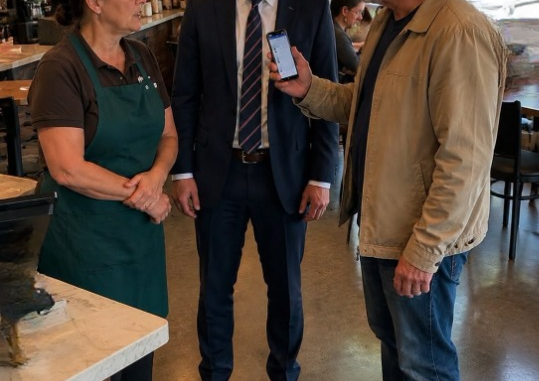
He walked toward us, stepped between Carlton and me, and pulled a sleek, expensive phone from the pocket of his worn jacket.
Then he calmly called someone named Marcus and instructed him to look into my son’s employment history, debts, and business dealings.
The color disappeared from Carlton’s face.
Lance turned toward him.
“People show you who they really are when they think no one important is paying attention.”
What happened next exposed the truth about the quiet old man everyone in the diner had assumed was poor.
The following morning, Lance finally told me who he really was.
His full name was Lance Morrison.
He was a retired businessman who had spent five decades building successful companies in technology, manufacturing, restaurants, and real estate. His investments were worth hundreds of millions of dollars.
After losing his wife, Lance noticed that his own children had become increasingly focused on what they would inherit.
So he deliberately began living simply.
He wanted to discover who would treat him with kindness without knowing how wealthy he was.
His attorney had also looked into my situation. According to him, the documents Carlton and Rebecca had convinced me to sign could potentially be challenged because I had been grieving, vulnerable, and had not received independent legal advice.
Then I learned something even more surprising.
One of Lance’s companies held an investment connected to Carlton’s employer.
Another had financial interests tied to the mortgage on my former home.
Lance offered to help me recover my savings, property, insurance records, and rightful estate assets.
But he made one thing clear.
He would not take a single step without my permission.
“I don’t want revenge,” I told him.
“I want my son to understand what he did.”
Within days, Carlton was facing serious legal scrutiny and the possibility of losing much more than the money he had taken from me.
Eventually, he agreed to return everything, including interest, and signed a formal agreement recognizing my ownership rights.
Six months later, my life had changed completely.
My savings were back.
Carlton had begun counseling and was slowly trying to repair our relationship.
Rebecca, however, chose to keep her distance.
And Lance and I became something neither of us had expected.
We became family through friendship rather than obligation.
He still visited Murphy’s Diner regularly. Ruth, one of the servers, often teased him about it. The man who had once carefully counted every quarter now quietly left generous tips for the staff.
I never forgot the humiliation of standing in that diner while my own son mocked my uniform.
But I no longer viewed that uniform as evidence that I had failed.
To me, it became proof that when nearly everything was taken away, I still found the strength to keep moving forward.
And the simple sandwich I once shared with a lonely stranger taught me something I would never forget:
Sometimes the smallest act of kindness can open a door that no amount of money could ever unlock.
Leave a Reply