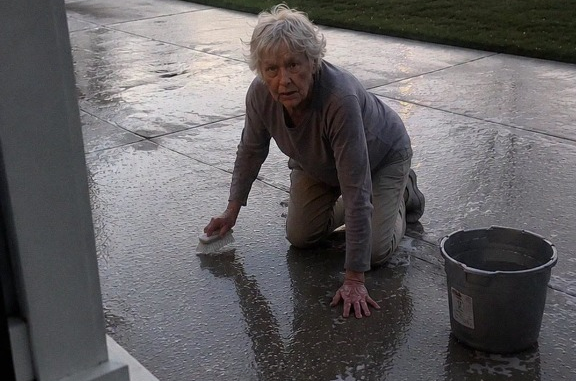
After my father passed away, my mother moved across the world to live with us. Just three weeks later, I found her outside before sunrise desperately scrubbing a hateful message off our driveway.
Only two words were still visible beneath the water.
“GO HOME.”
She lowered her eyes.
“I was almost done.”
Her voice cracked.
Huge white chalk letters stretched across the driveway where everyone passing by could see them.
My 72-year-old mother had been on her knees before dawn trying to erase the message before anyone else woke up.
“Who did this?” I asked.
She tightened her grip on the scrub brush.
“It doesn’t matter.”
“It matters to me.”
“Leila… please. Just go inside.”
Her hands trembled.
Mom had arrived from Lebanon only three weeks earlier after losing my father. She had left behind the apartment they’d shared for 46 years, the neighborhood grocery where everyone knew her, and the little balcony where she grew mint in worn clay pots.
First she lost her husband.
Now someone wanted her to believe she didn’t belong here either.
I knelt beside her.
“Has someone been bothering you?”
She stayed silent.
That silence told me everything.
I gently took the brush from her hands.
Her palms were scraped raw.
“Come inside,” I said.
“I can finish.”
“No.”
“The girls shouldn’t see this.”
My daughters, eight and eleven, slept in rooms overlooking the driveway.
“They shouldn’t have to.”
“Neither should you.”
As I helped her toward the house, our next-door neighbor, Greg, stepped outside wearing sweatpants.
His eyes drifted from the wet driveway to my mother.
“Everything okay?” he asked, sounding almost too concerned.
Greg had lived beside us for years.
He organized neighborhood events, complained about untidy lawns, and always seemed friendly whenever other people were watching.
I had never trusted him.
That morning, I began fearing him.
“Someone wrote on our driveway,” I said.
Greg leaned forward.
“That’s awful.”
Mom quietly squeezed my wrist.
Don’t make this worse.
Greg shrugged.
“Probably teenagers.”
“At four in the morning?”
“They do stupid things.”
“Can we see your security footage?”
His eyes flicked toward the camera mounted beneath his roof.
“It hasn’t worked in months.”
That was a lie.
I’d seen it installed the previous summer.
When Greg noticed me looking at it, he quickly added, “Convenient timing, I guess.”
My mother tugged at my arm.
“Leila, please.”
Before returning inside, Greg looked at Mom.
“She should be careful wandering around at night.”
I stopped.
“What exactly do you mean?”
“Nothing.”
“She wasn’t wandering. She was cleaning our driveway.”
“I just meant this neighborhood is different from where she came from.”
Mom’s grip tightened.
Right then I understood one thing.
Greg knew exactly who those words were meant for.
Inside, I helped Mom wash the chalk from her hands while my husband, Samir, came downstairs.
When he saw the redness on her skin, he immediately asked what had happened.
Mom answered first.
“I spilled bleach.”
She was still trying to shield us from conflict.
After I told Samir the truth, he marched outside without even putting on a jacket.
Greg was waiting in his driveway.
“You wrote it,” Samir said.
Greg laughed.
“Seriously?”
“If not, show us your security footage.”
“I told you the camera doesn’t work.”
The tiny green light beneath it was blinking.
Greg noticed it too.
“So… I guess it started working again.”
“Then show us.”
“No.”
I pulled out my phone.
“I’m calling the police.”
Greg folded his arms.
“For chalk? Good luck.”
Behind us, Mom quietly called us back inside.
That’s when I realized this wasn’t the first time Greg had targeted her.
Sitting at the kitchen table, Mom finally admitted something.
The week before, Greg had asked her to sign paperwork.
He claimed it was permission for repairs to the fence dividing our properties.
But Mom, who had spent nearly four decades working as a civil engineer, immediately noticed something suspicious.
The document wasn’t about fence repairs at all.
It acknowledged that the property line belonged entirely to Greg, surrendering our claim to nearly two feet of land—including the area where our storm drain sat.
When she questioned him, Greg insisted she was confused.
The next day he returned with an Arabic translation.
Except it wasn’t a translation at all.
The English version transferred property rights.
The Arabic version mentioned only temporary access for repairs.
Greg assumed an elderly immigrant woman wouldn’t notice.
He underestimated her.
Before handing the papers back, Mom secretly photographed both versions.
She also photographed the property line, the fence, and the storm drain.
When Samir asked why she never told us, she quietly replied,
“You already have enough worries.”
Then she revealed something even more alarming.
Greg had already begun digging for a stone wall.
If built where he planned, rainwater would collect beside our home’s foundation.
He wasn’t simply trying to steal land.
He wanted us legally responsible for future drainage damage his wall would cause.
The hateful message wasn’t random.
It was intimidation.
He wanted my mother frightened enough to stay silent.
This time, we called both the police and the city.
Greg denied everything.
He insisted my mother misunderstood.
He claimed the Arabic paperwork came from someone else.
Then the officer asked again about his security camera.
Greg repeated that it didn’t work.
But Mom remembered something none of us had considered.
Mrs. Jenkins across the street had a doorbell camera facing our house.
The elderly neighbor welcomed us inside.
Her footage showed everything.
At 3:41 a.m., Greg crossed the street carrying a bucket of white construction chalk.
He carefully wrote GO HOME across our driveway.
Before leaving, he placed a small bottle near the storm drain.
The police recovered it.
Inside was concrete sealant mixed with industrial dye.
Investigators determined Greg planned to dump it into our drain, making it appear that we had illegally contaminated the stormwater system.
The resulting fines—and legal complications—would have strengthened his position in the property dispute.
This time, Greg was arrested.
Not for writing on the driveway.
For harassment, fabricating evidence, and attempting illegal dumping.
City inspectors soon discovered even more.
Greg had already begun unauthorized construction.
The forged paperwork was real.
Because he worked as a licensed contractor, investigators expanded their review.
Soon other victims came forward.
An elderly couple unknowingly signed away property rights.
Another homeowner discovered Greg had intentionally redirected water toward their basement.
A widow learned he charged her to repair a retaining wall he had built incorrectly himself.
His entire business depended on misleading older homeowners, immigrants, and anyone he believed wouldn’t understand legal paperwork.
My mother simply happened to understand it better than he did.
Greg lost his contractor’s license.
His company shut down.
Within six months, he sold his home to help pay legal costs and restitution.
On moving day, Mom watched from our kitchen window.
I expected relief.
Instead she quietly said,
“He has children.”
“So do we.”
“I know.”
“He tried to frame you.”
“I know.”
“Then why do you feel sorry for him?”
She folded a dish towel.
“Because people ruin their lives one small bad decision at a time.”
Then she smiled sadly.
“Your father used to say engines fail the same way. Ignore one little problem long enough, and eventually everything breaks.”
Even after everything Greg had done, Mom still saw the person behind the wrongdoing.
I wasn’t ready for that kind of forgiveness.
Maybe I never will be.
When my oldest daughter asked why Greg had written GO HOME, Mom answered before I could.
“No one gets to decide where you belong,” she said firmly.
“You belong wherever you build your life.”
A month later, city crews repaired the drainage system.
Mom pointed out a flaw in the grading that everyone else had overlooked.
The foreman checked.
She was right.
Soon neighbors began asking her to look at cracked sidewalks, leaning retaining walls, and drainage problems.
She always laughed and replied,
“I’m retired.”
Then she’d put on her shoes and help anyway.
A few weeks later, Mrs. Jenkins surprised her with a handmade wooden sign that read:
ENGINEER ON DUTY.
Mom laughed until she cried.
We hung it proudly beside our front door.
Not because she had gone back to work.
Because she had spent weeks believing she’d become a burden after moving in with us.
Instead, she’d protected our family from a neighbor who counted on fear, silence, and deception.
The words GO HOME faded from the driveway over time, but faint traces still appeared whenever the concrete became wet.
One morning I offered to have them pressure-washed away.
Mom smiled and shook her head.
“No.”
“Why not?”
She gently squeezed my hand.
“So I remember.”
“The message?”
She smiled again.
“No.”
“That I stayed.”
Leave a Reply