My father thought embarrassing me online was a harmless joke, and my sister encouraged him with a laughing emoji. By the next morning, her rejected credit card reminded both of them of the one thing they had forgotten.
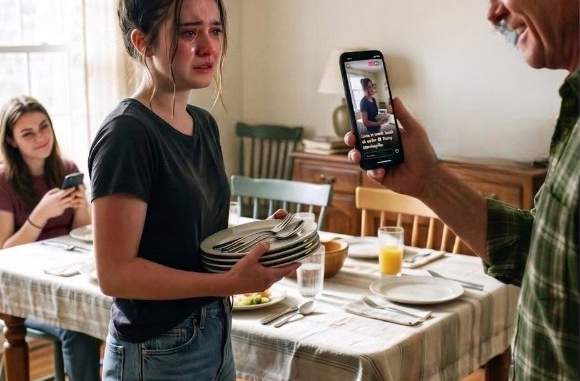
I was setting up the dinner table when my dad started filming me.
At first, I assumed he was recording the birthday meal—the roasted chicken, the decorations, or the amount of effort I had put into preparing everything for him.
I had spent the entire day cleaning the house, buying groceries, picking up his medication, and even paying for the caterer he canceled at the last minute because he always said family should be willing to step in.
Then I heard him laugh.
“Look at her,” Dad joked from behind his phone. “Our personal maid. At least she’s useful for something.”
The entire room went quiet.
My hands froze around the stack of plates I was holding.
My mother avoided eye contact and focused on the table arrangement.
My younger sister, Kylie, stayed on the couch scrolling through her phone as if nothing inappropriate had happened.
Dad continued recording.
“Come on, Emma. Give the camera a smile.”
I stared at him, waiting for him to laugh and admit he was joking.
I waited for the apology.
I waited for him to delete the video.
Instead, my phone buzzed on the counter.
He had already posted it.
There I was, walking through my parents’ dining room carrying dishes, my hair pulled back, my sleeves rolled up, looking exactly like the person he had just mocked me as.
Then Kylie commented.
Just one laughing emoji.
Somehow, that hurt more than my father’s words.
For two years, I had paid Kylie’s credit card bills because Mom insisted she was “trying to figure things out.”
I covered Dad’s prescriptions, Mom’s car insurance, and part of their mortgage after Dad retired early and promised it would only be temporary.
I did it because I thought supporting them meant I was loved and needed.
But standing there while my own sister laughed at my humiliation, I finally understood the truth.
They didn’t see me as a daughter.
They saw me as someone who provided a service.
I calmly placed the plates on the table.
Dad lowered his phone.
“What’s wrong? You can’t handle a joke?”
I took off my apron, folded it neatly, and placed it beside the silverware.
Then I picked up my purse.
Mom looked confused.
“Emma, dinner is about to begin.”
“I know.”
Kylie finally lifted her eyes from her phone.
“You’re actually leaving?”
I didn’t answer.
I walked out before they could watch me break down.
That night, I opened my banking app and removed Kylie from my emergency credit card account.
The next morning at 9:11, she messaged me.
Why isn’t my card working?
I looked at the screen.
Then I blocked her.
By 9:30, my phone showed twelve missed calls.
Kylie called from her number, then from Mom’s phone, and eventually from Dad’s.
When I refused to respond, the messages started coming.
“Emma, this is embarrassing.”
“I’m at Target.”
“The cashier keeps looking at me.”
“This isn’t funny.”
“You need to fix this immediately.”
I sat at my kitchen table with my untouched coffee, reading every message with a strange sense of peace.
For years, my first reaction had always been panic whenever my family needed something.
If Dad asked for money, I sent it.
If Mom was upset, I apologized.
If Kylie had a problem, I solved it.
But this time, I did nothing.
At 10:04, Mom left a voicemail.
“Emma, sweetheart, Kylie says her card isn’t working. I’m sure it’s just a mistake. Please call me before your father gets angry.”
Before your father gets angry.
Those words had controlled me since childhood.
Don’t upset Dad.
Don’t embarrass Dad.
Don’t argue.
Don’t make things harder for Mom.
No one ever told me not to humiliate Emma after she paid the bills and prepared the birthday dinner.
At 10:22, Dad texted.
“Stop overreacting. It was only a joke.”
Then another message appeared.
“Your sister needs gas money.”
Then another.
“You walked out on my birthday. Very mature.”
I opened my laptop.
I didn’t reply privately.
Instead, I commented beneath the video.
I saved a screenshot first.
Then I wrote:
“Since I’m apparently the family maid, I’m officially resigning. Effective immediately, I will no longer cover Kylie’s credit card, household expenses, insurance, prescriptions, groceries, or emergency costs for anyone.”
For nearly a minute, nothing happened.
Then the video disappeared.
Dad called instantly.
I let it ring.
Kylie sent one last message.
“You really posted that publicly?”
Before blocking her everywhere, I replied:
“You laughed publicly first.”
Around noon, Mom appeared outside my apartment.
She knocked softly, the way she always did when she wanted to seem fragile and innocent.
I opened the door but didn’t invite her in.
Her eyes were swollen.
“Emma, your father is furious.”
“I figured.”
“He deleted the video.”
“That doesn’t undo what happened.”
She gripped her purse tightly.
“Kylie is crying.”
“So was I.”
Mom looked genuinely shocked, like she had never considered that I might have gone home and fallen apart.
“Your father didn’t mean it.”
“Yes, he did.”
“He jokes that way.”
“No,” I said. “He humiliates people that way.”
She frowned.
“You know how he is.”
That sentence exhausted me more than any insult.
“Yes,” I answered. “And now you know how I am.”
“What does that mean?”
“It means the money stops.”
Her expression changed instantly.
Not when I explained that Dad hurt me.
Not when I told her I cried.
Only when she realized the financial support was ending.
Mom stepped back like I had physically hurt her.
“Emma, we can’t afford that.”
“I know.”
“Your father’s medication…”
“He has retirement income.”
“The mortgage…”
“You and Dad own the house.”
“Kylie is still trying to get started.”
“Kylie is twenty-nine years old.”
Mom’s face fell.
“Family helps family.”
I looked at her for a long moment.
“Family doesn’t record family members like employees and laugh when others join in.”
She had no answer.
That evening, Dad and Kylie arrived together.
Neither of them wanted to face me alone.
Dad looked angry.
Kylie looked annoyed.
Mom stood behind them, nervous.
I opened the door but kept the security chain attached.
Dad’s first words were:
“Are you proud of yourself?”
I almost laughed.
“No. But I’m getting there.”
His face tightened.
“You embarrassed me online.”
“You uploaded the video.”
“It was harmless.”
“Then why did you delete it?”
Kylie crossed her arms.
“You canceled my card over a laughing emoji.”
“No,” I said. “I canceled it because you’re an adult who laughed while Dad publicly degraded me.”
She rolled her eyes.
“You always make yourself the victim.”
I opened the folder I had prepared and held it up.
“Over the past twenty-eight months, I paid $47,600 for this family.”
The hallway went silent.
Dad tried to dismiss it.
“Nobody asked you to keep track.”
“You asked me to keep paying.”
I continued.
“Kylie’s credit card payments totaled $13,400. Dad’s medical expenses were $9,800. The rest covered insurance, groceries, repairs, utilities, and mortgage shortages.”
Kylie’s face turned red.
“Why are you sharing my personal business?”
“Because you publicly turned me into a maid. I’m explaining the reality behind that.”
Dad pointed at me.
“You owe this family respect.”
“I owed myself some first.”
For once, he had nothing to say.
I handed him a paper through the small opening.
“This shows every automatic payment I canceled. You have thirty days to replace them. I’ll cover Mom’s medication one last time directly through the pharmacy because I’m not heartless. Everything else ends today.”
Kylie grabbed the paper.
“You’re serious?”
“Yes.”
“What am I supposed to do?”
“Get your own credit card.”
She looked at me as though I had suggested something impossible.
Dad said, “If you leave this family, don’t expect us to welcome you back.”
The old fear appeared for a moment.
Then it disappeared.
“I left yesterday,” I said. “Nobody came after me until the card stopped working.”
Mom started crying.
Dad pulled her away, angry and embarrassed.
They left without apologizing.
Three months later, Dad contacted me again.
I didn’t answer his call.
Instead, he mailed me a letter.
It was formal, defensive, and only partly apologetic.
But I kept it because it was the first time he admitted what he did was wrong.
Kylie eventually found a job at a dental office.
Mom learned how to handle their finances herself.
Dad complained to relatives until someone finally asked why his daughter had been paying their bills for years.
After that, things became quieter.
So did my life.
On Thanksgiving, I cooked dinner in my own apartment.
Four friends joined me.
No one filmed me.
No one mocked me.
Everyone helped clean afterward.
When they left, I checked my phone.
There was one message from Mom.
“Happy Thanksgiving, Emma. I miss you. I’m sorry I didn’t defend you.”
I read it twice.
Then I replied:
“I miss the person I needed you to be. I’m trying to forgive the person you were.”
It wasn’t a perfect ending.
It was something better.
It was honest.
For the first time in years, I went to sleep knowing no one in my family had control over my money, my work, or my silence.
Leave a Reply