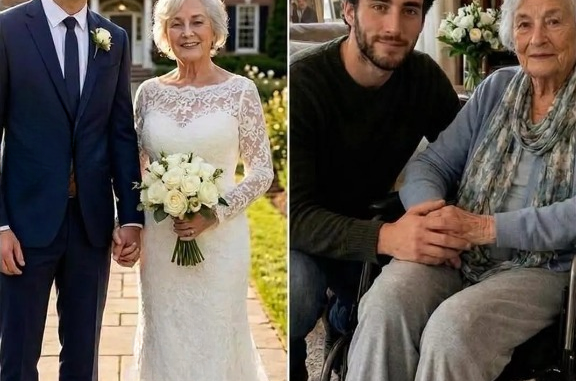
Evie’s spoon slipped from her hand and hit the kitchen floor just before her legs collapsed beneath her. I caught her only inches before she reached the tile. Three days later, I stood at her funeral wearing the thick wool coat she had bought me, wondering if everyone could see the guilt written across my face.
Evelyn Harper was 71 years old when she married me.
I was 25, living out of my truck, buried under $18,600 in credit card and medical debt, and desperate for a way out.
When she offered me a future, I accepted because her small blue house had warmth, fresh sheets, and a kitchen stocked with food.
I knew exactly why I said yes.
Evie knew too.
But instead of judging me, she treated me with a kindness I didn’t deserve.
She paid $740 to fix my broken truck, covered an expensive dental bill, and left brand-new boots by the door without making me feel ashamed.
I kept telling myself the arrangement benefited both of us.
Still, deep down, I found myself counting her medical appointments and noticing every prescription bottle on the counter.
Two weeks before our courthouse wedding, Evie placed a prenuptial agreement in front of me at the kitchen table.
The house, her savings, and her personal belongings would remain hers.
Her will would decide what happened after her death.
I signed without hesitation because I assumed time would eventually change her mind.
Then one evening, while Evie sat nearby sipping the tea I had made her, my friend Jesse sent me a message asking how my “retirement plan” was going.
I replied:
“Once she’s gone, I’m set.”
I never noticed Evie looking at my phone.
She never said a word.
I convinced myself she hadn’t seen it.
After her funeral, her attorney, Mr. Carson, asked me to meet him.
I arrived expecting to discuss my future.
Instead, he told me something I never saw coming.
The house had been left to her niece, Claire.
Her savings had been placed into a charity fund.
Then he placed an old shoebox on his desk.
“Evie believed this was what you truly wanted,” he said.
Inside was a printed copy of my message to Jesse.
Underneath it were receipts.
The truck repair.
The dental bill.
The boots.
The coat.
The debts she had quietly helped me pay.
Alongside them were handwritten notes from Evie.
“You lied about this one.”
“You almost thanked me honestly.”
“This was the first time you looked ashamed.”
There was no hidden fortune waiting for me.
No paid-off house.
No investment account.
No inheritance.
Nothing I had secretly hoped to receive.
At the bottom of the box was a letter.
Evie wrote that she understood my reasons for marrying her before we ever stood at the courthouse.
She knew I was scared.
She knew I was struggling.
But she also noticed the moments I never thought anyone saw.
Helping a neighbor repair a porch without accepting payment.
Sitting beside her during every hospital appointment.
Making her tea when she was tired.
She wrote that fear had made me selfish…
But it had not made me heartless.
Then she gave me one final choice.
I could walk away with the box and disappear.
Or I could attend her charity luncheon and tell everyone the truth myself.
The next afternoon, I entered the church basement knowing Claire and Evie’s closest friends had every reason to hate me.
When Mr. Carson explained that Evie’s charity would help people facing eviction, overwhelming debt, and desperate circumstances, I stood up.
I confessed everything.
I admitted that I married Evie because I wanted security.
I admitted I confused comfort with love.
I admitted the message she found was the truth.
Then I revealed that Evie had requested the charity fund carry my name.
I refused.
“Put her name on it,” I said. “Mine can wait until it actually means something.”
Six months later, I was volunteering at the church pantry and making monthly payments toward everything Evie had given me.
Claire eventually stopped seeing me as someone who stole her aunt’s kindness, though neither of us pretended the past had disappeared.
I married Evie hoping to inherit a comfortable life.
Instead, she left me something far more valuable.
The chance to become the kind of person who could build one for himself.
Leave a Reply