PART 1: THE MONEY THAT NEVER REACHED ME
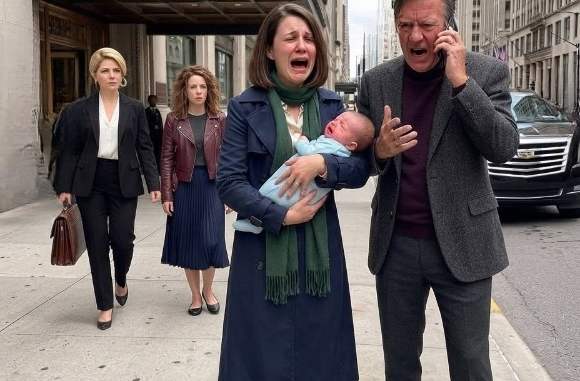
When my grandfather saw me standing outside Riverside Community Clinic with my two-month-old daughter wrapped in a worn hospital blanket, he stopped so suddenly that his driver almost ran into him.
I hadn’t seen Grandpa Warren in nearly three years.
The last time we spoke, I was twenty-three, newly pregnant, and desperate for help. Daniel, my boyfriend at the time, had emptied my savings account and disappeared. I went to my father hoping he would support me.
Instead, he called me irresponsible.
My stepmother, Vanessa, acted as if my pregnancy had brought shame to the family. By the next morning, my phone had been disconnected, my apartment lease had been canceled, and every family account I had access to was frozen.
Now I was twenty-six years old, standing outside a clinic in a torn coat with only four dollars left in my pocket.
“Emily?” Grandpa said quietly.
I wanted to disappear before he noticed the donated diapers beside me or the worn clothes hidden beneath Lily’s blanket.
But he noticed everything.
Then he asked a question that left me completely confused.
“Wasn’t $250,000 a year enough?”
I stared at him.
“What are you talking about?”
Grandpa explained that after my father told him I needed distance from the family, he had approved yearly payments of $250,000 to support me. The family trust was also supposed to cover my housing, medical expenses, pregnancy care, and childcare.
“I never received any of that,” I whispered.
The color disappeared from his face.
I told him what had actually happened.
I had spent months without stable housing while pregnant. I slept in my car until it was taken away. I relied on community clinics. I delivered Lily through emergency medical assistance.
Grandpa said my father and Vanessa had submitted regular reports showing that I was receiving everything I was entitled to. They had provided bank statements, rental records, and even photos of an apartment and nursery supposedly prepared for me.
“I live in a room behind a laundromat,” I told him.
Without hesitation, Grandpa called his attorneys.
“Freeze every distribution connected to Richard and Vanessa,” he ordered. “I want every bank record, trust document, transfer history, and financial report reviewed.”
Then he looked down at Lily.
“And send a vehicle with an infant seat.”
The SUV that arrived carried diapers, formula, wipes, and warm blankets.
I held myself together until Lily was safely buckled inside.
For months, every struggle had been mine alone. Watching someone else check the car seat twice to make sure my daughter was safe broke something inside me.
At Grandpa’s Lake Forest home, his staff prepared a guest room with a crib and baby supplies.
I touched a tiny yellow sleeper and felt ashamed by how much I wanted it.
“Emily,” Grandpa said gently, “this is not charity.”
“Then what is it?”
“Restitution.”
The next morning, his dining room became the center of an investigation.
Lawyers and accountants uncovered fake receipts, fraudulent medical records, and payments for appointments I had never attended.
They found photographs of a beautiful apartment and nursery that supposedly belonged to me.
One image showed a woman holding what appeared to be a baby.
“That isn’t me,” I said.
The investigators confirmed the photos were taken from a staged property listing.
Over three years, approximately $812,000 meant for Lily and me had been redirected elsewhere.
While I was choosing between buying formula and paying for transportation, someone had been signing my name and collecting money meant to protect us.
Grandpa authorized civil action and criminal referrals.
“No warnings,” he said. “Richard doesn’t get time to prepare this time.”
PART 2: THE BOARDROOM TRUTH
Three days later, Grandpa walked into the quarterly board meeting of Aldridge Development Group.
I followed behind him carrying Lily.
Every conversation stopped.
My father, Richard, sat at the polished conference table wearing an expensive navy suit. Vanessa sat beside him in cream silk, wearing the concerned expression she used whenever she wanted people to believe she was innocent.
“Emily,” Dad said coldly. “This is a private meeting.”
“It became a family trust matter the moment you stole from my granddaughter,” Grandpa replied.
Vanessa stood immediately.
“We have been incredibly worried about her. You know how unstable Emily has always been.”
Unstable.
Ungrateful.
Difficult.
Those were the labels they used whenever I questioned their version of events.
But this time, documents spoke louder than accusations.
Grandpa’s attorney presented records of a bank account opened using my full legal name.
I had never created it.
The mailing address belonged to one of my father’s private offices, and a copy of my old driver’s license had been used during the application.
Dad claimed I had authorized him to control the money because I was too emotional and irresponsible to manage it myself.
“No, I didn’t,” I said.
I reminded him that after Daniel left, the only thing I asked for was a place to stay for one night.
He refused because he believed I had embarrassed the family.
The investigators presented forged signatures, altered medical bills, fake rental documents, and payments made to a company registered under Vanessa’s former name.
Eventually, Vanessa broke.
“We were protecting the family,” she said.
Not protecting me.
Protecting their image.
She argued that I had made bad choices, walked away from responsibility, and expected everyone else to save me.
She insisted the money had been kept “safe.”
“Safe?” I repeated.
I adjusted Lily against my shoulder.
“I gave birth alone. A nurse held my hand because nobody from my family was there. I washed bottles in a janitor’s sink. I brought my daughter home to a room behind industrial machines.”
I looked directly at her.
“What exactly did you keep safe?”
Nobody answered.
Dad lowered his voice.
“There is no reason to destroy this family in front of strangers.”
Grandpa interrupted.
“You destroyed this family when you stole from your daughter and granddaughter.”
The investigation showed that stolen funds helped pay for my parents’ vacation property. Other money went into accounts controlled by Vanessa. Investigators also traced payments to someone who helped create false paperwork.
The attorneys outlined possible charges involving identity theft, financial fraud, wire fraud, and misuse of trust funds.
For the first time, Dad looked afraid.
“After everything I’ve done for this company, you believe her?”
Grandpa’s expression was painful but steady.
“I trusted you with my business, my name, and my granddaughter. You sent me lies while Emily and her child struggled nearby.”
Dad pointed at me.
“She’s manipulating you.”
For years, I would have defended myself.
Explained.
Begged to be understood.
But Lily stirred in my arms.
And I finally stopped.
“No,” I said. “I’m finished being used as someone else’s excuse.”
Grandpa removed my father from his executive positions and blocked his access to company accounts and properties. Vanessa was removed from all trust responsibilities.
“You would choose her over your own son?” Dad demanded.
Grandpa looked at him.
“I am choosing the truth.”
Security escorted them out.
As Dad passed me, he whispered, “You have no idea what you’ve done.”
I looked at him.
“Yes, I do.”
“I told the truth.”
After they left, my legs finally gave out.
Grandpa approached carefully.
“I should have come looking for you myself.”
I looked at him.
“Yes. You should have.”
He accepted that answer.
No excuses.
No defense.
It was not forgiveness.
But it was the first honest conversation I had shared with my family in years.
PART 3: TAKING BACK OUR FUTURE
The investigation uncovered hidden accounts, fake companies, and years of fraudulent paperwork. Several assets belonging to my father and Vanessa were frozen.
Dad resigned before the board could remove him.
Legal proceedings followed.
I expected their downfall to feel satisfying.
Instead, I felt exhausted.
Being believed did not erase what happened.
I still woke up afraid that I would return to the tiny room behind the laundromat. I checked my accounts repeatedly. I folded Lily’s new clothes carefully because part of me feared they could disappear.
Grandpa never rushed me.
The trust restored everything that should have reached me, including accumulated interest. New protections ensured that no relative could ever control funds meant for me or Lily again.
I used the money to pay medical expenses, create a college fund for Lily, and begin therapy.
Eventually, I realized therapy was not proof that my family had been right about me.
It was proof that I had survived something painful.
Grandpa visited every Sunday.
At first, he brought too many gifts.
Eventually, I told him one bag was enough.
The next week, he arrived carrying a single bag filled with bananas, coffee, and a stuffed rabbit.
“I said one bag,” I reminded him.
He looked confused.
“This is one bag.”
It was the first time I laughed with him in years.
I found a position at a legal aid organization and returned to finish the degree I had abandoned.
I wanted to help people who arrived scared and carrying paperwork nobody had bothered to understand.
Months later, my father accepted a plea agreement involving restitution and a recommended sentence. Vanessa reached a separate agreement.
I submitted a statement to the court.
I wrote about sleeping in my car while my trust money paid their mortgage.
I wrote about splitting prenatal vitamins and bringing my daughter home in donated clothes.
I explained that they had stolen more than money.
They had taken security.
Time.
Trust.
The ability to believe my own name on a document.
When the judge described their actions as deliberate and ongoing, something inside me finally settled.
The official record reflected what had always been true.
I had not disappeared because I was irresponsible.
I had been abandoned, deceived, and robbed.
One year after Grandpa found us outside the clinic, we celebrated Lily’s birthday in his garden.
It was small.
A cake.
A few friends.
The people who had helped us rebuild.
Grandpa lifted his glass.
“To Emily, who told the truth when telling the truth was expensive.”
I held Lily close.
“To Lily, who gave me a reason to keep going.”
That evening, Grandpa gave me an updated trust document naming Lily directly and placing me in control of anything intended for her.
Attached was a handwritten note.
“I cannot erase the years when I failed to see what was happening. But I can make sure nobody ever stands between you and what belongs to you again.”
I folded the note carefully.
“I’m still angry sometimes,” I admitted.
“I know.”
“I might always be.”
“I know that too.”
Life did not become perfect.
It became honest.
Lily had warm clothes, medical care, and a home where survival was never called a weakness.
Whenever I passed Riverside Community Clinic, I remembered Grandpa’s first question.
“Wasn’t $250,000 a year enough?”
The money would have changed our lives.
But what I truly needed was someone willing to see me, listen to me, and believe me before the damage became permanent.
This time, someone finally did.
Leave a Reply