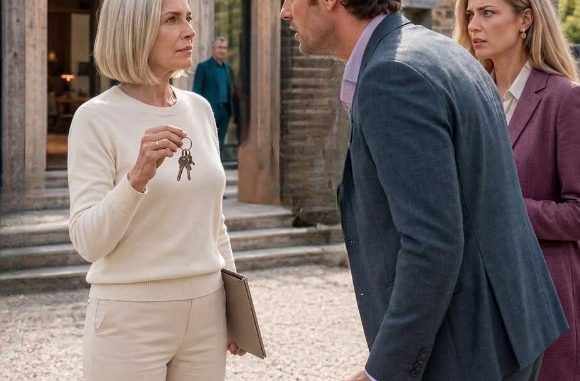
When Chloe entered the renovated barn for the first time, she didn’t look amazed. Instead, she dragged a perfectly polished finger across one of the handcrafted cherrywood cabinets and frowned at the tiny mark left behind, as if the entire room had failed some invisible inspection.
Sunlight streamed through the enormous windows, highlighting the reclaimed oak floors, the restored chestnut beams, and every detail I had spent four years bringing to life. My son David stood near the walnut kitchen island with his hands tucked into his jacket pockets, avoiding my gaze.
I had imagined this moment so many times.
I pictured excitement.
I pictured pride.
Maybe even tears.
But Chloe only looked around and asked, “Are the appliances supposed to be exposed?”
I stared at her.
“They’re high-end professional appliances.”
“Yes, but most modern homes hide them behind custom panels.”
I smiled faintly.
“This isn’t a modern house. It’s a restored dairy barn. The design is supposed to respect what it used to be.”
David cleared his throat.
“Mom, it really is beautiful.”
But the way he said it bothered me.
Beautiful in its own way.
Four years of planning, paperwork, construction problems, endless decisions, and a huge portion of my retirement savings had been reduced to a polite compliment that sounded more like an apology.
Only one person seemed truly impressed.
My six-year-old grandson, Leo, walked toward the staircase and ran his fingers along the custom iron railing.
“Dad, look! There’s a room upstairs.”
“I see it.”
“You said I could have bunk beds.”
Before David could answer, Chloe interrupted.
“We haven’t decided that yet.”
Leo’s expression immediately changed.
That attic bedroom had been created for him. I had imagined him reading by the window seat, bringing friends over, and filling the space with childhood memories.
But Chloe saw it as another decision to control.
She walked through the great room and folded her arms.
“It’s impressive,” she admitted. “But it feels more like a luxury cabin.”
“That was the intention.”
“We’re more of a clean, modern-minimalist family.”
David nodded.
“Simple lines. Less texture.”
I looked around the room.
The beams had survived more than a century.
The fireplace was built from stones found on the property.
The floors came from an old abandoned mill.
Every part of the barn carried a story.
To Chloe, those stories were simply things waiting to be replaced.
Then she turned toward me.
“What if you sold it?”
I thought she meant one of the furnishings.
“Sold what?”
She motioned around the room.
“The barn. Maybe some of the land.”
David stayed quiet.
Chloe continued.
“A developer would pay a lot for this property. You could use the money to help us buy a condo closer to the city. Better schools. More convenient. More suited to our lifestyle.”
The only sound was the heating system beneath the floor.
Leo stopped touching the railing.
Finally David spoke.
“Mom, we really appreciate everything you tried to do.”
“Everything I tried to do?”
He paused.
“You spent years on this. We know that. But realistically, living this far out doesn’t make sense if it doesn’t match how we live.”
I looked at my son.
“You told me your apartment was too small.”
“It is.”
“You said Leo needed outdoor space.”
“He does.”
“You said rent was becoming impossible.”
Before David could answer, Chloe stepped in.
“Exactly. Selling this would fix all of those problems.”
She had already stopped seeing the barn as a home.
She saw it as money.
David tried to make the conversation gentler.
“We don’t need to decide today.”
Chloe smiled.
“I’ll send you some condo options. There’s a building near Riverside Park that would be perfect.”
I looked at David.
When he first married Chloe, I told myself her criticism was just confidence.
She questioned my decorating choices.
She called my furniture outdated.
She corrected how I hosted dinners.
Back then David defended me.
“Mom likes traditional things.”
“She put a lot of work into this.”
“She loves history.”
But over time, those defenses became quieter.
Eventually, they disappeared.
Standing there, I realized something painful.
David no longer defended what mattered to me.
He defended what mattered to Chloe.
Everything I loved became old-fashioned.
Everything I created became an opportunity.
Everything I offered became something they expected.
I invited them into the farmhouse for lunch.
Chloe touched her forehead.
“I think the country smell is giving me a headache.”
The house smelled like coffee, cedar, beeswax, and fresh wood.
David looked uncomfortable.
But he still said nothing.
Within an hour, they were leaving.
Leo hugged me near the driveway.
“Can I sleep in my room sometime?”
I looked at David.
He stared down at his keys.
“We’ll see.”
I held Leo tighter.
“You’ll always have a place here.”
Chloe called from the vehicle.
Leo climbed inside.
Before David closed the door, he looked back at me.
“Think about the condo idea, Mom. It could help everyone.”
Everyone.
Their car disappeared down the gravel road.
I remained standing between the farmhouse and the barn until the dust settled.
My name is Martha Ellison.
I was sixty-four years old, recently retired, and widowed after spending decades as an interior designer.
My husband Arthur and I bought this neglected farm when we were young.
The roof leaked.
The plumbing barely worked.
The kitchen belonged to another era.
But we loved it.
Arthur repaired the structure while I transformed the interiors.
Together, we built a home.
David grew up there.
He learned to ride his bike on the gravel driveway.
He built forts behind the barn.
He spent summers running through the fields while Arthur watched proudly.
We were never wealthy.
But we gave him everything we had.
When David went to college, Arthur and I refinanced part of the property to help reduce his student loans.
We never told him.
We wanted him to feel like his success belonged completely to him.
After college, David built a successful career in Manhattan.
Then he met Chloe.
She was sophisticated, ambitious, and comfortable in expensive places.
The first time she visited the farm, she smiled and said,
“People pay a fortune to make new houses look this old.”
I thought she was complimenting us.
Arthur didn’t.
After they left, he quietly said,
“She looks at everything like it has a price.”
I defended her.
“She works in luxury branding.”
Arthur simply replied,
“That’s exactly why I noticed.”
Years later, when he became seriously ill, we barely had enough time to understand what was happening before I lost him.
After his funeral, the farmhouse felt empty.
His chair remained untouched.
His boots stayed by the door.
Every room carried memories of someone who would never return.
David called often at first.
Then less.
Eventually, our conversations became brief.
I never blamed him.
Life moves forward.
Grief does not always follow.
Then Leo was born.
Holding my grandson gave me something to look forward to again.
Whenever David and Chloe visited, they complained about their apartment.
Too small.
Too expensive.
No space for Leo.
One evening David stood by the kitchen window looking toward the old dairy barn.
“What if we moved somewhere with more room someday?”
That night, I walked into the barn carrying a flashlight.
The building was neglected.
Dust covered everything.
But I could already see what it could become.
A family room.
A beautiful kitchen.
Bedrooms.
A reading corner.
A special attic room for Leo.
I had spent my career restoring forgotten spaces.
Maybe this project could restore something in my own life too.
When I suggested the idea to David, he immediately smiled.
“You’d really do that?”
“I’m considering it.”
“Mom, that would be amazing.”
For the first time in a long time, I believed I was building something for my family’s future.
Leave a Reply