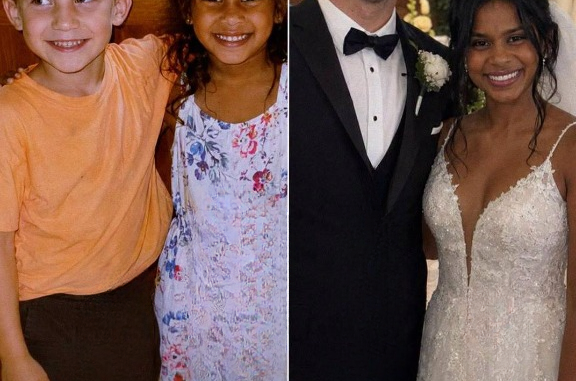
Monica never forgot Leo, the little boy who had been her closest friend when they were five years old. They grew up just a few houses apart, spending every day together building forts, riding bicycles, and making childhood promises. The day his family suddenly moved away, Leo hugged her tightly and promised, “One day I’ll come back, find you, and marry you.” Though she laughed at the idea, she carried those words with her for years.
Life moved on. Letters never came, families relocated, and Leo slowly became nothing more than a treasured memory. As an adult, Monica worked in a bakery, pouring her heart into decorating wedding cakes. Then, one rainy evening just before closing, a familiar-looking man walked through the door.
He smiled, called her by name, and introduced himself as Leo.
Overwhelmed with emotion, Monica embraced him without hesitation. He claimed he had spent years searching for her after his family’s move, explaining how life had separated them. As they rebuilt their connection, he effortlessly recalled stories from their childhood—the bicycle crash, the blanket forts, the pond where she pushed him, and countless little details only Leo could have known. Although he occasionally mixed up minor memories, Monica assumed twenty years had simply blurred them.
Their relationship blossomed. He was kind, attentive, patient, and quickly became part of her family. Her mother adored him, convinced fate had reunited the childhood sweethearts. A year later, he proposed at the same ice cream shop they had loved as children, reminding Monica of the promise he’d made at age five. She happily accepted.
The night before the wedding, however, he stood alone on their balcony looking troubled. He asked Monica whether someone could do something terrible for a reason that had once seemed good. Assuming he was simply nervous, she reassured him and thought nothing more of it.
The following afternoon, friends and family gathered inside a small chapel. Monica walked down the aisle smiling, but something about Leo seemed different. He looked frightened instead of joyful.
Just before exchanging vows, he stopped the ceremony.
“I can’t marry you today,” he confessed.
The room fell silent.
Then he pulled out an old photograph showing two nearly identical boys standing together.
Pointing to one, he said, “This is Leo.”
Then he pointed to himself.
“My name is Jake.”
Monica refused to believe him, but Jake admitted everything.
The real Leo had been his cousin. After Leo’s family moved away, the boys grew up together, looking so much alike that people constantly confused them. Leo often spoke about Monica, never forgetting their childhood friendship or the promise he’d made before leaving.
Several years earlier, Leo had been diagnosed with a rare cancer. Before he died, he begged Jake to find Monica and tell her he had never forgotten her.
Jake had intended to deliver that message honestly.
But when he finally visited Monica’s bakery, she recognized him instantly as Leo before he could explain. She ran into his arms, crying with happiness, and he couldn’t bring himself to tell the truth. One lie became another, and before long he was living the life that had belonged to his cousin.
Everything spiraled from there.
He admitted that many childhood memories came directly from Leo’s stories, while others he learned from old photographs and conversations. Yet he insisted his feelings for Monica were genuine. The proposal, his affection, and the life they built together had been real—even if they had begun with deception.
Heartbroken and furious, Monica ended the wedding immediately.
She walked out of the chapel, leaving Jake behind.
Outside, Jake confessed one final truth: Leo had spent years trying to find Monica but never managed to locate her after her family moved. On his deathbed, Jake had promised to tell her everything—but instead he had broken that promise by pretending to be someone he wasn’t.
For four months Monica refused all contact.
During that time she mourned Leo properly for the first time, while also grieving the man she thought she’d known for two years.
Jake respected her wishes. The only thing he sent was a heartfelt letter introducing himself honestly for the first time. He admitted he wasn’t the boy who had taught her to ride a bike, but simply a flawed man who had fallen in love, lied out of fear, and would answer any question she had without asking for forgiveness.
Eventually Monica agreed to meet him in a public park.
This time there were no lies.
Jake answered every difficult question. The little daily acts of love—making her coffee, listening after long workdays, sharing his interests and fears—had all been genuine. Only the identity he had built their relationship on was false.
When he quietly asked whether she still wanted to marry him, Monica said no.
She explained that she didn’t know if she could ever reach that point again, but admitted she had truly loved the man she’d spent two years with—she had simply never known his real name.
Rather than rushing back into a romance, they chose to start over from the beginning.
Jake reintroduced himself to her family and friends as himself. He apologized sincerely to her mother without expecting comfort or forgiveness. Both sought counseling separately before trying it together, rebuilding trust piece by piece.
A year later, they visited Leo’s grave together.
Monica placed the childhood photograph beside the headstone and quietly admitted she had been angry that Leo had died before they could reunite. She also told him she was slowly learning to trust Jake—not because of the lies he had told, but because he had finally accepted responsibility for them.
Standing there, Monica realized she no longer saw Jake as Leo’s shadow.
She saw him as an imperfect man who had made a terrible mistake, confessed before it became permanent, accepted the consequences, and was trying to become someone worthy of honesty.
They didn’t set another wedding date or make grand promises about forever.
Instead, they chose to discover whether a relationship built on truth could grow from a beginning founded on lies.
For the first time since they met, Jake told Monica he loved her as himself.
And this time, when she said she loved him too, it was the start of something entirely real.
Leave a Reply