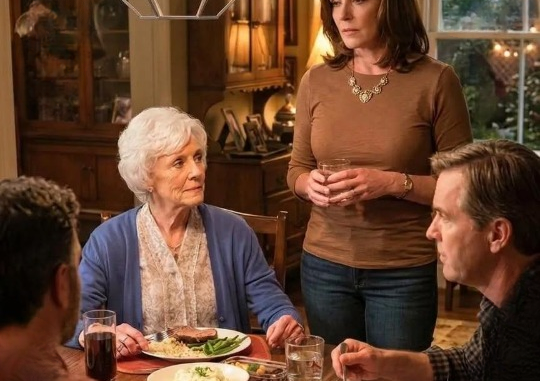
My daughter lifted her glass during Sunday dinner and announced that the woman sitting beside her had come to determine whether I was still capable of living in my own home. Everyone at the table went silent. The roast I had spent hours preparing sat untouched beneath the dining room lights.
“It’s only because I care about you, Mom,” Denise said, using the same gentle tone she always used when she wanted to make something hurtful sound like an act of love.
Her brother Gary looked stunned. Her husband, Kyle, avoided everyone’s eyes and focused on his plate. Dr. Okafor, the evaluator Denise had brought with her, appeared almost as uncomfortable as I was.
I didn’t argue. I didn’t raise my voice. I simply invited the woman to eat dinner and agreed to take every test Denise had arranged.
I was 70 years old and had been living alone since my husband, Elden, passed away three years earlier. I still lived in the Nebraska home he and his father had built with their own hands. The house was worth nearly $385,000, and for months Denise had been suggesting that I move into assisted living, sell the property, or “make things easier” by downsizing.
What she never mentioned was that she and Kyle were struggling financially. Their mortgage business had taken a hit, and they were already four months behind on their own house payments, owing almost $14,000.
After overhearing Denise talking about selling my home without my knowledge, I quietly took steps to protect myself. I met with a family attorney, Howard Lindqvist, who helped place my house, savings, and Elden’s pension benefits into a revocable trust with a bank acting as a co-trustee.
My doctor also completed a detailed cognitive evaluation confirming that my memory, judgment, and decision-making skills were completely intact.
When the official evaluation began, Denise tried answering questions for me several times.
Dr. Okafor eventually stopped her.
“Please allow your mother to respond for herself,” she said.
After Denise left the room, the evaluation continued. I answered questions about my finances, recalled details from memory tests, explained my accounts, and provided my previous medical assessment.
The results were clear.
There was no indication that I was unable to care for myself.
However, Dr. Okafor noticed something else. She recognized possible signs that someone might be attempting to pressure me financially, and she explained that she would have to document those concerns.
After she left, I asked Gary and my granddaughter Sophie to remain behind for a moment.
I placed the trust paperwork on the table next to my phone.
Then I looked at Denise.
“There’s one more evaluation you need to hear,” I said.
And I pressed play.
The recording filled the room.
It was Denise’s voice explaining that if I were declared mentally incapable, she could seek guardianship and gain control over my finances.
She talked about using power of attorney, selling my house, and keeping the details hidden from Gary and Faith until everything was completed.
The room went completely quiet.
But Denise’s plan had already failed.
My attorney had ensured that no one could secretly transfer, mortgage, or misuse my property. With the bank serving as co-trustee, even a legal attempt to take control would not be simple.
Denise’s face turned pale.
Kyle finally admitted the truth: their financial problems had pushed them into desperation.
I told them clearly that my home, insurance money, and estate were not going to become a solution for their debts.
But I also offered another option.
Through the trust, they could receive a legitimate loan with written repayment terms and financial counseling—help, but not at the cost of my independence.
Eventually, Denise and Kyle accepted the arrangement.
They began counseling and started rebuilding their finances.
But forgiveness did not happen overnight.
Eleven days later, Denise called.
She asked if she and Sophie could come over and help me can tomatoes, something we used to do together before everything changed.
She also asked if I would teach her how I managed my finances instead of assuming I was no longer capable.
I agreed.
Not because the betrayal had disappeared, but because trust could only return through honesty and accountability.
Today, I still live in my home on Larkspur Lane.
I climb my stairs.
I pay my own bills.
I make my own decisions.
And the next time my daughter questions whether I can handle my own life, she won’t need to bring a stranger to judge me.
She can simply ask me.
Leave a Reply