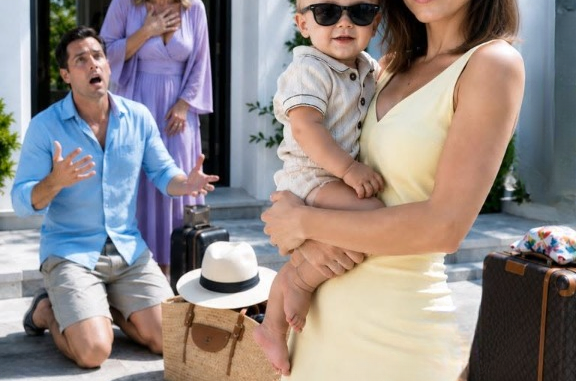
My one-year-old son was burning with a dangerously high fever, but my mother-in-law just rolled her eyes. “You’re making a fuss over nothing. He’ll be fine by tomorrow, and we’re not canceling our Hawaii vacation.” My husband sided with her, packed his suitcase, and left me alone with our trembling little boy. A week later, they came home smiling—only to find an empty house and a single envelope waiting on the table. The moment my husband read the first sentence, the color drained from his face.
The night my son nearly lost his life, my husband chose a tropical getaway instead of staying with his own child.
By sunrise, I had stopped begging him to care and started planning a future without him.
Ethan shook in my arms beneath a damp blanket, his tiny body burning with a fever of 104.2.
Fighting to stay calm, I called Mark from the nursery.
“We have to take him to the hospital. Right now.”
Mark stood in the hallway beside an open suitcase while his mother, Diane, calmly fastened a gold bracelet onto her wrist. She wore the smug expression she always had whenever she believed she’d gotten her way.
She glanced at the thermometer and dismissed it with a sigh.
“You’re overreacting. Babies get fevers all the time. He’ll be better tomorrow, and we’re certainly not canceling our Hawaii trip.”
I looked straight at Mark.
“Our son can barely keep his eyes open.”
Instead of answering me, he looked at his mother first.
“Mom raised three kids. She knows what she’s doing.”
“You’re actually leaving?”
“It’s only a week, Claire. Stop turning everything into an emergency.”
His words stung, but instead of breaking down, something inside me settled.
For years, every concern I raised had been brushed aside.
Whenever I questioned the money disappearing from our accounts, Mark called me emotional.
Whenever I objected to Diane letting herself into our home, rearranging Ethan’s nursery, or treating me like hired help, she called me ungrateful.
They believed I stayed because I was weak.
What they forgot was who I had been before becoming a wife and mother.
Before Ethan was born, I worked as a forensic accountant for a federal contractor, specializing in tracing hidden money through fake companies, forged documents, and fraudulent transactions.
Motherhood had changed my career—not my instincts.
“Go,” I said quietly.
Mark frowned.
“What?”
“Go enjoy Hawaii.”
Diane smiled triumphantly.
“Finally. Some common sense.”
The second their car disappeared down the street, I rushed Ethan to the emergency room.
Doctors diagnosed him with a severe kidney infection that had already begun progressing toward sepsis.
After hearing how long Mark had known about the fever, the pediatrician looked horrified.
“If you’d waited until tomorrow,” she said, “your son might not have survived.”
I stayed beside Ethan’s hospital bed, holding his tiny hand while antibiotics slowly flowed through the IV.
Then I opened my laptop.
For months, I had quietly saved records of every suspicious bank transfer Mark made.
That night I followed every dollar.
He had emptied nearly all of our joint savings, borrowed against our house, and funneled the money into a company owned by Diane.
Even worse, he’d forged my electronic signature on two separate loan documents.
Looking at my sleeping son, I whispered,
“They picked the wrong mother.”
By morning, Ethan’s fever had finally begun to drop.
At the same time, every illusion I still had about my marriage disappeared forever.
PART 2
By the second day, Ethan was finally stable.
I contacted only three people: my former supervisor, a family-law attorney named Naomi Price, and my father.
Mark always believed my dad owned a modest bookkeeping business in Ohio.
I had never corrected him.
In reality, my father led one of the region’s most respected financial fraud investigation firms, working with banks across multiple states.
Before getting married, I had spent nearly a decade building its digital forensic division.
Dad arrived that afternoon, kissed Ethan on the forehead, and silently reviewed everything on my laptop.
“How much?” he finally asked.
“Four hundred eighty-seven thousand dollars—including the home-equity loan.”
His expression hardened.
“And your signatures?”
“Forged.”
Naomi reviewed the evidence before giving me a cold smile.
“Perfect. Don’t confront them. Let them keep believing they’re safe.”
That advice was harder than anything else.
Following Naomi’s instructions, I preserved every text message, every hospital record, and every security-camera recording showing Mark willingly leaving while Ethan was critically ill.
She reminded me that judges trusted evidence—not emotions.
Meanwhile, Mark flooded social media with vacation photos.
Cocktails beside an infinity pool.
Diane wearing designer sunglasses.
Both of them smiling beneath the caption:
Some people choose happiness.
I replied with only four words.
“Ethan is improving.”
Mark answered with a thumbs-up emoji.
He never asked what illness our son had.
He never called the hospital.
Instead, he texted asking whether I’d paid the credit-card bill because the resort had temporarily frozen his account.
I ignored it.
Instead, Naomi filed emergency requests for temporary custody, exclusive possession of our home, and an immediate freeze on marital assets.
At the same time, Dad’s investigators assembled a complete forensic report detailing every fraudulent transfer, forged approval, and fake business expense.
Then we uncovered something even worse.
Diane’s company had billed Mark’s employer for consulting services that had never existed.
Mark had personally approved every payment.
The Hawaii vacation wasn’t simply selfish.
It had been funded with stolen money.
Still, I needed them to remain overconfident.
So when Diane called from Maui, I answered quietly.
“You’ve made your point,” I told her. “Please come home so we can talk.”
She laughed.
“There’s nothing to discuss. Mark finally understands that a wife supports her husband instead of questioning him.”
Then Mark took the phone.
“We’ll talk when I get back,” he said. “You should apologize to Mom.”
“I’ll leave something for you,” I replied.
“Good,” he said. “Make it sincere.”
After Ethan was discharged, I moved with him into my father’s secure guesthouse.
Professional movers collected only our belongings.
Everything remaining inside the house was photographed and documented through a court-approved inventory.
Finally, a process server placed a sealed packet directly in the center of our dining table.
On top sat the divorce petition.
Beneath it were emergency custody orders, the asset freeze, the forensic accounting report, and notice that Mark’s employer had received evidence of suspected financial fraud.
The evening before they returned, Dad found me standing in Ethan’s empty nursery.
“Are you scared?” he asked.
“Yes.”
“Of losing Mark?”
I looked down at Ethan sleeping peacefully against my shoulder.
“No,” I answered. “I’m afraid of ever becoming the woman who would forgive him again.”
PART 3
Mark and Diane returned the following Sunday, laughing as they unlocked the front door.
The security camera captured the exact second Diane’s smile disappeared.
The house was empty.
Mark spotted the envelope waiting on the dining-room table.
He called me eleven times before I finally answered.
“What have you done?” he shouted.
“I protected my son.”
“You froze all my accounts!”
“No,” I replied calmly. “The court froze marital assets after discovering you forged my signature.”
Diane grabbed the phone.
“Those transfers were family decisions.”
“No,” I answered. “They’re evidence.”
Someone suddenly knocked loudly at the front door.
The process server had returned—this time accompanied by an investigator from Mark’s employer.
Mark’s voice immediately softened.
“Claire… please tell them this is all a misunderstanding.”
“You said Ethan’s fever was just an inconvenience,” I replied. “Think of this paperwork the same way.”
Three days later, Mark appeared in court wearing an expensive suit, accompanied by Diane and his attorney.
He accused me of kidnapping Ethan and fabricating hospital records.
Naomi calmly handed the judge the emergency-room reports, followed by every message proving exactly when I warned him our son needed immediate medical care.
The judge paused at Mark’s thumbs-up emoji.
“You knew your one-year-old son had been hospitalized,” she said, “and this was your only response?”
Mark cleared his throat.
“My wife exaggerates.”
The pediatrician testified next.
“She did not exaggerate. The child was approaching septic shock.”
Then my father’s forensic team presented months of financial evidence.
Forged loan documents.
Missing savings.
Fake invoices.
Vacation expenses disguised as business costs.
As the evidence mounted, Mark’s attorney leaned over, desperately whispering in his ear.
Diane suddenly jumped to her feet.
“My son gave me that money!”
The judge looked up.
“Sit down before I remove you from this courtroom.”
Mark stared at me.
“You planned all of this.”
“I documented it,” I answered. “You planned it.”
The judge awarded me temporary custody, granted me exclusive use of the home, and limited Mark to supervised visits.
That same afternoon, Mark lost his job.
His employer referred the fraud investigation to prosecutors.
Authorities seized Diane’s business accounts.
She eventually sold her car, mortgaged her home, and watched both her company and reputation collapse.
Mark later tried negotiating.
He offered me the house if I withdrew the fraud allegations.
Naomi recorded the conversation and immediately forwarded it to investigators.
Six months later, Mark pleaded guilty to fraud and forgery.
He received eighteen months in county custody, probation, and an order to repay the stolen money.
Diane accepted a plea agreement on conspiracy charges, avoiding jail but losing her business, her savings, and the social status she’d always treasured.
The following spring, our divorce became final.
I sold the house and used my share of the proceeds to create an emergency fund helping single parents facing pediatric medical emergencies.
Soon afterward, I returned to my father’s firm as director of forensic investigations.
One year later, Ethan raced through our new kitchen laughing, healthy and full of life.
His terrifying illness had faded into memory.
The lesson never did.
One afternoon, my father asked whether I regretted destroying Mark.
I watched Ethan happily stacking wooden blocks across the floor.
“I didn’t destroy him,” I said quietly. “I simply stopped protecting him from the consequences of his own choices.”
Outside, the morning was peaceful.
For the first time in years, so was my heart.
Leave a Reply