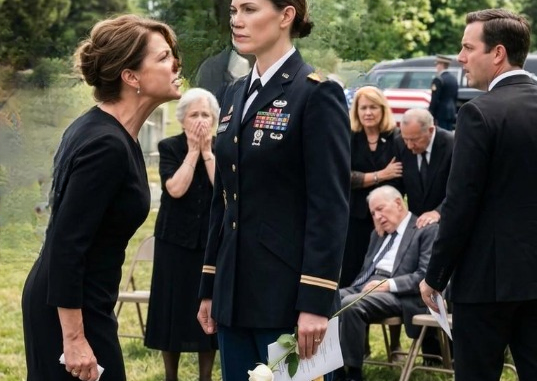
“Couldn’t you have worn a real black dress?” my sister Serena said loudly as we stood beside our father’s grave.
Several family members looked over at my Marine Corps dress uniform and exchanged quiet smiles, pretending her comment was harmless. My mother stood beside her and said nothing as the rain soaked through my coat and mud collected around my polished shoes.
Serena’s husband, Nathan Bellamy, smirked and called my uniform a costume. He joked that I was turning our father’s funeral into another “military show.”
What none of them knew was that I had arrived straight from a deployment situation after receiving two fallen Marines from my unit. Not one person asked where I had been, what I had gone through, or whether I was okay.
When the funeral ended, my family left together for Serena’s expensive suburban house without waiting for me.
I stayed behind.
I stood beside my father’s grave until the last bit of soil covered the ground, never realizing that Nathan was about to discover exactly who he had just mocked.
For three years, I had quietly helped take care of my father, Arthur Whitmore, while he battled a serious illness.
Whenever my mother, Vivian, called needing help with medical equipment, nursing costs, insurance bills, or mortgage payments, I sent money from my military income and hazard pay.
Sometimes it was $2,500 at a time.
Altogether, I contributed nearly $90,000.
Serena always claimed she and Nathan were handling everything, but her social media told a different story. While I was overseas, she posted pictures from expensive restaurants, vacations, and charity events.
My father never saw my service as something embarrassing.
He kept my deployment letters.
He followed every promotion.
He learned every rank I earned.
During one hospital video call, he once asked me to step back so he could see my full uniform.
“That’s my girl,” he whispered proudly, lifting his weak hand toward the screen.
But at his wake, Serena told Nathan’s wealthy friends that she was the one who had arranged and paid for Dad’s care.
My mother noticed me hearing it.
She gave me the same look she had given me for years — the silent warning to stay quiet and protect the family’s reputation.
Later, Nathan approached me holding a glass of wine.
“So what exactly do you do in the military?” he asked.
He guessed I probably handled paperwork or trained younger soldiers.
Then he offered to help me find a “normal” office job when I was ready to leave the military.
Serena laughed.
My mother added that Dad had always wanted me to choose a more stable career.
Before I could respond, someone else entered the room.
Master Sergeant Daniel Keats, one of my father’s oldest friends, walked in wearing a simple suit with a veteran pin on his jacket.
His eyes immediately moved toward my uniform.
He looked at my ribbons.
My medals.
My insignia.
Then his entire expression changed.
He recognized what they represented.
Nathan noticed his reaction but misunderstood it.
He started bragging about his law firm, explaining that Bellamy, Stroud & Kline worked with high-ranking military officials on an important defense logistics project called Bid 132.
Then he laughed and joked about whether my medals were earned for “just showing up.”
That was when I finally stepped forward.
I looked him directly in the eyes and said:
“Colonel Elena Whitmore, commanding officer of Strategic Task Force 132.”
The confidence disappeared from Nathan’s face.
His wine glass slipped, spilling onto his shoe.
But that was only the beginning.
At that exact moment, a secure message appeared on my phone.
The message confirmed that Nathan’s firm was already under review by an independent procurement ethics board connected to Bid 132.
The investigation involved concerns about inaccurate financial projections, undisclosed relationships, and questionable communications with defense officials.
I immediately reported my connection to Nathan and removed myself from any involvement in the final contract decision.
I wanted the process to remain completely fair.
No one would ever be able to claim my personal feelings influenced the outcome.
The investigation later revealed that Nathan’s firm had misrepresented costs and attempted to use personal connections to gain influence with government officials.
At the same time, my father’s estate attorney contacted me with another discovery.
Bank records showed that my money — not Serena’s — had covered the majority of Dad’s medical expenses, insurance payments, and mortgage costs during his final years.
Even worse, Serena and Nathan had taken credit for several of my contributions while quietly protecting their own savings and investments.
When they were confronted with the documents, Nathan threatened legal action.
But his own attorney quickly explained that the evidence was overwhelming.
The financial records, estate documents, and procurement investigation left no room for argument.
His firm eventually withdrew from the contract.
Several business partners demanded accountability.
And Serena had nothing to say when the attorney placed years of financial records in front of her.
I never celebrated Nathan losing his position.
I never wanted revenge.
What mattered was correcting the story my family had been telling for years.
My father’s care had not been carried by Serena alone.
My sacrifices had not been invisible.
My service was not something to mock.
Eventually, my mother admitted the truth.
She said she allowed Serena to take credit because Nathan’s wealth and connections made things easier, while my military life felt distant and difficult for her to explain.
Serena never gave me a sincere apology, but she stopped telling people she had carried the entire family by herself.
Before I returned to duty, Master Sergeant Keats gave me my father’s folded flag and a letter Dad had written before he passed away.
In it, he said my courage and dedication were the greatest things he had ever been proud of.
I kept that letter with me.
I kept the flag beside my desk.
My family thought my uniform made me someone they could look down on.
My father knew the truth.
It represented sacrifice, responsibility, and the strength to stand alone when doing the right thing was more important than being accepted.
Leave a Reply