My Husband Promised to Pick Me Up After the ER—Instead, I Found a Text Saying He Had Already Left for His Parents’ Anniversary Trip and That I Should Find My Own Ride. I Thought It Was a Last-Minute Choice Until His Sister Messaged Me Before I Even Got Home.
Kara’s message came through while my rideshare was still leaving St. Vincent’s.
Thanks for understanding about Caleb going. Mom was already upset about the possibility of him missing the anniversary weekend.
I read it twice before replying.
I never told him to go.
The typing bubble appeared, disappeared, then came back.
Wait. What?
I didn’t respond right away.
The car’s air conditioning was freezing, and every turn made the dizziness return. The ER doctor believed my vertigo was probably caused by dehydration following a stomach virus. I was told to rest, drink plenty of fluids, and contact my primary doctor Monday if I wasn’t getting better.
It wasn’t life-threatening.
But I had spent seven miserable hours under fluorescent lights, vomiting into a basin and struggling to stay upright whenever I stood.
Caleb knew exactly how bad I felt.
At 11:40 that morning, he had texted:
I’m still here. I’ll pick you up as soon as they discharge you.
At 12:26:
Mom keeps asking when we’re leaving. Don’t worry about it.
At 1:18:
They’re taking forever.
Then, at 2:07, shortly after the nurse gave me my discharge papers:
I’m sorry. If I don’t leave now, I’ll miss dinner. You’re cleared to go home, so can you get an Uber? I already headed north.
I called him immediately.
No answer.
I called again.
His response came by text:
Driving. We’ll talk later.
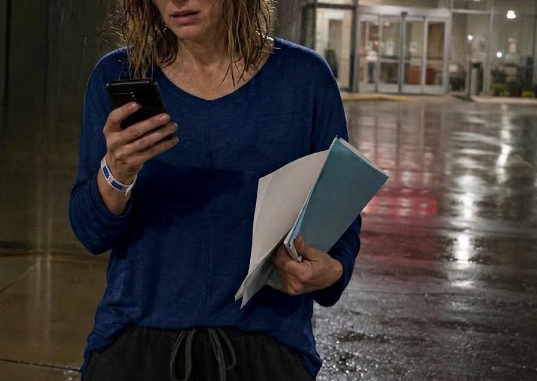
So I sat outside the hospital entrance with two electrolyte drinks, my discharge papers, and the blue hospital wristband still around my arm.
Caleb’s parents were celebrating their fortieth wedding anniversary at a cabin in northern Michigan.
This wasn’t some casual family getaway.
Pamela had been planning it since January.
All three adult children were expected Friday evening. Saturday included catered dinner, family photos, and possibly a boat outing Sunday morning if the weather was good.
I had handled most of the arrangements.
I found the cabin.
Compared catering prices.
Made the Friday dinner reservation because Pamela hated making phone calls.
Ordered the anniversary cake.
Two days earlier, I had even packed a cooler with breakfast groceries because Caleb’s older brother had forgotten food on their previous trip.
I genuinely wanted to go.
That mattered.
Thursday night, I had been sitting on the bathroom floor fighting nausea when Caleb crouched beside me.
“If you’re still this sick tomorrow, we’ll stay home.”
I told him I hoped we wouldn’t have to.
Friday morning, I nearly collapsed walking from the bedroom to the kitchen, so Caleb drove me to the ER.
Before we left, I pointed toward the two bags packed beside our bedroom door.
“If they let me out early enough, we can still make it.”
He kissed my forehead.
“I’ll grab everything when I come back for you.”
That was the plan I believed in.
Until 2:07.
When the rideshare dropped me home, my suitcase was still beside the bedroom door.
Caleb’s was gone.
So was the cooler.
I stood there staring at the empty space in the kitchen.
He had come home.
He had walked past my packed bag.
He had loaded the groceries I had purchased for his family.
Then he had driven north without me.
My phone buzzed again.
Kara.
I’m calling you.
I almost ignored it.
Instead, I answered.
“Leah?”
“Yeah.”
“You really never told him to go?”
“No.”
There was a long pause.
“That’s not what he told Mom.”
I sat at the kitchen table.
“What did he tell her?”
Kara lowered her voice.
“He said you were being discharged and told him not to ruin the weekend.”
My stomach tightened.
“I never said that.”
“Oh.”
That single word told me she believed me.
Kara wasn’t cruel. Neither were Caleb’s siblings.
Their family simply had a quieter problem.
Pamela planned everything months ahead and treated changes as personal rejection.
If someone missed Thanksgiving, she demanded an explanation.
If a grandchild had a Saturday game during a family birthday, she wanted to know why the game couldn’t be skipped.
Caleb had spent most of his life trying to prevent his mother from being disappointed.
I had spent eleven years helping him do it.
“Did she pressure him?” I asked.
Kara sighed.
“She kept saying Dad would notice if one of them wasn’t there. Caleb said he might have to stay with you. Mom told him, ‘She’s at a hospital, not stranded somewhere. They won’t discharge her if she can’t take care of herself.’”
I closed my eyes.
Kara continued.
“I’m not saying that excuses what he did.”
“Did he tell her I agreed?”
“Yes.”
“When?”
“Before lunch.”
Before lunch.
At that moment, I was still sitting in the ER waiting for my IV fluids to finish.
Caleb had already decided that if I was discharged, he was leaving.
His later text hadn’t been a sudden decision.
It was simply the first time he admitted to me that he’d already made the choice.
After the call ended, I carried my bag into the bedroom.
I changed into an old T-shirt, finished half an electrolyte drink, and went to bed.
At 5:43, Caleb finally called.
I watched his name appear.
Then disappear.
Ten minutes later, he called again.
I answered.
“Hey,” he said cautiously. “How are you feeling?”
“Did you tell your family that I told you to go?”
Silence.
Only a couple of seconds.
But long enough.
“Leah—”
“Did you?”
“I told them you understood.”
“That isn’t what I asked.”
He exhaled.
“Yes.”
I looked toward the bedroom doorway.
My packed bag was still sitting there.
“Why?”
“Because Mom was already making it into a whole thing. I didn’t want everyone spending the weekend angry with you.”
“So you lied about me to make things easier for yourself.”
“I was trying to keep the peace.”
“With them.”
“That isn’t fair.”
“Where are you?”
“About twenty minutes from the cabin.”
He had already driven nearly four hours.
There had been plenty of opportunities to turn around.
I said, “Go enjoy the weekend.”
“Leah, don’t do that.”
“I’m exhausted. I need to sleep.”
“We’ll talk Sunday.”
I ended the call.
Then I noticed a folded sheet sticking out of the side pocket of my weekend bag.
It was the cabin itinerary Pamela had emailed earlier that week.
Caleb had printed two copies Thursday night.
Friday dinner.
Saturday breakfast.
Family photographs.
Boat rental.
Next to Friday afternoon, written in Caleb’s handwriting, was a note I’d never seen:
If Leah is still sick, leave by 1:30 alone.
He had written it before we even went to the hospital.
PART 2
I photographed the note and sent it to Caleb.
He called almost immediately.
“I wrote that last night,” he explained. “I was trying to make a backup plan.”
“A backup plan you never told me about.”
“I didn’t know what the hospital would say.”
“Neither did I. That’s why you were supposed to wait.”
He fell silent before finally admitting the truth.
“I knew Mom would make the entire weekend miserable if I canceled. I thought if the doctor released you, that meant you were well enough to be home without me.”
There it was.
Not cruelty.
Not confusion.
A decision.
He had interpreted being medically cleared to leave the ER as meaning I no longer needed him.
I told him I was going to sleep and silenced my phone.
Saturday morning, I woke after nine to six messages in the family group chat.
Pamela wanted confirmation about the cake.
Caleb’s brother needed the boat-rental address.
Someone had forgotten coffee filters.
Normally, I would have handled all three.
Instead, I sent one message:
Everything I arranged is in the shared trip folder. I’m recovering at home, so you’ll need to handle the rest yourselves.
Pamela answered almost immediately.
Of course. We just don’t want Caleb stressed during his parents’ anniversary weekend.
I stared at the message.
Then put my phone down.
Around noon, Kara called to check on me.
She apologized for assuming I’d told Caleb to leave.
“He needs to correct that with Mom,” she said.
“I agree.”
That evening, Caleb called again.
He sounded different.
Less defensive.
He said dinner had been uncomfortable after Kara told him she knew what had actually happened.
“Mom thinks this is between us,” he said.
“It is.”
“But she keeps saying you would’ve wanted me to come if you were thinking clearly.”
I laughed quietly.
“Caleb, listen to what you’re saying.”
He became silent.
I told him the hospital wasn’t the only issue.
The real problem was that he’d invented my answer because the truth might disappoint his family.
“I’ve spent eleven years helping you manage your mother’s feelings,” I said. “I’m done doing that.”
“What does that mean?”
“It means your family’s plans are yours to handle. Reservations, groceries, gifts, schedule changes—all of it. I’m not going to be the buffer anymore.”
He said, “Okay.”
It sounded like he thought that was the entire consequence.
It wasn’t.
Sunday morning, he texted that they were leaving after breakfast and he’d be home around two.
I looked at the discharge papers on my dresser and the weekend bag I’d never unpacked.
Then I replied:
Don’t come home today. Stay at your brother’s tonight.
His response came immediately.
Leah, seriously?
Yes. I need a few days where I don’t have to make this easier for you too.
The typing bubble appeared.
Stopped.
Then started again.
Finally:
Okay.
For the first time all weekend, he accepted my answer without trying to rewrite it into something more convenient.
PART 3
Caleb stayed with his brother Sunday night.
Monday morning, he sent one message.
Can I come by after work tomorrow?
I said yes.
Tuesday evening, he arrived at 6:15 carrying a small pharmacy bag with medication my doctor had prescribed.
He didn’t bring flowers.
I was glad.
Flowers would’ve made the conversation feel like something that could be fixed with a simple gesture.
He placed the bag on the counter.
“Can I sit down?”
I nodded.
For a moment, neither of us spoke.
The house looked normal again.
My weekend bag had finally been unpacked.
The hospital wristband was in the trash.
The empty electrolyte bottles were in the recycling bin.
Caleb looked exhausted.
“I told my family the truth,” he said.
“What truth?”
“That you never told me to leave. I decided to go, and I told everyone you were okay with it because I didn’t want Mom angry with me.”
I asked whether he’d told Pamela directly.
“Yes.”
“How did she react?”
He rubbed his forehead.
“She said she never told me to abandon you.”
“That may technically be true.”
“I know.”
He looked down.
“She also said I’m an adult and she can’t make me do anything.”
“That’s true too.”
He nodded.
For once, he wasn’t using his mother’s behavior as the only explanation.
“I’ve been thinking about what you said,” he continued. “About spending eleven years helping me manage her disappointment.”
I waited.
“You have.”
There was no excuse afterward.
I appreciated that.
Caleb had grown up in a family where keeping Pamela happy was everyone’s responsibility.
If she was disappointed, everyone adjusted.
Restaurants changed.
Weekends moved.
Holidays stretched longer.
Someone always called to smooth things over.
I had become part of that system because I thought being a good wife meant making his family life easier.
Eventually, I became resentful because no one noticed how much I was doing.
That part was mine to acknowledge.
“I should’ve stopped years ago,” I said.
Caleb looked surprised.
“I’m not saying what you did was my fault. It wasn’t. But I kept volunteering to make everything run smoothly and then acting like I had no choice.”
He nodded.
“So what happens now?”
“I don’t know yet.”
That was the most honest answer I could give.
I wasn’t ready to say our marriage was fine.
I wasn’t ready to say it was over.
I told him I wanted another week sleeping separately.
When he returned home, he would use the guest room.
I wanted us to see a marriage counselor.
And I wanted one rule immediately.
“You don’t speak for me anymore.”
He looked confused.
“What does that mean?”
“If your mother asks whether I’m attending something, you tell her you’ll ask me. If your sister asks whether I’ll organize something, tell her to ask me. If I’m sick, upset, busy, or undecided, you don’t turn that into whatever answer keeps everyone else comfortable.”
“Okay.”
“And your family’s logistics belong to you now.”
He almost smiled.
“That part I understand.”
“I mean it.”
“I know.”
The first test came quickly.
Thursday afternoon, Pamela messaged the family group.
Since Leah already has everyone’s food preferences, can she handle Thanksgiving reservations this year?
I saw it while standing in the grocery store.
Before I could decide whether to respond, Caleb replied:
Mom, I’ll handle the reservation. Leah isn’t coordinating family events anymore.
Pamela responded:
I was only asking.
Caleb wrote:
I know. I’m answering.
Nothing dramatic followed.
No argument.
No family meltdown.
The conversation simply moved on.
That was new.
Counseling was harder.
During our second session, Caleb admitted something I had suspected.
When he realized I might miss the anniversary trip, he felt embarrassed.
Not because I was sick.
Because he knew Pamela would make his absence the center of the weekend.
“I thought I could avoid all of it if I got you home and left,” he admitted.
The counselor asked why he’d told everyone I had approved.
Caleb answered honestly.
“Because then nobody could say I chose the trip over my wife.”
I looked at him.
“But you did.”
“Yes.”
That was the first time he’d said it without softening the truth.
It didn’t repair everything.
But it made rebuilding possible.
Over the following months, I watched what he did instead of listening only to what he promised.
Caleb arranged his mother’s birthday dinner.
He bought his father’s Christmas gift without asking me what to choose.
When his brother created a group chat about a spring fishing trip, Caleb handled his own arrangements and only included me if I wanted to come.
I stopped checking whether he remembered family dates.
A few things were forgotten.
Nobody died.
Pamela remained distant for a while.
Then one Sunday, she called and asked whether I wanted to have lunch with her.
Not whether Caleb and I were coming.
Whether I wanted to come.
I said yes.
Lunch was awkward.
She never gave me the dramatic apology I had imagined during that ride home from the hospital.
Instead, while we cleared the dishes, she said, “I shouldn’t have pressured him about that weekend.”
I answered, “No, you shouldn’t have.”
She nodded.
That was enough.
I didn’t need to make it bigger than it was.
Six months after the ER visit, I had a routine appointment at the same medical complex.
Nothing urgent.
The night before, Caleb asked:
“Do you want me to drive you, or would you rather go alone?”
That question meant more than he probably realized.
“I want you to drive me.”
“Okay.”
He blocked off the morning on his calendar.
The next day, we arrived early.
While I checked in, his phone buzzed.
Pamela’s name appeared.
He glanced at it, silenced the call, and put the phone away.
“You can answer,” I said.
“I’ll call her later.”
He stayed beside me until they called my name.
Afterward, we walked through the same glass doors where I had stood alone six months earlier.
The pickup lane was crowded with cars.
For a moment, I remembered the hospital wristband, the paper bag, and the message telling me to find my own ride.
Caleb didn’t make a speech.
Neither did I.
He simply opened the passenger door.
On the drive home, he asked what I wanted for dinner.
“Soup.”
He nodded and turned toward the grocery store.
Leave a Reply