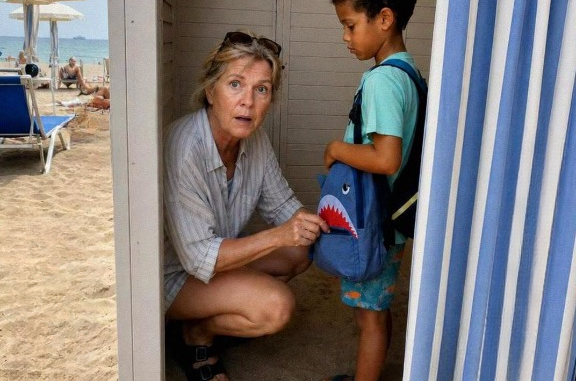
For six years, I trusted Cheryl with my son more than anyone. Then I found her inside a beach changing booth, whispering that Mommy could never find out what was hidden inside his backpack. By the end of the day, one tiny glass bottle revealed she had been teaching him something I never even realized.
The curtain was slightly open, just enough for me to see Nathan’s blue sandals.
That was the first reason I stayed calm.
The second was Cheryl’s voice.
I didn’t panic.
It was the same voice that sang terribly while making pancakes every Wednesday morning; the one Nathan copied when he told his stuffed animals to listen.
That voice had always reminded me how lucky I was to have married into Will’s family.
Then she whispered, “Now tell Grandma what we promised.”
I froze with my hand inches away from the curtain.
“Now tell Grandma what we promised.”
Inside the booth, Nathan answered in a serious little voice, almost like he was repeating something he had practiced.
“Mommy can never know what you gave me.”
The ground beneath me suddenly felt unsteady.
Cheryl responded quietly.
“That’s my good boy.”
I pulled the curtain open.
Cheryl was kneeling in front of my six-year-old son. One hand rested gently on his shoulder. The other hovered near the front pocket of his shark backpack, where the zipper had just been closed.
For a moment, nobody moved.
Nathan looked up at me, confused by my expression.
Then his eyes widened.
“Mommy?”
I reached for him immediately.
“What did Grandma give you?”
The zipper was still closed.
Cheryl stood up quickly.
“Taylor, please.”
That one word told me she knew exactly how this looked.
I pulled Nathan behind me and grabbed his backpack.
Cheryl stepped closer.
“Don’t open it here.”
But I opened it anyway.
Inside the front pocket was a tiny glass bottle tied with a blue ribbon.
At the bottom was beach sand. Above it were dozens of tiny rolled-up pieces of paper, each one carefully folded and packed inside.
A small tag hung from the bottle, written in Cheryl’s neat handwriting.
“For Nathan, when ordinary days become hard to remember.”
I froze.
The beach suddenly felt different.
People nearby turned to look. Children stopped playing. A woman washing sunscreen from her hands stared in our direction.
Nathan started crying because I had shouted.
The color disappeared from Cheryl’s face.
“I’m sorry, sweetheart,” she whispered to Nathan.
I pulled him closer.
“Don’t.”
Will came running back from the pier, sand covering his legs and a fishing pole still in his hand.
I held up the bottle.
“Your mother told our son to hide this from me.”
Cheryl closed her eyes.
For the first time, I saw her look old.
Every summer, Will’s parents rented the same small blue beach house on the Gulf Coast for the entire family.
By the second day, the porch was covered with beach towels.
The kitchen smelled like lemon cleaner and fried shrimp.
The refrigerator was always filled with Cheryl’s labeled containers because she believed kids became happier when their grapes were already washed.
That was the kind of grandmother she was.
Thoughtful.
Reliable.
Always there.
She never missed a birthday. She knitted Nathan a sweater every Christmas, even though we lived in Texas and he would sweat just walking outside.
Every Wednesday, she picked him up from kindergarten and made pancakes shaped like whatever animal he loved at the time.
One week, whales.
Another week, armadillos.
Once, Nathan asked for a dragon, and Cheryl made something that looked more like a strange shoe with horns.
He ate the entire thing and said it was “probably sleeping.”
He adored her.
Whenever anyone asked who his favorite person was, he answered immediately.
“Grandma!”
And I loved that.
That Saturday started like every other beach day.
Will and his father went fishing before lunch.
The kids built a giant sand castle and called it a fortress.
Cheryl sat under the striped umbrella, sorting grapes because Nathan refused to eat the wrinkled ones.
It was one of those simple afternoons you never think will become important.
Sun on our shoulders.
Sand everywhere.
Snacks crushed into towels.
Nathan running around with his shark backpack bouncing behind him.
“Don’t go too far,” I called.
“Okay, Mommy!”
I turned away for only a few minutes to help my niece.
When I looked back, Nathan was gone.
At first, I checked the obvious places.
The water.
The snack stand.
The pirate ship playground.
I even smiled, thinking Cheryl probably took him for ice cream and would come back laughing.
Then I saw the changing booths.
The blue sandals.
The curtain.
And I heard my son promise that I would never know.
That was when I knew I needed answers.
Back at the beach house, I kept the bottle hidden until Nathan finally fell asleep.
It took longer than normal.
He asked if Grandma was in trouble.
Then he asked if secrets were always bad.
I sat beside him and chose my words carefully.
“Some secrets can make people feel scared or unsafe,” I told him. “Surprises are different. Surprises are things that make people happy when the time comes.”
He looked at the ceiling.
“Grandma said surprise.”
I brushed the sand from his eyebrow.
“But you said secret.”
He thought for a moment.
“I forgot the difference, Mommy.”
After he fell asleep, I found Cheryl sitting alone at the kitchen table.
Will stood nearby, quiet.
The bottle was sitting between us.
Cheryl hadn’t asked for it back.
That somehow made everything more confusing.
“Explain,” I said.
She stared at the bottle.
Then she reached into her pocket and pulled out an old folded piece of paper.
“I never showed you this before,” she said.
Her hands shook slightly.
“This belonged to my mother.”
She unfolded it carefully.
“My mother wrote this when I was nine years old. We were visiting a lake, and I had lost my front tooth. I refused to smile in pictures.”
She smiled faintly.
“She wrote, ‘Cheryl keeps hiding her smile behind watermelon slices. She thinks nobody notices. We all notice.'”
She placed the paper beside the bottle.
“When my mother died, I thought grief would take away the important memories first.”
The room became silent.
“But it didn’t.”
Her fingers touched the old paper.
“The first things I forgot were ordinary moments.”
“The way she laughed when she burned pancakes.”
“The song she hummed while watering flowers.”
“Whether she moved her hair before reading or after.”
Her eyes filled with tears.
“I still loved her. But love wasn’t enough to keep every little memory alive.”
Nobody spoke.
“That summer after she passed away, I started writing down one ordinary memory every time we came here.”
“Not birthdays. Not special occasions.”
“Just the little things you never realize you might lose.”
I looked at the tiny papers inside the bottle.
They no longer looked suspicious.
They looked precious.
I opened the bottle and pulled out the first note.
It read:
“The first time your mommy saw the ocean, she cried because she thought the waves were chasing her.”
I laughed softly.
“You remembered that?”
Will smiled.
“You told me you screamed louder than Nathan did.”
I covered my face.
“I forgot that.”
“I know,” Cheryl said gently.
The next note said:
“Your daddy whistles whenever he’s nervous, even though he doesn’t realize it.”
Will immediately stopped whistling.
I laughed.
I hadn’t even noticed.
Another note said:
“Nathan cried because a crab only had one claw.”
Then another:
“Your mommy always brings broken shells home because she thinks someone should love them too.”
I stared at the words.
Every summer, I collected broken shells.
I never knew why.
One by one, the notes revealed little pieces of our family that I had forgotten.
“Daddy checks your beach chair before sitting because he worries about hurting your fingers.”
“Nathan falls asleep faster when someone rubs circles on his back.”
None of these moments were huge.
That was exactly why they mattered.
They were the little pieces of life that disappear while we focus on tomorrow.
I looked at Cheryl.
“When did you start asking Nathan that question?”
“What question?”
“What happened today that you never want tomorrow to forget?”
She smiled.
“I was teaching him to notice.”
The words stayed with me.
Children learn to walk.
They learn to read.
They learn to ride bikes.
But Cheryl had been teaching my son something much deeper.
How to appreciate the moments that disappear too quickly.
“Then why tell him not to tell me?” I asked.
She looked embarrassed.
“I wanted it to become a surprise one day.”
She sighed.
“But Nathan has never been good at keeping surprises.”
Will laughed.
“Remember the puppy?”
I smiled.
“And the Christmas present?”
Cheryl nodded.
“So I told him Mommy couldn’t know yet.”
She shook her head.
“He turned ‘surprise’ into ‘secret.'”
For the first time that day, I laughed.
“Of course he did.”
The next morning, everyone packed up to leave.
Coolers were closed.
Bags were loaded.
Kids searched for missing shoes.
Nathan suddenly ran back toward the porch.
“My bottle!”
I started after him.
Then stopped.
He wasn’t running away.
He was running toward something.
Cheryl handed him a tiny blank piece of paper and a little pencil.
I had never noticed that pencil before.
Nathan sat on the steps, concentrating carefully.
When he finished writing, he rolled the paper and placed it inside the bottle.
Cheryl never asked what he wrote.
Neither did I.
Halfway home, Nathan fell asleep in the back seat.
His shark backpack rested beside him.
I reached back and took the bottle out.
Inside was Nathan’s newest note.
His handwriting was uneven.
It said:
“Grandma cries when she smiles really big.”
I looked at Cheryl sitting in the passenger seat, laughing with Will.
She had no idea what Nathan had written.
I folded the note carefully and placed it back inside the bottle.
Then I returned it to his backpack and zipped the pocket closed.
Finally, I understood.
Some family traditions aren’t meant to sit on shelves.
They’re meant to be carried.
One ordinary day at a time.
Because one day, those ordinary moments become the memories we miss the most.
Leave a Reply