My Daughter Vanished Ten Years Ago — Then Hundreds of Rubber Ducks Appeared in Our Pool With a Message
The neighbor’s dog began barking a little after six that morning, its desperate noise cutting through the silence of the neighborhood until I finally forced myself outside in my robe. It was a date I had dreaded for a decade—the tenth anniversary of the day my daughter Emma disappeared—and I already knew sleep would never come.
But when I reached the back door, I stopped cold.
Our pool was no longer visible.
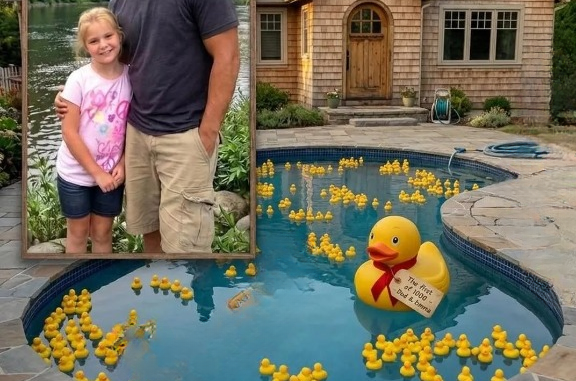
The entire surface had been covered by hundreds of floating rubber ducks of every color, shape, and size imaginable. They were packed together so tightly that only tiny patches of water could be seen between them. There were pirate ducks, ducks with crowns, ducks wearing sunglasses, and even tiny construction-style ducks with helmets.
But one duck stood apart from the rest.
It was larger than the others and floated in the middle of the pool with a bright red ribbon tied around its neck.
I stepped into the freezing water, reached for the note attached to it, and carefully unfolded the damp paper.
The words made my heart stop:
“You blamed the wrong person for ten years. You still have one chance to see your daughter again.”
Emma was only eight years old when she disappeared.
It happened during one of her favorite traditions—a Sunday afternoon walk to the neighborhood pond with my husband, Roger. Feeding the ducks had become something they did every week. Emma never went anywhere without her butterfly field guide because she believed every outdoor adventure could lead to a new discovery.
That day, Roger came home alone.
His clothes were soaked from the knees down, and he could barely explain what happened. He said he had looked away for only a moment, and when he turned back, Emma was gone.
Search crews, volunteers, divers, and investigators searched the area for weeks. They examined every possible location, but they never found a single trace of her.
Eventually, one detective suggested that the pond may have hidden dangers beneath its peaceful appearance.
But I refused to accept that Emma was gone.
The years afterward slowly destroyed everything we had. Roger became distant and silent. I became trapped in my grief. Eventually, the only thing connecting us was the home we still shared.
When police saw the address written on the note, they came with us, believing it might finally reveal the truth.
Instead of finding a secret location or abandoned building, we arrived at Emma’s old elementary school.
There, a retired principal named Mrs. Whitaker greeted us and quietly led us inside.
She walked us through familiar hallways before opening the door to a small classroom that instantly brought back memories I had buried for years.
Inside were butterfly habitats, children’s notebooks, milkweed plants, and reminders of the little girl I had lost.
Then I noticed something that made me uneasy.
Roger walked through the room as if he knew it perfectly. He knew where everything was stored, which shelves held supplies, and where every memory was kept.
Mrs. Whitaker finally explained why.
Since Emma disappeared, Roger had returned every spring to volunteer in that classroom.
Then Roger opened a cabinet and pulled out something I never expected to see.
Emma’s old butterfly field guide.
And he was finally ready to tell me the truth he had carried silently for ten years.
Roger admitted that shortly after the search ended, he found Emma’s butterfly guide beneath the passenger seat of his truck. But he never knew how to tell me. Every time he tried, he saw how deeply I was still connected to the pond and how much pain the memory caused me.
Over the years, every rubber duck he collected represented something that reminded him of Emma’s happiness and curiosity.
Mrs. Whitaker explained that Roger had donated Emma’s beloved guide to the classroom so other children could learn about butterflies and continue the passion that had meant so much to her.
Suddenly, all the things we had spent years worrying about—legal documents, financial responsibilities, paperwork, and practical matters—felt meaningless compared to what I was finally understanding.
There was no hidden criminal.
No shocking secret.
No dramatic confession.
There were only two parents grieving the same child in completely different ways, each carrying pain the other never saw.
The next day, I returned to the school’s nature room with Roger instead of visiting the pond alone.
As children gathered around to watch a monarch butterfly emerge from its chrysalis, I found myself thinking about Emma’s laughter instead of only the day she disappeared.
Her old field guide was filled with handwritten notes, including one that brought tears to my eyes:
She wanted to discover a new butterfly someday and name it after me because she believed I was the best at finding things.
For ten years, I had searched for the moment my daughter was taken from me.
Roger had spent those same years preserving every moment that showed who she truly was.
And for the first time since Emma vanished, I walked away with something more precious than answers.
I carried my daughter’s memory with me—not just the pain of losing her.
Leave a Reply