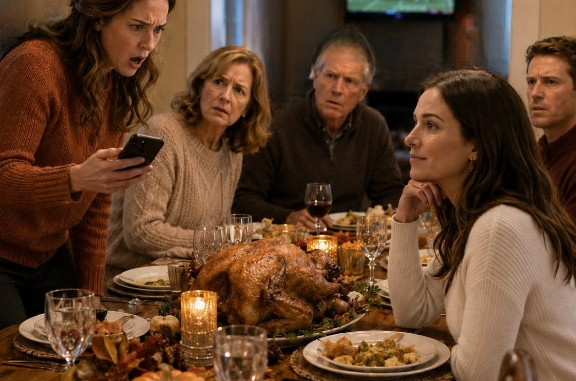
My sister humiliated me at Thanksgiving, saying, “Quit asking people for money. It’s pathetic.” The whole family agreed with her. I smiled and said, “You’re right.” Then I opened my banking app and canceled every payment I had been making toward her credit cards. Within seconds, her phone started lighting up.
The room had already gone quiet by the time Lauren finished her little speech.
“Stop asking for money,” my sister said, making sure everyone at the table could hear.
“It’s embarrassing.”
Only ten minutes earlier, I had quietly reminded her about the $240 she owed me for the winter coats I had bought for her children.
Instead of answering privately, Lauren decided to turn it into a family spectacle.
She told everyone that my latest consulting contract had obviously fallen apart and implied that I was once again coming to her for financial help.
She sat back with a smug expression, apparently pleased with herself for saying what she believed everyone else was thinking.
Mom looked down at her plate.
Dad nodded slightly.
Even my brother Daniel avoided my eyes before muttering, “She’s got a point, Emma.”
I glanced around my parents’ Connecticut dining room.
Candles glowed beside the turkey. A football game played softly in the next room. Lauren’s two kids were upstairs watching a movie.
Everything looked peaceful.
Except my family had just agreed that I was some kind of financial burden.
The irony nearly made me laugh.
For three years, I had been quietly paying Lauren’s credit-card bills.
After her divorce, she had called me crying. She said she couldn’t keep up with rent, groceries, and expenses for the kids.
I agreed to help.
I linked her three credit cards to an automatic-payment account in my name.
Lauren begged me to keep it secret because she didn’t want our parents to know she was struggling.
I respected her wishes.
Apparently, my silence had only given her another weapon to use against me.
So I smiled.
“You’re right.”
Lauren looked surprised.
She had clearly expected me to defend myself.
Instead, I picked up my phone, opened my banking app, and contacted my private account manager.
Cancel every payment associated with Lauren Bennett’s credit cards. Effective immediately.
Less than a minute later, I received a response.
Confirmed. All scheduled payments have been canceled.
Lauren’s phone vibrated.
Then again.
And again.
She looked down at the screen.
The color drained from her face.
Three alerts were sitting there:
PAYMENT SOURCE REMOVED.
AUTOPAY CANCELED.
BALANCE DUE.
“What did you do?” she whispered.
I set my phone beside my plate.
“I stopped begging.”
Dad frowned.
“What exactly does that mean?”
Lauren shot to her feet so quickly that her chair scraped loudly across the floor.
“You had no right!”
Daniel finally looked up.
“No right to do what?”
Lauren stared at me.
She suddenly had two choices: admit what had really been happening or continue pretending.
I lifted my glass of water.
“Go ahead,” I said calmly. “Tell them who’s actually been paying your bills.”
Part Two
Lauren looked from me to our parents, desperately searching for an escape.
Mom frowned. “Lauren, what is she talking about?”
“Nothing,” Lauren snapped. “Emma is exaggerating.”
I unlocked my phone and placed it on the table.
The screen showed three years of payment records.
Thirty-six months.
Three credit cards.
Thousands of dollars withdrawn from my account.
Daniel picked up the phone and started scrolling.
His expression changed.
“Emma has paid more than forty-eight thousand dollars,” he said.
Dad’s fork slipped from his hand.
Lauren reached for the phone, but Daniel moved it away.
“You told us your consulting work was paying for everything,” he said.
“It was,” Lauren replied. “Mostly.”
“Mostly?” I said. “Your business shut down fourteen months ago.”
Mom stared at her.
“You told us you were getting new clients.”
Lauren became defensive.
“Why is everyone attacking me? She offered to help.”
“I did,” I said. “Because you called me from a grocery-store parking lot and told me your children were about to lose their home.”
I paused.
“You promised the help would be temporary. Every time I asked when you planned to start paying me back, you told me you just needed a little more time.”
Lauren crossed her arms.
“And now you’re embarrassing me in front of everyone.”
I gave her a tired smile.
“You were the one who called me a beggar.”
For years, Lauren had quietly distorted the family’s perception of me.
I worked as a freelance financial-systems consultant. My income fluctuated depending on contracts, so I rarely discussed my finances.
Lauren used that against me.
Whenever I stayed at our parents’ house between contracts, she told people I had moved back home because I couldn’t afford my own place.
When I declined expensive family vacations, she claimed I was broke.
The truth was completely different.
I had been saving toward buying a house while simultaneously paying her bills.
Daniel kept scrolling through the records.
“There are charges from luxury stores too.”
Lauren’s face tightened.
“Those cards were used for necessities.”
“A designer handbag?” Daniel asked.
He continued.
“A resort weekend?”
Another pause.
“And a $1,200 Thanksgiving catering deposit?”
I looked at Mom.
“You thought Lauren paid for tonight, didn’t you?”
Mom slowly looked at me.
“You paid for this?”
“Yes.”
The room went silent again.
Dad rubbed his forehead.
“Lauren, apologize.”
She stared at him.
“You’re taking her side?”
“I’m taking the side of the person who has been paying your bills while you insulted her.”
Lauren grabbed her coat.
“Fine. I’m leaving.”
She started toward the door.
“Not yet,” I said.
She stopped.
“There’s something else.”
Lauren turned around.
“Tomorrow morning, your landlord will receive the final rent payment I agreed to make. After that, you are responsible for your own expenses.”
Her expression changed.
“I’ll continue helping with the children’s basic needs, like food and school supplies. But I will no longer finance your lifestyle.”
“You can’t do that.”
“I already did.”
Part Three
Lauren left without saying goodbye.
The front door slammed behind her.
For several minutes, everyone remained silent.
Mom began collecting plates even though hardly anyone had eaten.
Dad stood by the window and watched Lauren drive away.
Daniel eventually handed my phone back to me.
“I’m sorry,” he said. “I believed her.”
“So did I,” Mom said quietly.
Their apologies didn’t bring me the relief I expected.
For years, I had kept Lauren’s secrets because I thought protecting her from embarrassment would protect her children too.
Instead, my silence had taught her that she could take advantage of me while making me look like the problem.
The next morning, Lauren called seventeen times before eight.
I didn’t answer.
Then the texts started.
You’re destroying my children’s lives.
Dad is furious with me because of you.
Just turn the payments back on and we’ll forget this happened.
Her final message was different.
Please. I don’t know what to do.
I waited until later that afternoon before responding.
Meet me Monday at my attorney’s office. Bring your bills, bank statements, and debt notices. I’ll help you build a plan, but I will not give you unrestricted access to my money anymore.
Lauren arrived twenty minutes late on Monday.
She was wearing sunglasses even though it was raining.
My attorney, Melissa Grant, had prepared a financial agreement.
I would cover six months of rent by paying the landlord directly. I would also help with necessary expenses for the children and pay for a certification program that could help Lauren find stable employment.
But there were conditions.
Lauren would surrender her credit cards, close unnecessary accounts, attend credit counseling, and provide proof of her income each month.
She read the agreement twice.
“This makes me look like some kind of criminal.”
“No,” I said. “It makes you accountable.”
She pushed the papers away.
“What happens if I refuse?”
“Then the financial help ends today.”
Lauren sat silently.
After nearly a minute, she opened her purse.
One by one, she placed three credit cards on the table.
The transition wasn’t easy.
She missed her first credit-counseling appointment.
She accused me of trying to control her.
She told relatives that I was using money to punish her.
But without my automatic payments covering her debts, she finally had to confront the reality of her finances.
She owed more than $62,000.
Two of her cards were nearly maxed out.
Her checking account had less than $400.
Three months later, Lauren completed a project-management certification and landed an administrative job with a medical-equipment company.
It wasn’t enough to maintain the lifestyle she had been pretending to afford.
But it was steady.
She sold the designer handbag.
Canceled the expensive gym membership.
And when her lease expired, she moved into a smaller apartment.
Our relationship remained strained.
The following Thanksgiving, our parents invited both of us again.
I almost refused to go.
Daniel convinced me otherwise.
When I arrived, Lauren was already sitting at the table.
She looked tired.
But she also looked calmer than she had the year before.
During dinner, Dad raised his glass and thanked everyone for helping prepare the meal.
Lauren stared down at her plate.
Then she looked directly at me.
“Last year, I called Emma a beggar.”
Nobody spoke.
“The truth is, I was the one begging. I was just too ashamed to admit it.”
The room became completely still.
“I’m sorry,” she continued. “Not because you stopped paying my bills. I’m sorry because I made you look weak when I was actually depending on you.”
I nodded.
“Thank you.”
It wasn’t forgiveness.
Not yet.
But it was the first honest apology she had ever given me.
And for the first time in years, the phone beside Lauren’s plate buzzed with nothing more than an ordinary notification—not another warning that someone else had stopped funding the life she refused to take responsibility for.
Leave a Reply