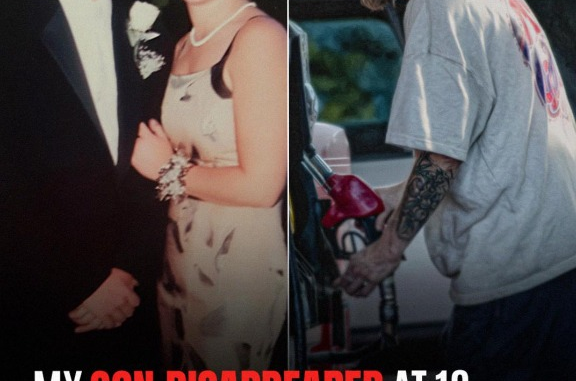
I had spent years learning to live with unanswered questions—but one ordinary afternoon at a gas station brought them all rushing back.
I still remember the quiet click of the front door the night my son turned eighteen. It wasn’t loud or dramatic—just a simple sound—but at the time, I barely noticed, folding napkins from the small birthday dinner I’d tried so hard to make special.
“Ethan?” I called. “Did you take the trash out?”
No answer.
I smiled nervously, teasing, “You’d better not be sneaking off to meet your friends without eating the cake.”
Still nothing.
A tight knot formed in my chest. I walked down the hall and saw his jacket and sneakers gone. His room felt wrong—too still, too empty. The bed was made, the desk clean, and his wallet drawer open. I froze, staring at it, hoping it could explain everything.
I checked the backyard, the garage, called his phone repeatedly, sent messages that grew more desperate by the minute.
By midnight, I sat on the living room floor, knees to chest, as police officers asked calm questions that made me want to scream:
“Did he seem upset recently?”
“Was there conflict at home?”
“Has he ever talked about leaving?”
“No,” I said so many times it lost meaning. But he had left—or at least that’s how it seemed.
The days that followed swallowed me. Flyers, nighttime drives, frantic searches. Friends came, then slowly drifted away. People offered what they thought were comforting words:
“He’s 18. Maybe he just needs space.”
“Boys that age can be unpredictable.”
“You have to prepare yourself that he chose to leave.”
That last word—chose—cut deeper than any knife.
Fourteen years later, on the first vacation I’d taken in over a decade, I was standing at a gas station when I saw him.
The man walking toward me stopped my world. I froze, trying to match the boy I raised with the stranger who looked back at me.
“Ethan,” I whispered. “Look at me. Please.”
He did. His eyes scanned my face like searching for something buried deep inside. A flicker of recognition passed—and then it vanished.
“I’m sorry,” he said softly. “I don’t remember you.”
The words knocked the air out of me. I stepped closer, reminding him of childhood memories—thunderstorms, scattered socks, a scar from falling off his bike. Slowly, I saw that flicker again.
“I…” he began, touching his temple, “I don’t—”
“Daniel,” the woman with him interrupted.
“I need to hear this,” he said, trying to hold on to the feeling that something was familiar.
I told him how he had disappeared fourteen years ago. His eyes widened. “That doesn’t make sense. I’ve lived here for years. With her.”
“She gave me a home,” the woman said. “You were found injured. You didn’t remember anything. We gave you a life.”
“You told me I was your son,” he said, voice tight.
“We became your family,” she replied.
I explained that I had never stopped looking for him. Slowly, he admitted flashes of memory—places and voices he couldn’t place.
“I don’t remember you,” he said. “But… when you speak, it feels like I should.”
I showed him I could prove our connection—photos, documents. He hesitated, then handed me his number, asking for time to think.
“I don’t remember you,” he said quietly. “But… I don’t feel like you’re lying.”
I let the words settle. He turned toward the store, glanced back once, and was gone.
For fourteen years, I prayed he was alive. Now I knew he was. But one question remained as I held his number in my hand: when he finally uncovers the truth, will he choose me—or the life he was given?
Leave a Reply