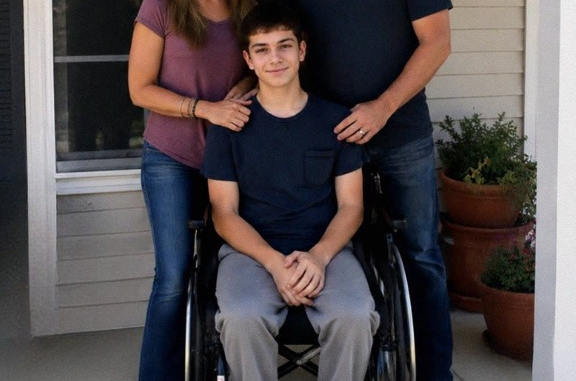
For 18 years, my husband blamed me for the life he thought we’d lost, never realizing our son had witnessed every painful moment. On my son’s 18th birthday, one heartfelt speech forced us all to face the truth.
I used to believe love could outlast disappointment.
I told myself that if I loved my husband enough, stayed patient, and carried the weight of our family without complaining, one day he would stop looking at me as though I had stolen the future he always wanted.
But instead of healing, the distance between us only grew—and our son suffered most.
My name is Cyra, and my son, Liam, has used a wheelchair since he was a young child.
To me, he was never anything less than extraordinary.
He was kind, witty, and incredibly intelligent. He solved problems that left adults amazed and had a gift for lifting people’s spirits with his sense of humor.
But my husband, Greg, couldn’t let go of the image of the son he’d always imagined.
Greg came from a family where football was more than a pastime—it was a legacy. His late father had coached high school football, and Greg often spoke about those Friday night games with pride.
Long before we became parents, he used to tell me, “If we have a son, I’ll teach him everything my dad taught me.”
Neither of us expected life to unfold differently.
When Liam was three, years of medical appointments finally led to a diagnosis explaining why he struggled to walk. We had hoped the doctors would tell us it was temporary.
They didn’t.
I still remember sitting in that exam room as the doctor gently explained Liam’s condition.
Greg barely said a word on the drive home.
At first, he buried himself in work.
Then, little by little, he began pulling away.
He stopped talking about football.
He stopped coming to Liam’s therapy sessions.
Eventually, every hardship became my fault.
“If only you’d noticed the signs sooner…”
“If you’d pushed the doctors harder…”
“If your family’s medical history wasn’t so complicated…”
He never needed to finish those sentences.
The blame was always there.
As Liam grew older, Greg learned to disguise hurtful comments as jokes.
Whenever someone talked about their son’s football achievements, he’d laugh and say, “Well, I won’t be buying any football equipment.”
People laughed awkwardly.
I forced a smile.
Liam quietly looked away.
Late one evening, Greg stood staring out the kitchen window.
“You know what hurts?” he asked.
“What?”
“I see dads tossing footballs with their sons at the park.”
I nodded quietly.
“They don’t realize how lucky they are.”
“I know,” I whispered.
He turned to me.
“No,” he said coldly. “You don’t.”
It wasn’t just his words—it was the way he looked at me, as though I had personally taken that future away from him.
Even though every doctor assured me Liam’s condition wasn’t anyone’s fault, years of hearing Greg’s accusations slowly filled me with guilt.
Liam was the one who reminded me otherwise.
When he was 12, I apologized after another one of Greg’s insensitive remarks.
“I’m sorry,” I told him.
He looked confused.
“For what?”
“For… everything.”
He smiled and squeezed my hand.
“Mom, none of this is your fault.”
Then he told me about Coach Mara from his adaptive basketball program.
“He says people spend so much time focusing on what they can’t do that they forget everything they can.”
I smiled through tears.
That was Liam.
He always found hope.
Greg rarely noticed.
Throughout high school, Liam excelled.
He earned academic awards, scholarships, and recognition for volunteering in the community.
College acceptance letters filled our mailbox.
I proudly spread them across the dining table.
Greg glanced at them after work and simply said, “Good,” before walking upstairs.
No congratulations.
No pride.
Just one word.
That night, I confronted him.
“Our son has accomplished so much.”
Greg shrugged.
“I said good.”
“It isn’t enough.”
His expression hardened.
“I didn’t ask for this life.”
“So did I,” I replied quietly.
The conversation ended there.
Liam never mentioned hearing us.
At least, that’s what I believed.
Looking back, I realize he heard far more than we ever imagined.
He graduated at the top of his class.
His principal praised his determination in front of hundreds of families.
I cried through the ceremony.
Greg applauded politely.
Nothing more.
Liam accepted an offer from a university known for engineering and assistive technology.
“I want to build things that help people,” he told me.
“You already do,” I replied.
A few weeks later, we gathered to celebrate his 18th birthday.
Our backyard was filled with family, neighbors, teachers, and Coach Mara.
For a few hours, everything felt normal.
Greg laughed with relatives.
I dared to believe things were finally changing.
After dinner and cake, my sister announced it was time for a birthday toast.
Everyone raised a glass.
Greg stood proudly beside me.
Liam thanked everyone for coming before turning toward us.
Then his expression changed.
“I’d like to make a toast to my parents,” he said.
The yard fell silent.
“So here’s the truth,” he continued. “I’ve known what’s been happening in this family for years.”
Greg’s smile disappeared.
“I’ve heard every argument you thought happened after I went to bed.”
Nobody moved.
“I’ve heard every joke Dad made.”
Greg shifted uncomfortably.
“And I’ve heard every time Mom tried to defend both of us.”
I wanted to stop him.
Instead, I stood frozen.
“I know Dad blamed Mom for my disability.”
The guests exchanged uneasy glances.
Greg forced a nervous smile.
“This isn’t the time.”
“I think it is.”
Liam’s voice stayed calm.
“You’ve spent 18 years acting like Mom stole your future.”
Greg quietly asked if they could discuss it in private.
Liam shook his head.
“Mom has carried this privately long enough.”
Tears filled my eyes.
“I know you dreamed of coaching football,” Liam said.
Greg nodded.
“But every time you saw fathers with their sons, you blamed Mom instead of accepting reality.”
“I was disappointed,” Greg said.
“No,” Liam replied.
“You were cruel.”
The words hung in the air.
My sister finally spoke.
“He’s right.”
My brother admitted they had all seen pieces of what had been happening.
Liam continued.
“I spent years wondering why I wasn’t enough.”
“I thought better grades would make you proud.”
“So I became valedictorian.”
“I thought scholarships would matter.”
“So I earned them.”
“I thought if I stayed positive and helped others, maybe you’d finally see me.”
His voice cracked.
“But eventually I realized the problem wasn’t me.”
He looked directly at Greg.
“It was the dream you refused to let go of.”
Greg quietly said, “I loved you.”
“I know,” Liam answered.
“But love shouldn’t have to be guessed.”
Then Liam reached into the pocket of his wheelchair and pulled out a stack of folded papers.
“I’ve been writing these since I was ten.”
He explained they were letters to his future self.
The first read:
“Dad didn’t come today, but Mom cheered loud enough for both of them. Don’t ever believe you’re worth less because of that.”
Another read:
“If Dad ever says he’s proud of you, remember how long Mom waited to hear those words too.”
The final letter said:
“Never become someone who blames others for the life you have. Be grateful for the people who stay.”
The backyard fell silent except for quiet sobs.
Greg covered his face.
“I didn’t know,” he whispered.
“No,” Liam replied softly.
“You didn’t.”
He turned to me.
“Mom spent 18 years protecting you.”
He wasn’t wrong.
I had spent years making excuses because admitting the truth felt too painful.
Finally, Liam looked back at his father.
“I don’t hate you.”
Hope flickered across Greg’s face.
“But I won’t let Mom keep carrying blame that was never hers.”
Greg slowly stepped forward.
“I was wrong.”
No one interrupted.
“I spent years grieving a life that never existed.”
His voice trembled.
“And while I was doing that… I failed to see the incredible son I already had.”
He turned to me with tears in his eyes.
“I blamed you because it was easier than accepting reality.”
I had imagined hearing those words for years.
Instead of relief, I felt only exhaustion.
“You made me believe I’d failed both of you,” I said quietly.
Greg lowered his head.
“I know.”
“You celebrated other people’s sons while overlooking your own.”
“I know.”
“You let Liam question his worth.”
“I know.”
“And you made me believe I deserved your resentment.”
This time, Greg had no defense.
Only tears.
Leave a Reply