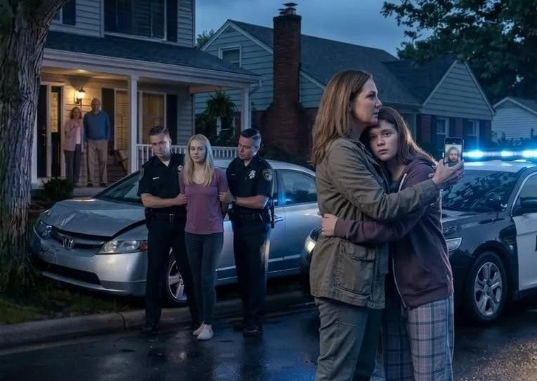
The knock at my door shortly after midnight changed everything in an instant. Two police officers arrived asking to speak with my 15-year-old daughter, Lily, about her brand-new silver Civic, which had reportedly crashed into a tree near my parents’ home. According to witness statements, she had been behind the wheel. The only problem was that Lily had never left the house that evening. She had been in her room the entire time, texting her best friend and watching videos online. Our lawyer immediately advised us not to panic. He told us to collect any proof that Lily had stayed home and to determine who actually took the car. We followed his instructions carefully, never expecting how quickly the truth would begin to surface. Everything shifted when our neighbor provided doorbell camera footage showing someone walking up our driveway, unlocking the Civic, and driving off alone. That person turned out to be my younger sister, Jenna.
As additional evidence emerged, the situation became even more unsettling. Lily’s phone records clearly confirmed she had not left the house, while the video footage left no doubt about who had taken the vehicle. However, when our attorney reviewed the official police report, we uncovered something even more painful. Jenna had claimed she saw Lily driving, and both of my parents had signed statements supporting her version of events. They even added remarks portraying Lily as recently rebellious to make the story more convincing. That betrayal hurt far more than the damaged car ever could. Lily simply looked at me and asked why her grandparents would say something untrue about her. I had no simple answer—only the promise that the truth would eventually be revealed.
A few days later, we all met at the police station for a formal review of the case. Our attorney presented printed stills from the neighbor’s security footage, one after another. Each image clearly showed Jenna entering the car alone and driving away. Investigators also examined Lily’s phone data, confirming she had been at home the entire time. The room grew silent as the evidence spoke for itself. Authorities officially cleared Lily of any involvement, while Jenna eventually admitted she had blamed her niece out of panic after the accident. Investigators also confronted my parents about the false statements they had signed. For the first time, they had to face the consequences of choosing family loyalty over truth. Seeing my daughter finally able to breathe again reminded me that protecting her mattered more than preserving appearances.
In the months that followed, the legal case was closed, insurance matters were settled, and our family’s path changed permanently. My parents and Jenna faced financial and legal repercussions for their false claims, while Lily and I focused on rebuilding our lives. We replaced the damaged vehicle with a reliable used car, and despite everything, Lily continued learning to drive. Gradually, her confidence returned with each lesson. Therapy helped her process the emotional impact of being wrongly accused and reinforced for both of us the importance of believing those we love. One day, she wrote a school essay that began with a line I will never forget: “My mom believed me before she had proof.” It didn’t win any awards, but it remains the most meaningful piece of writing I have ever kept. Looking back, I realized the true victory was never about the car or the case—it was about trust, truth, and standing firmly beside my daughter when it mattered most.
Leave a Reply