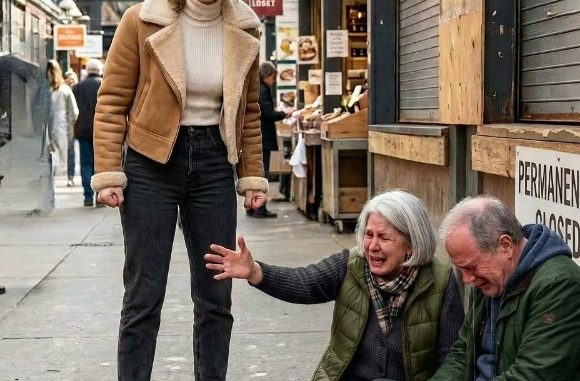
The abandoned produce stall sat beneath a torn awning in the old Delancey Street market, its rusted shutters tagged with faded graffiti. Cold wind pushed empty cups across the pavement. I only went there because my phone tracker showed my mother’s last known location nearby. I assumed she had simply forgotten her phone or stepped out for groceries—something normal.
But then I saw them.
My parents were curled up together on a flattened cardboard refrigerator box, wearing thin coats that offered little protection from the February chill. My father’s shoes were untied, his gray hair disheveled against his forehead. My mother rested one hand under her cheek while the other clutched a plastic grocery bag as if it held something valuable.
For a moment, I couldn’t move.
“Mom?” I called out, my voice breaking.
She slowly opened her eyes. The moment she recognized me, she jolted upright, nearly losing her balance.
“Emily,” she whispered.
My father stirred next, disoriented and embarrassed, trying to fix his jacket as though he could restore his dignity with the motion.
I dropped down beside them. “What is going on? Why are you here?” My gaze moved between the cardboard, the bag, and the medicine bottles near my father’s leg. “Where is the house I bought for you?”
My mother’s face collapsed into tears before she could respond.
“Your husband and his family forced us out,” she said.
The words struck harder than the cold air.
“What?” I breathed.
My father lowered his eyes. “We didn’t want to burden you.”
“Burden me?” I stood, shaking. “That house in Queens is mine. I bought it for you.”
My mother wiped her tears with her sleeve. “Daniel said you agreed. He said the house was needed for Vanessa’s family. He brought papers… he said if we loved you, we wouldn’t cause trouble.”
My stomach tightened. “What papers?”
“He said you signed them,” my father said quietly. “He said we were just guests now.”
I stared at them, struggling to breathe. Daniel—my husband of six years. The man who kissed me good morning and told me I worked too hard. The man whose family called me selfish for supporting my parents. The same man who smiled beside me at social events while my parents slept outside an empty stall.
I pulled out my phone and called him.
He answered quickly, sounding relaxed. “Hey, everything okay?”
I looked at my parents, shivering on cardboard.
“No,” I said. “Nothing is okay.”
There was a pause.
Then I added, “I found them.”
Silence filled the line.
Part 2
Daniel didn’t respond for several seconds. I could hear dishes clinking in the background, faint laughter, and Vanessa’s voice. They were eating—inside my parents’ house.
“Emily,” he finally said in a controlled tone, “where are you?”
“With my parents,” I replied. “On the street.”
Another pause.
“They left voluntarily,” Daniel said.
My mother, hearing his voice, shook her head in disbelief.
I turned away slightly. “Don’t lie to me.”
“I’m not lying. Your father got aggressive. My mother felt unsafe. Vanessa has children—we had to think about them.”
My father clenched his jaw but said nothing.
“You had no right to remove them,” I said sharply.
Daniel exhaled, as if I were being unreasonable. “Come home. We’ll talk properly.”
“Home?” I repeated. “You mean my parents’ house?”
“It’s the family home now,” he said. “Vanessa needed stability.”
I ended the call before I lost control.
Within an hour, I had my parents in a small Midtown hotel room. I brought food, warm clothing, and chargers. My mother kept apologizing between bites. My father sat stiffly, staring at the floor, looking defeated in a way I had never seen.
“You should have called me,” I said quietly.
My father didn’t look up. “Your husband said you would divorce him if we caused trouble.”
My mother added softly, “He said we would be accused of trespassing.”
I closed my eyes.
Daniel had manipulated them perfectly. My parents had worked their entire lives after immigrating, never asked for help until medical bills drained them, and had only accepted the house I bought them after years of sacrifice. And Daniel had turned that kindness into leverage.
That night, after they fell asleep, I opened my laptop and checked the property records.
The house was still in my name.
No transfer. No lease. No sale.
Then I found the documents Daniel had emailed—files with my signature digitally inserted. One gave him authority over the property. Another falsely stated my parents had agreed to leave.
My signature was forged.
Part 3
The next morning, I contacted an attorney, Rachel Stein, who immediately asked me to gather everything—messages, records, proof of coercion, and evidence of my parents being forced out.
She reviewed it all the same day.
“This is straightforward legally,” she said. “The property is yours. The eviction was unlawful. The documents appear falsified.”
My mother looked worried. “Will Emily be in trouble?”
“No,” the lawyer said gently. “She is the victim here.”
My father admitted he had signed something but hadn’t understood it, believing it was confirmation of leaving willingly.
That afternoon, legal action was filed.
By the next day, Daniel, his mother Patricia, and Vanessa were served notices.
My phone exploded with messages—accusations, guilt, pressure, and denial. I didn’t respond. Rachel advised me to communicate only through legal channels.
Then came a voicemail from Patricia, insisting my parents were “better off elsewhere” and urging me not to “destroy the family over pride.”
I forwarded it to Rachel.
“Keep that,” she said.
Two days later, we appeared in court.
Daniel tried to frame it as a misunderstanding. His lawyer called it informal permission. But the evidence told a different story.
The judge reviewed everything carefully.
“Did you have written authorization from your wife?” she asked.
Daniel hesitated.
That silence was enough.
“No,” he admitted.
The court ordered immediate restoration of the property to my control and barred Daniel and his family from interfering. The forged documents were referred for investigation.
Outside court, Patricia confronted me, furious. My father stepped between us without saying a word. For the first time, my mother spoke firmly in her quiet voice, defending him.
That moment stayed with me.
Part 4
When we returned to the house, it had been left in chaos. Belongings scattered, furniture damaged, signs of careless occupation everywhere. My mother stood silently in the doorway, devastated not by the damage itself, but by what it represented.
I hired cleaners, replaced locks, installed cameras, and restored the home. My father repainted the fence himself, insisting on doing it alone.
Eventually, life settled.
Daniel came to see me once afterward. He tried to justify his actions as pressure from family and circumstance.
“You chose control,” I told him.
The divorce followed. It wasn’t dramatic—just final.
Final
In the months that followed, my parents slowly recovered. My father walked every morning again. My mother replanted herbs by the back steps. The house became warm again, filled with routine and quiet stability.
One evening, we sat together at the kitchen table.
My parents apologized for believing Daniel. I told them they had nothing to apologize for.
“He tricked you,” I said. “Not the other way around.”
And I meant it.
Later, as I stood in the backyard watching the garden grow back, I realized something simple but lasting:
Some people build homes out of control. Others build them out of truth.
And only one of those lasts.
Leave a Reply