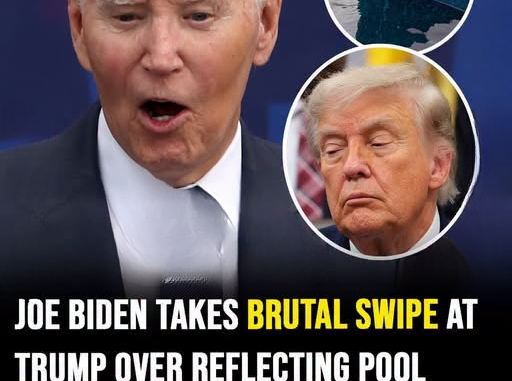
The Lincoln Memorial Reflecting Pool was envisioned as one of the nation’s most iconic landmarks, but criticism erupted after reports described the restoration project as plagued by cracks, leaks, peeling surfaces, and discolored water. What was intended to showcase a striking new finish instead became the center of a heated political dispute. As debate intensified, former President Joe Biden used the controversy to criticize Donald Trump, arguing that the troubled project reflected broader issues of leadership and accountability.
When Biden stepped to the podium, the room grew quiet. Though his appearance suggested the weight of age, his remarks were pointed and deliberate. Rather than focusing only on construction flaws, he framed the project as an example of what he characterized as poor judgment and misplaced priorities. A renovation promoted as a symbol of national pride, he argued, had instead become a visible reminder of promises that failed to match results.
Biden accused his political rival of fostering what he described as a culture of mismanagement, claiming it extended far beyond a single public works project. As the audience listened, he shifted from discussing the physical condition of the Reflecting Pool to criticizing the decision-making behind it. At one point, he mocked the choice of contractors, joking that Trump had relied on “his own pool guy” before ending the remark with a cutting insult that drew loud reactions from supporters.
Trump’s response came swiftly through social media. Rather than accepting criticism over the reported construction problems, he argued that the damage was not the result of poor workmanship but of deliberate sabotage. According to his claims, unidentified individuals had intentionally harmed the project using tools and chemicals, turning what was meant to be a patriotic restoration into what he described as a target of politically motivated vandalism.
Trump also called for investigations and demanded severe penalties for anyone found responsible, suggesting lengthy prison sentences for those involved. However, his allegations were not accompanied by publicly presented evidence such as surveillance footage, forensic findings, or witness testimony linking any individuals to the alleged acts.
For many observers, the controversy has grown into something much larger than a debate over repairs to a historic landmark. Instead, it has become another chapter in the nation’s ongoing political divide. Supporters of Trump argue that outside forces are responsible for undermining his accomplishments, while critics contend that the project illustrates a pattern of emphasizing appearance over long-term planning and accountability.
Biden used the condition of the Reflecting Pool to reinforce that broader message. In his view, the visible deterioration represented more than construction setbacks—it symbolized what he sees as a leadership style that prioritizes image while avoiding responsibility when problems arise.
The symbolism has not gone unnoticed. A memorial pool designed to reflect both the Lincoln Memorial and the ideals it represents has instead become the focus of criticism over stained surfaces, green water, and structural concerns. Some view the problems as an unfortunate renovation failure, while others see them as a metaphor for the larger political battles shaping the country.
As arguments continue over responsibility, the Reflecting Pool remains at the center of competing narratives. One side insists the project was undermined by outside interference, while the other points to the visible condition of the site as evidence that deeper problems cannot simply be explained away. The dispute has evolved beyond maintenance issues into a broader struggle over credibility, leadership, and public perception.
While political accusations and calls for investigations continue, the monument itself remains the focal point. Whether it is remembered as an ambitious restoration that encountered setbacks or as a cautionary tale about political symbolism depends largely on perspective. What is clear is that the debate surrounding the Reflecting Pool is far from over, and it continues to serve as another flashpoint in an increasingly polarized political landscape.
Leave a Reply