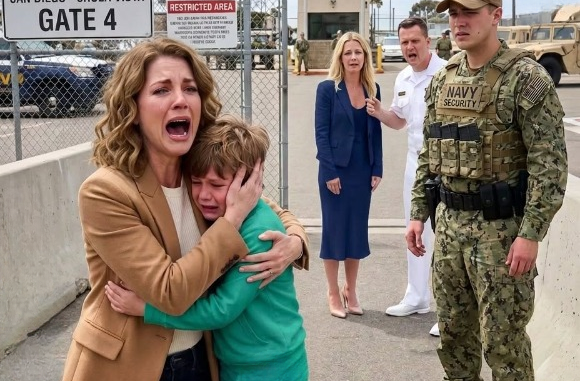
I brought my son to see my husband, the commander, but a guard stopped us at the gate and told me, “His girlfriend is inside the unit. No visitors allowed.” I covered my son’s ears, immediately called my second brother, and told him to cut off every form of support without delay.
That morning in San Diego, at 8:17 a.m., Olivia Whitaker stood outside Naval Support Unit Coronado with her eight-year-old son, Ethan. One hand rested on his shoulder, the other held a paper bag of warm cinnamon rolls. Ethan had been excited to surprise his father—carefully packing a thermos because “commanders like coffee,” he’d said on the drive.
Olivia had smiled then. She wasn’t smiling anymore.
At the gate, the young guard checked her military dependent ID and hesitated. His name tag read Harris. He looked nervous, like he was repeating instructions he didn’t fully believe in.
“Ma’am, Commander Whitaker is unavailable,” he said.
“Unavailable?” Olivia replied sharply. “He promised our son lunch today.”
Before he could answer, Ethan tugged her sleeve. Then Harris lowered his voice.
“His girlfriend is inside the unit. No visitors.”
For a moment, everything in Olivia went still. She covered Ethan’s ears instinctively, but the damage was already done. The guard’s expression, her own face, the sudden silence—it told the story too clearly.
Inside the building, Olivia saw her husband through a second-floor window. Andrew Whitaker stood with Serena Vale, a civilian contractor tied to a consulting firm linked to her family’s nonprofit funding. His hand rested at her waist like it belonged there.
The realization didn’t bring tears. It brought clarity.
She turned away, walked Ethan back to the car, buckled him in, and closed the door. Only then did she make a call.
Her brother Marcus answered immediately.
“Cut everything,” she said. “No warnings.”
No explanation was needed. In their family, that tone meant action.
“Andrew?” he asked.
“And Serena Vale. All of it.”
“Done.”
By midday, financial pipelines tied to Andrew began freezing. By afternoon, Serena’s contracts were under review. By evening, the quiet network that had supported Andrew’s career started collapsing piece by piece.
Andrew called repeatedly. Olivia didn’t respond.
At 6 p.m., a government vehicle arrived at the unit. Minutes later, Andrew walked out—no authority, no composure, no Serena beside him. From across the street, Olivia watched everything unfold while Ethan slept in the back seat.
Marcus texted: He thought you were powerless. He was wrong.
But the day didn’t end there.
Instead of going home, Olivia parked near the marina and let the sound of water steady her thoughts while Ethan slept. She wasn’t just a military spouse; she was part of the Langford family—quiet, powerful, and deeply connected to defense logistics and funding networks that shaped careers like Andrew’s.
She had chosen marriage over the boardroom. Andrew had benefited from that choice more than anyone.
That changed the moment he humiliated her son at the gate.
Later that evening, Marcus updated her. Serena’s firm had received suspicious payments tied to Andrew’s recommendation. Contracts were traced. Shell companies appeared. Suddenly, it wasn’t just betrayal—it was financial misconduct, misuse of influence, and fraud.
Olivia didn’t flinch. She only asked for clarity. Not vengeance.
By nightfall, Andrew’s name was already under internal scrutiny.
When he finally messaged her—Come home before your family ruins everything—she forwarded it without reply.
He was waiting at their house when she arrived with Ethan still in the car. He looked desperate, stripped of his usual confidence.
“Olivia, listen to me,” he began.
She didn’t lower the window fully.
“Do you understand what you’ve done?” he demanded.
“Yes,” she said calmly. “I finally understand what I should have done sooner.”
He tried to minimize it. “Serena means nothing.”
“That,” Olivia said, “is the first honest thing you’ve said.”
She drove away with Ethan while Andrew shouted after them.
That night they stayed in a secure family-owned apartment. Ethan slept fitfully. Olivia stayed awake.
The next morning brought documents, reports, and confirmation of everything Marcus had uncovered. Payments, fake consulting structures, misused credentials, and evidence of Andrew leveraging her family’s foundation for personal benefit.
Lydia Chen, the attorney, reviewed everything without emotion and asked simple questions about custody, property, and support. Olivia’s answers were steady.
“I don’t want his money,” she said.
“You may be entitled to it,” Lydia replied.
“I don’t care.”
That surprised even Lydia.
Andrew’s legal team tried damage control. Serena tried to reach her. Olivia answered one call, listened to Serena’s rehearsed attempt at sympathy, and calmly pointed out the truth: she had been seen, she had been complicit, and none of it would disappear.
Serena hung up.
By the time military oversight and internal investigations escalated, Andrew’s command was suspended. His reputation collapsed faster than expected. Serena’s company lost contracts tied to Langford-backed programs. The structure that had supported them both began to unravel completely.
Through it all, Ethan struggled quietly. He stopped asking simple questions and started asking harder ones.
One night he asked, “Is Dad bad?”
Olivia chose her words carefully. “He made bad choices. That doesn’t erase who you are.”
“I miss him,” Ethan said.
“So do I,” she answered honestly. “The version I thought he was.”
Months later, at the divorce hearing, Andrew looked smaller than before—no longer a commander in control, just a man facing consequences he couldn’t negotiate away. Serena was absent. The settlement was straightforward: custody with Olivia, structured visitation for Andrew, and strict conditions regarding exposure to the investigation.
He signed when confronted with evidence of Serena’s repeated access to their son’s environment.
Outside the courtroom, he tried to speak to Olivia.
“I lost everything,” he said.
“No,” she replied. “You lost what you were borrowing.”
He asked if Ethan hated him.
“No,” Olivia said. “But he doesn’t trust you. That’s harder to fix.”
He didn’t argue.
For the first time, he just listened.
A year later, life had changed shape. Olivia and Ethan lived in a quieter home in La Jolla. Nothing extravagant—just stable, calm, and theirs.
Andrew saw Ethan on scheduled weekends. At first, the visits were awkward, filled with forced effort. But slowly, something softened.
One day Ethan came home and said, “We just ate sandwiches. Dad said sorry without excuses.”
Olivia nodded. “And how did that feel?”
“Better,” he admitted.
Not perfect. But better.
On a weekend morning not long after, Ethan asked to make cinnamon rolls. Olivia paused for a moment, remembering everything that began with a paper bag at a gate, a guard’s sentence, and a moment that changed everything.
Then she smiled faintly.
“Alright,” she said. “But this time, we make them for us.”
Ethan grinned, already spilling flour on the counter.
And for the first time in a long time, Olivia didn’t feel like she was reacting to the past.
She was simply living in the present.
Leave a Reply