Part 1 – The Trip That Revealed Who My Family Really Was
My name is Calvin Draper. I’m thirty-four years old, and I work as a doctor in a small Tennessee community near the Appalachian Mountains. It’s the kind of place where winding roads cut through green hills, old pickup trucks sit outside family homes, and neighbors still greet each other by name.
I love this town because it became the place where I truly belonged. But it was also where I learned the painful truth about how my own family had treated the woman who had always loved me without conditions.
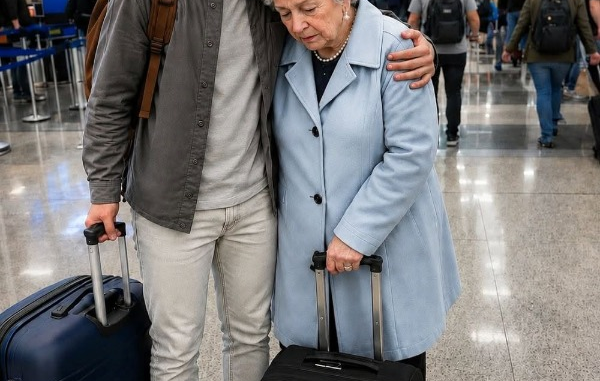
One afternoon, a memory notification appeared on my phone: “On this day, 16 years ago.” When I opened it, I saw an old photo of my grandmother, Hazel Draper, and me standing together at the Atlanta airport.
I was eighteen, nervous and excited, with my arm around her shoulders. She stood beside me wearing her favorite cardigan and comfortable walking shoes, smiling like she was finally about to experience something wonderful.
But that picture still carries pain.
Because that was the day I discovered that sharing the same blood does not always mean someone will love you.
I grew up in Greenville, South Carolina. My father worked as an engineer, and my mother was an accountant. We had a stable home, everything looked respectable, and nothing was missing financially.
But emotionally, something always felt absent.
My parents cared about achievements, grades, and appearances. They wanted success, but they rarely asked whether I was happy.
The one person who made me feel truly valued was my grandmother.
Every summer, I stayed at Grandma Hazel’s small wooden house in Tuloma, Tennessee. Her home smelled like fresh cookies, aged wood, and the faint hospital scent that followed her after years of working as a nurse.
She had raised my father and my aunt on her own after her divorce. She worked exhausting hours, sacrificed her own comfort, and saved every bit she could.
Yet after they grew up, both of her children moved away and rarely returned.
My father built his life in Greenville.
My Aunt Paula married a successful real estate businessman and moved to Georgia.
Grandma was left behind with her flowers, her porch swing, and the memories of the family she had worked so hard to raise.
When I was eighteen, my parents announced that our family was planning a huge European vacation. Paris. Rome. London.
They said everyone would be coming, including Grandma.
I pictured her standing beneath the Eiffel Tower, smiling the way she did on her porch back home.
Then I overheard my mother mention that Grandma could help cover the cost because she had money saved.
Shortly afterward, my father and aunt suddenly became much more interested in Grandma. They called often, visited more frequently, and acted as though they wanted to reconnect.
They convinced her the trip would bring the family closer.
Grandma wasn’t sure.
She worried about traveling such a long distance at her age.
Then she looked at me and said, “If Calvin wants me there, I’ll go.”
I hugged her and promised I would look after her.
I didn’t realize I was helping guide her into a betrayal.
The next day, I overheard my mother say that Grandma had transferred the money.
Every dollar.
More than $30,000.
Part 2 – Abandoned at the Airport
The day of departure finally arrived. We drove from Greenville to Atlanta while my parents excitedly discussed restaurants, sightseeing plans, and everything they wanted to experience in Europe.
I sat in the back seat holding Grandma’s hand, feeling happy that she was finally getting a chance to see the world.
At the airport, Aunt Paula’s family was already there. Everyone looked dressed perfectly and ready for the adventure ahead.
We joined the check-in line, and I felt a nervous excitement building.
Then Grandma quietly leaned toward me.
“Calvin, where is my ticket?”
I looked toward my father.
He was standing at the counter with a worried expression.
When he returned, he claimed there was an issue with the reservation system and that Grandma’s ticket had not been confirmed.
Grandma stared at him.
“Did you ever actually buy a ticket for me?”
He hesitated.
That hesitation told me everything.
Then he explained that the flight would be too difficult for her, that traveling might affect her health, and that she should stay home. He promised they would plan a smaller trip with her “someday.”
That was when the truth became clear.
They had used her savings to pay for their dream vacation.
They had never intended for her to come.
I looked at Aunt Paula, expecting her to defend her mother.
She looked away.
My uncle focused on his phone.
No one said a word.
I felt anger rising inside me.
“She paid for this trip,” I said. “How can you leave her here?”
My mother told me to stop making a scene and said it was “family business.”
But it wasn’t family business.
It was betrayal.
I looked at Grandma and made my decision.
“I’m staying with you.”
She begged me not to give up the trip because of her.
But I couldn’t get on that plane knowing what they had done.
My father told me that if I chose to stay, I was responsible for myself.
Then they walked away.
No apology.
No guilt.
Nothing.
Grandma and I stood in the middle of the airport watching her own children disappear behind security.
I took her home.
During the drive back to Tuloma, she quietly asked if they abandoned her because she was old, because she didn’t have enough money, or because she no longer fit into their lives.
I told her the truth.
“They don’t deserve you.”
The next morning, I searched for help and contacted Adult Protective Services.
What my family had done wasn’t just hurtful.
It was financial abuse.
I spoke with an investigator named Dorian Hail, who listened carefully and asked us to bring any evidence we had.
Grandma was afraid.
She didn’t want to cause problems because they were still her children.
But I told her, “You protected them long enough. Now it’s time for someone to protect you.”
With bank records and a statement from an airport employee, an investigation began.
Three weeks later, when my parents and aunt returned from Europe, Dorian was waiting for them with legal documents.
Their vacation smiles disappeared.
They were informed they were being investigated for elder financial abuse.
I stepped forward.
“Grandma didn’t report you,” I said. “I did.”
They called me selfish.
They called me disloyal.
But I saw the truth in their faces.
They weren’t sorry.
They were angry they had been exposed.
Part 3 – Choosing the Family Who Chose Me
The case eventually went to court in Tuloma.
Grandma couldn’t bring herself to sit across from the people who had hurt her, so she trusted me to speak for her.
The evidence was clear.
She had given them her savings for a family vacation.
They had promised she would be included.
Instead, they intentionally left her behind at the airport.
My family’s attorney argued that the money had been a gift.
But the records, witness statements, and Grandma’s testimony proved otherwise.
When I took the stand, I told the court everything.
The sudden attention.
The pressure.
The lies.
The airport betrayal.
The moment they walked away from her.
The judge ruled that financial abuse had occurred.
My parents, Aunt Paula, and Uncle Leon were ordered to repay the full amount. They also lost their ability to control Grandma’s estate or benefit from future inheritance decisions.
I didn’t feel victorious.
I only felt heartbroken that justice had to come through a courtroom.
After everything ended, Grandma and I started rebuilding our lives.
I stayed in Tuloma and began studying medicine. Her years as a nurse had inspired me, and I finally understood the kind of person I wanted to become.
We painted together.
At first, Grandma laughed at her own artwork and called it childish.
But soon her paintings filled with mountains, flowers, sunsets, and memories.
I watched her happiness return.
Years passed.
I worked hard, volunteered at the same hospital where she had once cared for patients, and eventually earned my place in medical school.
Grandma was my biggest supporter.
Then, during my second year, she became sick.
Doctors diagnosed her with advanced lung cancer.
Treatment was possible, but she chose to spend her remaining time peacefully at home.
I wanted to fight harder.
She held my hand and said, “You are not my burden. You are my legacy.”
So I stayed beside her.
We painted.
We baked.
We shared stories.
She gave me every piece of wisdom she had left to offer.
When I graduated medical school, she was too weak to attend the ceremony.
I drove home wearing my cap and gown.
“Grandma,” I told her, “I did it. I’m a doctor.”
She smiled.
“You’re my doctor.”
That night, she passed away peacefully in her sleep.
Her funeral filled the small church she loved. Neighbors, former patients, hospital coworkers, and friends from her painting group came to honor her.
The people whose lives she had touched showed up.
My parents and aunt did not.
I stayed in Tuloma and became a doctor at the same hospital where Grandma once worked.
Her painting of marigolds hangs in my office.
Patients often tell me how cheerful it looks.
I always smile and say, “It belonged to someone very special.”
I never reached out to my parents again.
Not because I hated them.
Because I finally understood something Grandma had taught me.
Family is not always defined by who shares your blood.
Family is the person who stays when everyone else chooses to leave.
And Grandma Hazel stayed for me.
So when it was my turn, I stayed for her.
Leave a Reply