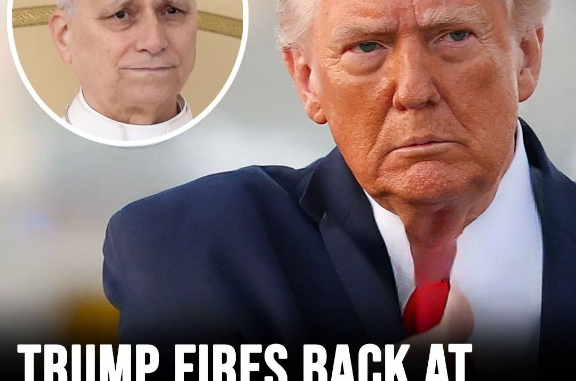
The world appears to be standing at a deeply unsettling crossroads, where the highest levels of spiritual and political authority have collided in a public clash of ideology and ego. In a moment that has reshaped discussions around international diplomacy, Donald Trump responded sharply to Pope Leo XIV with remarks that quickly reverberated through global political circles. What might once have been seen as a policy disagreement has now evolved into a far more intense and symbolic confrontation, one that many are describing as a battle over influence, morality, and public perception in a time of global uncertainty.
The tension reportedly began when Pope Leo XIV moved away from traditionally cautious diplomatic language and instead delivered a forceful moral critique of the ongoing international crisis. With widespread images of suffering and displacement circulating globally, the Pope framed the situation not simply as a geopolitical struggle, but as a moral test for humanity itself. He emphasized the human cost of conflict—particularly the impact on children, the elderly, and vulnerable communities—urging world leaders and citizens alike to prioritize peace and restraint over escalation. His message sought to redirect attention from military strategy toward the humanitarian consequences of continued violence.
Donald Trump, however, interpreted the Pope’s remarks as a direct challenge rather than a moral appeal. In response, he issued a pointed and highly confrontational statement that critics say aimed to undermine the Pope’s authority by reframing him as a political opponent. Rather than engaging with the humanitarian concerns raised, Trump shifted the focus toward questions of influence, loyalty, and strength, portraying the criticism as misplaced and politically motivated. His remarks intensified an already heated atmosphere, turning what was a global moral appeal into a broader contest over leadership and credibility.
This confrontation highlights a widening divide in leadership philosophies. Pope Leo XIV represents a perspective rooted in moral responsibility, compassion, and the protection of human life, emphasizing restraint and ethical accountability in global decision-making. Trump, by contrast, is seen as embodying a more force-driven and adversarial style of leadership, where strength, dominance, and unapologetic self-assertion take precedence over diplomatic caution. The clash between these approaches has fueled broader debate about how authority—whether spiritual or political—should be exercised in times of crisis.
The implications of this dispute extend well beyond headlines. As rhetoric escalates, it contributes to growing polarization across political and religious communities worldwide. Supporters on each side interpret the exchange through sharply different lenses, further deepening divisions in public discourse. Meanwhile, the individuals most affected by the underlying global crisis risk being overshadowed by the intensity of the symbolic confrontation unfolding at the highest levels of influence.
Ultimately, this situation reflects the fragile state of modern information and power dynamics, where moral authority and political force often collide in highly public ways. Whether viewed as a clash of ideologies or a struggle for influence, the dispute underscores how quickly global conversations can shift from humanitarian concerns to contests of narrative and control.
Leave a Reply